

What was handed over
Three licences. Each runs for five years from the first day of 2027. Between them they cover the lotto, the scratch-card lottery, and bets placed over a counter rather than online. The set Lotto B.V. holds today runs out at the end of December.[1]
Lotto B.V. sits inside Nederlandse Loterij. The state owns that. Nobody else was invited to bid, and the Ksa says plainly why: the licences went out onderhands — by direct award — because Lotto B.V. is a state holding and the State controls it.[1]
Three conditions come attached. Protect players. Keep under-18s out. And give notice of any planned change in who owns or controls the company. If Lotto B.V. is sold off during the five years, the Ksa will look again at whether the licence survives.[1]
Conditions of that kind are the part of Dutch gambling law that actually moves. The advertising rules sitting beside them are tight enough that a shirt number was once enough to break them.
The paragraph it did not have to write
The announcement could have stopped at the good news. Instead it explains that the decision came too early.
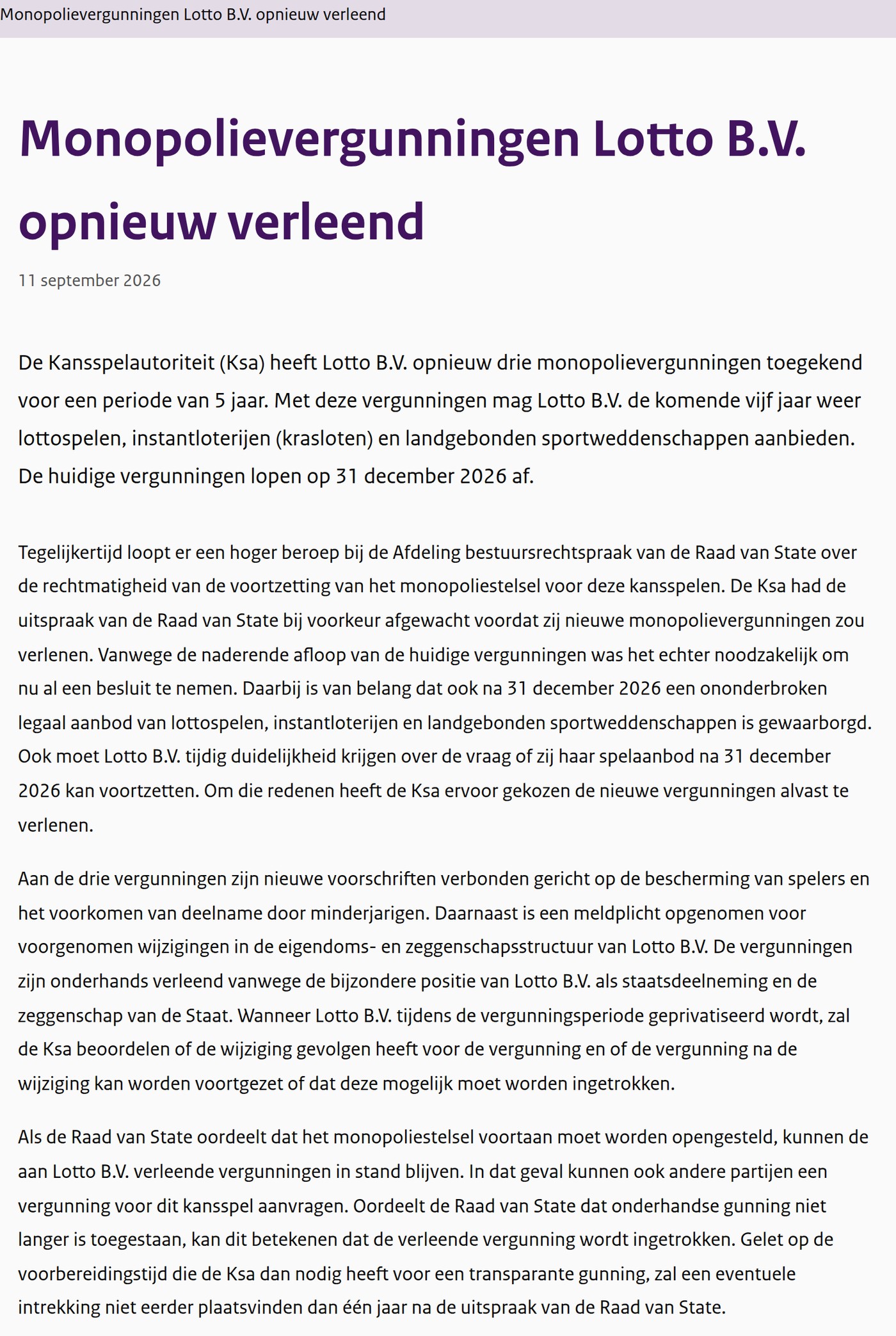
"De Ksa had de uitspraak van de Raad van State bij voorkeur afgewacht voordat zij nieuwe monopolievergunningen zou verlenen." The regulator would have preferred to wait for the ruling before granting new monopoly licences.[1]
Why not wait, then? Two reasons, both about keeping the shelves stocked. The three games have to stay legally on sale into next year. And Lotto B.V. needs to know in good time whether it may keep selling them.[1]
Both are real. But a decision that binds this market until the end of 2031 was made because another decision was late.
The case that is still running
On 4 January 2022 the Ksa turned down two companies from 's-Hertogenbosch, JVH Venture II B.V. and JVH Venture IV B.V. They wanted to run the same three games. The refusal came from the statute rather than from any judgement about them: the Gambling Act hands each of the three to a single company and stops there — articles 14b, 16 and 27b. All three had gone to Lotto B.V. two months earlier.[3]
JVH objected. The objection was rejected on 27 September 2022. JVH went to court.[3]
On 29 February 2024 the district court of Oost-Brabant found for JVH. Keeping one holder for the three shop-based games was not proportionate, it held, because the aims behind the arrangement were not being pursued in a systematic and coherent way. The Ksa had also failed to show the arrangement went no further than necessary. The court quashed the 2022 decision, gave the Ksa twelve weeks to decide again, and awarded €1,750 in costs.[2]
The Ksa appealed. So did Lotto B.V. On 19 April 2024 both asked for the position to be frozen while the appeal ran.[3] Two and a half years later, it still has not been heard out.
Betfair fought this for seven years and lost
This is the second long fight over the same three licences.
In November 2014 the licence went to the body that is now Lotto B.V. Two months later Betfair, which had asked for the same thing, was refused. The case ran through the courts for years. On 10 March 2021 Betfair's appeals were dismissed, and the arrangement stood.[4]
The law has not changed since. The market has. JVH's argument was that Dutch policy stopped hanging together once online play opened to any licensed company while three shop-based games stayed with one holder — and that nobody in 2021 had put the shop games and the online ones side by side.[2] The lower court agreed with that. Whether the judges upstairs do is the question nobody has answered.
What the Ksa says happens if it loses
The announcement sets out both ways the ruling could go.
Told the market must open up, it says the licences already granted can stand, and other companies may apply too.[1]
Told that direct award is no longer allowed, the licence may have to be withdrawn. But not soon. Any withdrawal will come no earlier than one year after the ruling, because that is how long the Ksa says it needs to organise an open competition.[1]
Read that again. A regulator has announced in advance that if it loses a case it has been fighting since 2024, nothing will change for at least a year after the judgment.
If you buy a scratch card in the Netherlands
Nothing changes in the shop. Same company, same tickets, same rules, into the new year and beyond.
Two different questions sit behind that counter, though, and only one of them has an answer. Who may sell you these three games is not settled; that is what the appeal is about. How they must behave while selling them is settled, and it tightened a little this week.[1]
Dutch regulation has been moving quickly on that second question. The authority put its player-risk algorithm out for anyone to download, then marked its own homework on how well it worked. The first question has been stuck in a courtroom since 2022. So a scratch card in a Dutch supermarket is sold under rules that keep changing, by a company whose right to sell it is still being argued about.
Missing from the record
The announcement carries no figures at all. Not what the three games are worth, not how many tickets are sold, not what a licence costs.[1]
It gives no case number for the appeal, does not name the companies that brought it, and does not say when a ruling is expected. None of that is confidential — the court records carry all of it.[1]
And nobody is quoted. Not a board member, not a spokesperson, not a minister.[1]
Sources
- Kansspelautoriteit — Monopolievergunningen Lotto B.V. opnieuw verleend (11 September 2026, Dutch). Three monopoly licences granted to Lotto B.V. for five years covering lotto games, instant lotteries and land-based sports betting; the current licences expiring 31 December 2026; the pending appeal at the Afdeling bestuursrechtspraak van de Raad van State on the lawfulness of continuing the monopoly system; the quoted sentence that the Ksa would have preferred to wait for that ruling, and the two reasons it did not; the new conditions on player protection, preventing participation by minors and the duty to report intended changes in ownership and control; the direct award because of Lotto B.V.'s position as a state holding and the State's control; the assessment promised if Lotto B.V. is privatised; and both contingencies — licences standing and others able to apply if the system must be opened, possible withdrawal no sooner than one year after the ruling if direct award is disallowed. No figures, no case number, no expected ruling date and nobody quoted.
- Rechtbank Oost-Brabant — ECLI:NL:RBOBR:2024:698 (29 February 2024, Dutch; archived from the Rechtspraak open-data endpoint). Cases 22/2703 and 22/2827, heard 12 October 2023 in 's-Hertogenbosch. The finding that the one-licence system for the three land-based games is not proportionate because the objectives are not pursued in a systematic and coherent way, and that the Ksa had not made it plausible that the system goes no further than necessary; the annulment of the decisions of 27 September 2022; the twelve-week order; €1,750 in costs and the €365 court fee; and the applicants' argument that Dutch policy ceased to be horizontally consistent after the Remote Gambling Act and that the 2021 ruling had not compared land-based games with online ones.
- Raad van State, voorzieningenrechter — ECLI:NL:RVS:2024:1654 (19 April 2024, Dutch). Case 202402072/2/A3. The refusals of 4 January 2022 of JVH Venture II B.V. and JVH Venture IV B.V.'s applications for the instant lottery, sports betting and lotto licences; the statutory basis in articles 14b, 16 and 27b of the Wet op de kansspelen allowing only one legal entity per licence; the licences granted to Lotto B.V. on 23 November 2021 running to 31 December 2026; the rejection of JVH's objections on 27 September 2022; and that both the Ksa and Lotto B.V. lodged appeals against the 29 February 2024 judgment and asked for an interim measure.
- Raad van State — ECLI:NL:RVS:2021:468 (10 March 2021, Dutch). Cases 201808735/1/A3 and 201808792/1/A3, brought by The Sporting Exchange Limited trading as Betfair. The grant of 25 November 2014 to the body now called Lotto B.V., the refusal of Betfair's own application on 8 January 2015, the course of the litigation and the Afdeling ruling of 2 May 2018, and the dismissal of Betfair's appeals on 10 March 2021.



