

What was published
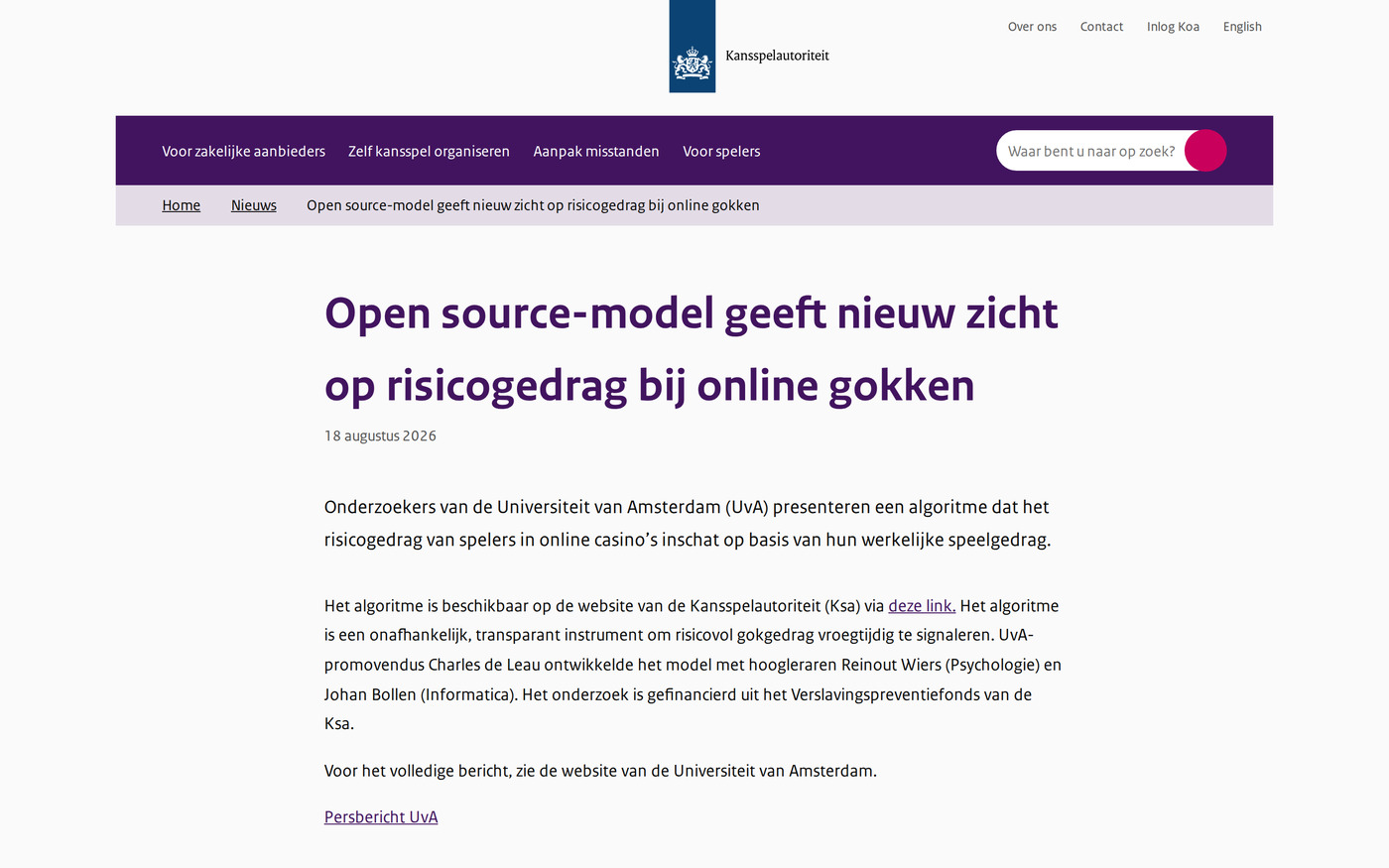
On 18 August the Kansspelautoriteit, the Dutch gambling regulator, announced an algorithm from the University of Amsterdam that estimates the risk in a player's behaviour at an online casino, working from how that player actually plays. The Ksa hosts it, and links to it from the announcement.[1]
The regulator describes it as an independent and transparent instrument for picking up risky play early. It was built by the doctoral researcher Charles de Leau with two professors, Reinout Wiers in psychology and Johan Bollen in computer science, and paid for out of the Ksa's addiction prevention fund.[1]
Why a free algorithm is a regulatory event
Reading account data for signs of harm is already an obligation under the British, Dutch and other European licences this desk covers. It is also where enforcement keeps landing. Britain's regulator settled with QuinnBet for £609,104 this month over exactly this. The monitoring missed deposits climbing, sessions running fast, stakes and bet counts rising; we went through that case in detail.
An operator answering such a case can say the technology is hard, the thresholds are a matter of judgement, and the science is unsettled. Each of those is arguable. They become harder to argue once a national regulator is hosting a method built by a university and giving it away.
What "transparent" is doing in that sentence
The word the Ksa uses is transparent. It has a specific meaning here. Operators already run risk models, but those are proprietary and their thresholds are not disclosed. A regulator auditing one is auditing a black box, supplied by the company under investigation.
A model anyone can inspect changes what an audit can ask. It also changes what a player could in principle ask, though nothing here gives anyone a right to see their own score.
What the announcement does not establish
No operator is required to use it. The Ksa announces a tool and does not announce a rule, and nothing in the release says the algorithm will be adopted in supervision, or that a licensee ignoring it is in breach of anything.[1]
The announcement itself publishes no measure of how well the model performs — no accuracy figure, no false-positive rate, no comparison against what operators run today.[1] The package behind its code link does. The metadata file reports an AUC of 0.9158 and an area under the precision-recall curve of 0.2332 on the test set, publishes two thresholds with their full counts, and states that the score is not calibrated.[2] Correction, 3 September 2026: this paragraph first said that no performance figure had been published anywhere. That was wrong. We had not opened the package behind the regulator's code link, and our later report goes through what it contains.
The funding is worth noting plainly rather than reading anything into it. The money came from the Ksa's addiction prevention fund, so the regulator paid for the research it is now hosting.[1]
What it means for a player
Nothing changes in what you can see. Your operator was already watching your account for these signals — that is what the duty requires — and this does not give you sight of what it concluded.
What it does is raise the floor under a familiar excuse. Ask an operator why its monitoring missed someone, and "this is difficult" is a weaker answer than it was in July. The point for anyone gambling is unchanged. Protections attach to a licence, and our gambling regulation map covers how to find which regulator, if any, stands behind a site.
Sources
- Kansspelautoriteit — Open source-model geeft nieuw zicht op risicogedrag bij online gokken (18 August 2026, Dutch). The algorithm and what it estimates, its availability on the Ksa's website, the description of it as an independent and transparent instrument, the three named researchers, the funding from the addiction prevention fund, and the pointer to the University of Amsterdam's own announcement.
- Kansspelautoriteit / Universiteit van Amsterdam — faro.json, the metadata file in the model package linked from the regulator's page (saved 5 July 2026). The AUC of 0.9158, the area under the precision-recall curve of 0.2332, the two thresholds with their test counts, and the statement that the score is not calibrated.



