

Where the numbers are
Neither the Kansspelautoriteit's announcement of 18 August nor the University of Amsterdam's press release puts a performance figure on the open-source risk model. Our report on the announcement noted as much. The figures sit in the package itself, in a metadata file called faro.json that ships beside the code the regulator links to.[1]
What is in the package
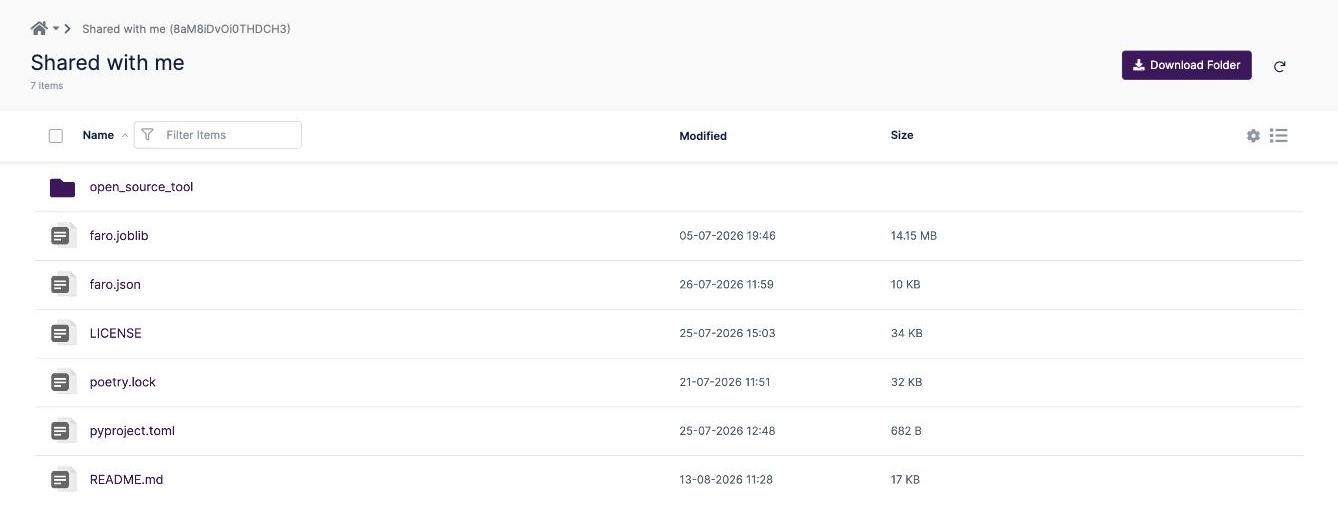
The model is called Faro. It is an XGBoost classifier saved on 5 July 2026, shipped as a 14.15 MB artefact with a 10 KB metadata file, a README, a lockfile and a licence.[2] The code that builds such a model is a separate release, Open Water, which the README points to on GitHub.[3]
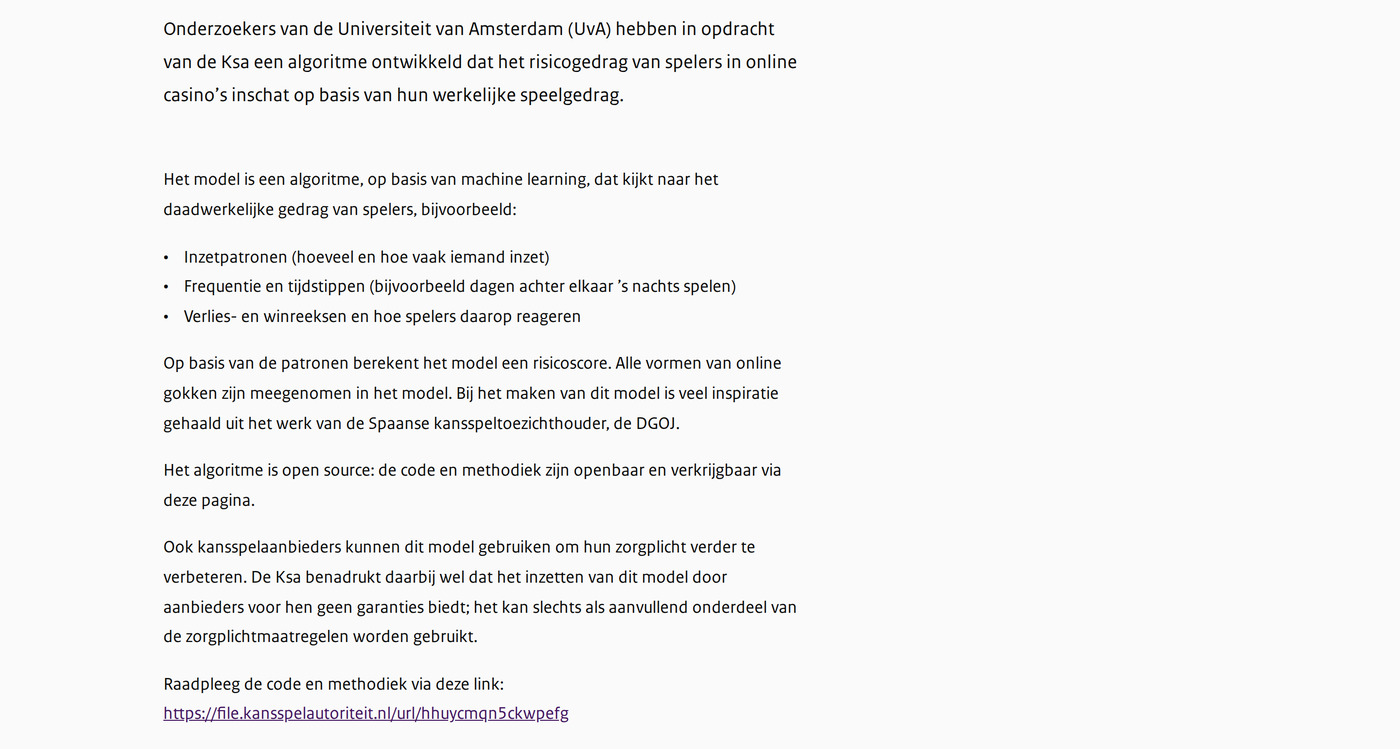
The regulator's page lists what Faro looks at: staking patterns, frequency and timing, and win and loss streaks with how players react to them. It credits the Spanish regulator DGOJ as an influence. Operators may run the model, the page says, but get no guarantees from it — only a supplementary part of their duty of care.[4]
It predicts self-exclusion, not harm
Faro was trained to spot behaviour preceding a temporary or indefinite self-exclusion in the following month, and that target shapes every figure below. Class 1 means one was recorded, class 0 that none was.[1]
Self-exclusion is a protective act, so what the model learns is who takes one. Someone being harmed who never self-excludes spends the whole of training in class 0. The metadata describes the target as self-exclusion and claims no wider reach, which leaves the score a ranking of who is likely to shut their own account.
The inputs are 180 columns: 60 behavioural features over three lookback windows of about one, six and twelve months. The exact spans differ a little between the training and test runs, and the file omits calendar dates deliberately.[1] Faro does not build these features from raw records. Whoever runs it calculates them first, using the definitions and windows from training.[3]
The numbers, and why two of them disagree
On the test set Faro scores an AUC of 0.9158 and an area under the precision-recall curve of 0.2332.[1] Those read like results for two different models, and the difference between them is the base rate.
The test set holds 809,651 rows and 12,770 of them are positive, or 1.58%.[1] We worked that share out from the four counts the file publishes. It does not state the rate, nor whether a row is one player or one player seen more than once. An event that rare flatters AUC and does not flatter precision-recall.
Two thresholds come with full counts. At the broad threshold of 0.2403, Faro flagged 71,523 rows; 8,975 were followed by a self-exclusion and 62,548 were not. That is about one in eight, or seven false signals for every true one, and it catches 70.3% of the self-exclusions that happened.[1]
At the selective threshold of 0.5763 it flagged 15,829 rows, of which 4,387 were followed by a self-exclusion. About one in 3.6, catching 34.4%.[1] The tighter setting buys precision and misses about two thirds of the self-exclusions.
The one figure that moved much between validation and test is sensitivity at the broad threshold, which fell from 0.9183 to 0.7028 while specificity held near 0.92.[1]
What the file says about its own limits
The metadata is explicit that the score is uncalibrated and must not be read as a probability of self-exclusion, so what it supports is a ranking. On the thresholds it says neither is universally preferred. The choice turns on what a missed case costs against what a false signal costs, and whichever is used should be validated for the population it is applied to.[1] Both came off the validation data before being measured on test.
The licence has teeth
Faro is released under the GNU Affero General Public License v3.0 only, and the README says that covers the source and the trained artefact.[3] The AGPL differs from other copyleft licences in that use over a network can trigger its obligations, where the others wait for distribution.
An operator building Faro into a platform players reach online should take advice on what that obliges it to publish. We are not lawyers. It is a term to read before an integration starts.
The law that made it possible, used once
The README names where the training data came from: rules the Ksa board issued in 2021 on releasing data for scientific research into gambling addiction.[3] Under them Faro was trained on every stake by every player at 13 Dutch online casinos, over the two years to 30 July 2025.[5]
The University of Amsterdam says Charles de Leau is the first and so far only researcher to use that route.[5] A rule compelling operators to hand player data to independent science has stood since 2021 and produced one model. Much of why the industry built nearly every risk tool in use sits in that sentence.
If you gamble
No operator has to run Faro, and nothing in it lets you see the score your own operator already keeps on you. The regulator gets a second opinion out of it: the Ksa says it can compute risk scores with the model and set them against the scores operators use.[5] That comparison only reaches companies a regulator licenses. Which regulator licenses a site, if any, is a check you can run yourself, and our gambling regulation map gives the regulator and the register for each country.
Sources
- Kansspelautoriteit / Universiteit van Amsterdam —
faro.json, the metadata file in the published package (saved 5 July 2026). The training target and its roughly one-month window, the 60 features over three lookback windows, the AUC of 0.9158 and AUPRC of 0.2332, both thresholds with their validation and test counts, and the statements that the score is uncalibrated and that neither threshold is universally preferred. The 1.58% base rate and the one-in-eight and one-in-3.6 ratios are our own arithmetic on the four counts the file publishes. - Kansspelautoriteit — the file listing at the address the regulator gives for the code and methodology, showing the seven items with their sizes and dates as read on 31 August 2026.
- Kansspelautoriteit / Universiteit van Amsterdam —
README.mdin the same package. The name Faro, the separate Open Water release, the AGPL-3.0-only licence and its coverage of the trained artefact, the feature-engineering requirement, and the citation of the 2021 rules on data for scientific research. - Kansspelautoriteit — UvA onderzoek: algoritme risicogedrag spelers (Dutch). The three families of behaviour the model examines, the risk score, the influence of DGOJ, and the statement that use by operators carries no guarantees and counts only as a supplementary duty-of-care measure.
- Universiteit van Amsterdam — Open source-model geeft nieuw zicht op risicogedrag bij online gokken (18 August 2026, Dutch). The 13 online casinos and the two-year period, the funding from ZonMw out of the Ksa's addiction prevention fund, the statement that De Leau is the first and so far only researcher to use the data-access route, and the statement that the Ksa can compute risk scores with the model and compare them with the scores operators use.



