

The meeting
It ran on 9 and 10 September in Bern. It happens once a year, and the four countries call the format DACHL after their number-plate letters.[1][2]
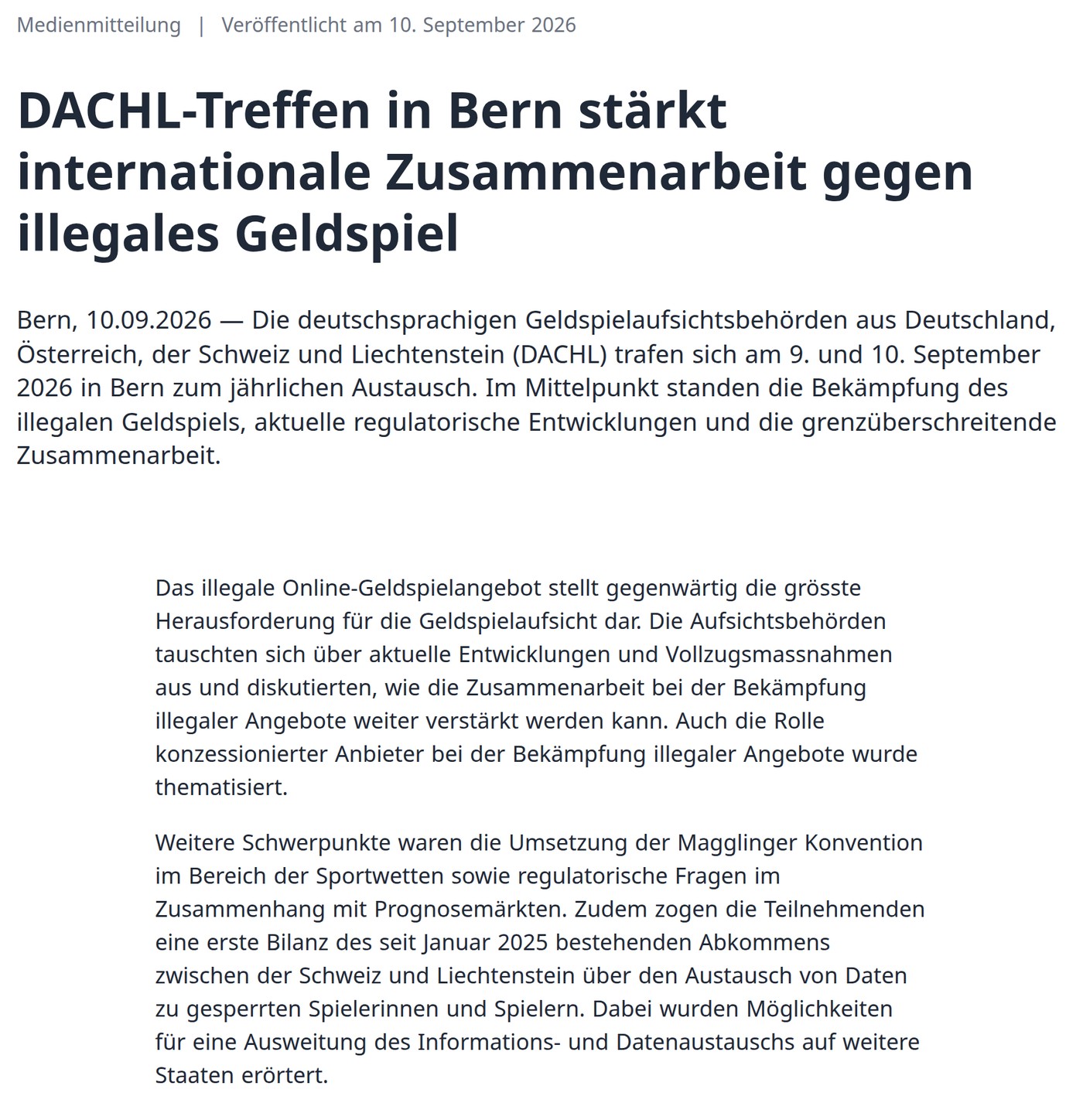
Switzerland hosted. Three Swiss bodies did it jointly: the Federal Gaming Board, the Federal Office of Justice, and Gespa, the inter-cantonal gambling authority.[2]
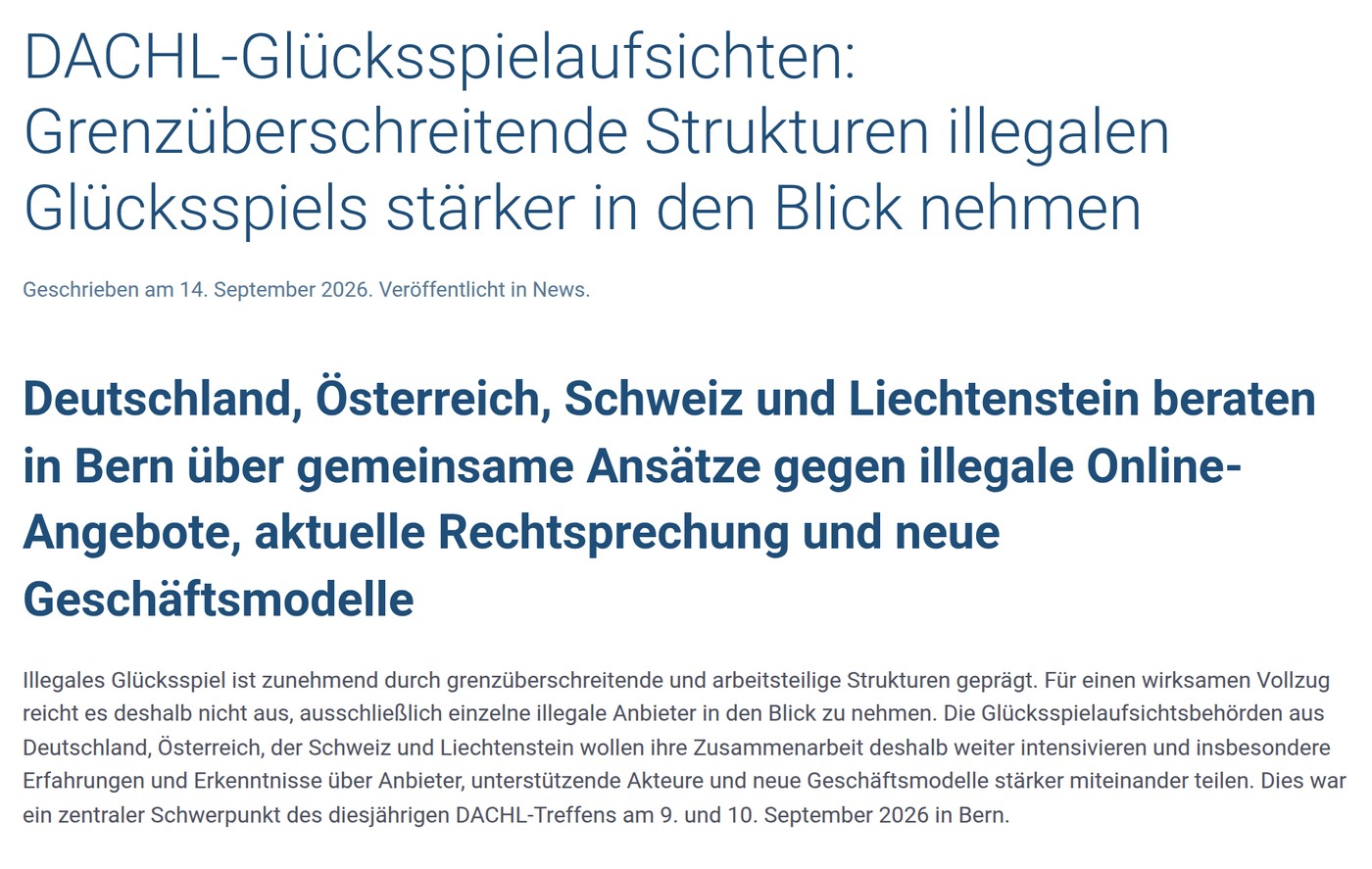
Switzerland published its account on 10 September, the day the meeting ended. Germany published its own four days later.[1][2]
What the German account says it was about
It opens with a claim about how illegal gambling is built now. It is "increasingly shaped by cross-border structures with a division of labour". Going after operators one at a time, it says, is therefore not enough.[1]
Then it names who else can be a target. Game studios, aggregators, platform operators and technical service providers. Those are the firms that make the games, bundle them, host them and keep them running. The German regulator's own market monitoring, it says, shows illegal offers sit inside "a complex market and support ecosystem".[1]
Licensed operators get a mention too. The German authority asked back in January 2026 for legal companies to do more against illegal offers. The idea came up again in Bern.[1]
The rest of the German account is court-watching. Recent European Court of Justice rulings on how hard a country may push players towards controlled channels, and what the civil-law consequences of an unlawful offer mean for enforcement.[1]
What the Swiss account says it was about
It starts from the same place. Illegal online gambling, it says, is currently the greatest challenge facing gambling supervision. Then it goes somewhere else entirely.[2]
Its second topic is the Macolin Convention, the Council of Europe treaty on the manipulation of sports competitions. Putting it into practice in betting was a main item.[2] The German account does not mention it.
Then the concrete thing. Switzerland and Liechtenstein have swapped data about barred players since January 2025 — people shut out of gambling, whether at their own request or otherwise. In Bern the group drew up a first assessment of how that has worked. They also discussed widening the exchange to other countries.[2]
That is the only item from these two days that would change what a player experiences. It appears in one write-up of the two.
The one thing both of them lead on
Prediction markets. Both accounts name them. Both frame them the same way: a new business model where it is not yet settled how to classify it, or where the line to other markets falls.[1][2]
Two of the countries in the room have stopped waiting for that answer. Germany decided last month that bets on prediction markets cannot be licensed under its own law. Korea, further away but facing the same product, simply ordered Polymarket blocked as gambling. "We are watching this early" describes something one of the four has already finished watching.
The two accounts side by side
Put them next to each other and the gaps say as much as the overlaps. The German account never mentions the Macolin Convention or the shared list of barred players. The Swiss account never mentions game studios, aggregators, platform operators or technical service providers.
Neither is wrong. Each regulator wrote up the part of the agenda closest to its own daily work. Germany runs enforcement against a supply chain. Switzerland shares a border and a register with Liechtenstein. But read only one, and you come away with a different idea of what four regulators did.
It is worth being plain about the word "agreed". Both accounts describe intentions — to cooperate more closely, to share findings, to keep meeting. Neither describes a rule, a deadline, a joint operation or a number.[1][2]
What changed since last year
The same four met on 8 and 9 October 2025 in Halle, hosted by the German authority. That agenda was technical. IP-blocking. The review of Germany's gambling treaty. How differently the four treat gambling in criminal law. Whether loot boxes count as gambling. Illegal betting in amateur sport. Ways to stop players getting round identity checks. And "markers of harm", the signals used to spot a player in trouble early.[3]
A year on, loot boxes and IP-blocking are gone from both accounts. The supply chain behind the operators has arrived. That is a real shift in where these four think the problem sits.
One other change. The 2025 announcement quoted somebody: Ronald Benter of the German authority's board, saying that close cooperation with European supervisors helps "in all areas of our work".[3] Neither 2026 account quotes anyone at all.
For a player in the four countries
Nothing changed this week. No rule was made in Bern, and none could be. This is a meeting, not a parliament.
The thing to watch is the shared list of barred players. A self-exclusion that stops at a border is a self-exclusion with a hole in it. Two small neighbours have been trading that data for twenty months and are now asking who else might join.
Every national register we have looked at has a version of the same weakness. Sweden's Spelpaus register got smaller last quarter, and nobody rang the people who left it. In the Netherlands the register did its job while the door did not. A register that covers one country is the same gap in another form.
Missing from both accounts
No figures anywhere. Not how many illegal sites the four are dealing with. Not how many player records have crossed between Switzerland and Liechtenstein in twenty months. Not how many cases any of this has produced.[1][2]
No named next step, and no date for one. Both end on an intention to carry on meeting.[1][2]
And Austria and Liechtenstein were both in the room. Neither published an account that either of these two points to.
Sources
- Gemeinsame Glücksspielbehörde der Länder — DACHL-Glücksspielaufsichten: Grenzüberschreitende Strukturen illegalen Glücksspiels stärker in den Blick nehmen (14 September 2026, German). The meeting on 9 and 10 September in Bern with the supervisory authorities of Germany, Austria, Switzerland and Liechtenstein; that illegal gambling is increasingly shaped by cross-border structures with a division of labour and that addressing individual operators alone is not enough; that game studios, aggregators, platform operators and technical service providers can be addressees of measures; the GGL's market monitoring describing illegal offers as part of a complex market and support ecosystem, and its holistic approach; the January 2026 call for legal operators to contribute more; the discussion of European Court of Justice decisions and of the civil-law consequences of unlawful offers; prediction markets as an example of a new business model whose regulatory classification and boundaries are unsettled; and the intention to continue the exchange. No figures, no named next step, nobody quoted, and no mention of the Macolin Convention or of the shared list of barred players.
- Der Bundesrat / Swiss Confederation — DACHL-Treffen in Bern stärkt internationale Zusammenarbeit gegen illegales Geldspiel (10 September 2026, German). That Switzerland hosted, and that the Eidgenössische Spielbankenkommission, the Bundesamt für Justiz and the inter-cantonal authority Gespa did so jointly; that the illegal online offer is currently the greatest challenge for gambling supervision; the role of licensed operators in combating illegal offers; implementation of the Macolin Convention in the field of sports betting; regulatory questions around prediction markets; the first assessment of the agreement in force since January 2025 between Switzerland and Liechtenstein on exchanging data about barred players, and the discussion of extending that exchange to further states; and the agreement to deepen cross-border cooperation. No figures, nobody quoted, and no mention of game studios, aggregators, platform operators or technical service providers.
- Gemeinsame Glücksspielbehörde der Länder — GGL Gastgeberin des DACHL-Treffens 2025 (7 October 2025, German). That the 2025 meeting ran on 8 and 9 October 2025 in Halle with representatives from Liechtenstein, Austria and Switzerland; the agenda of measures against illegal offers and IP-blocking, the evaluation of the German gambling treaty, differing criminal-law norms, the gambling-law assessment of loot boxes, illegal betting in amateur sport, technical means of preventing circumvention of player identity checks, and markers of harm; and the quoted remark by Ronald Benter of the GGL board that close cooperation with European supervisory authorities benefits the authority in all areas of its work.



