

What Sweden published
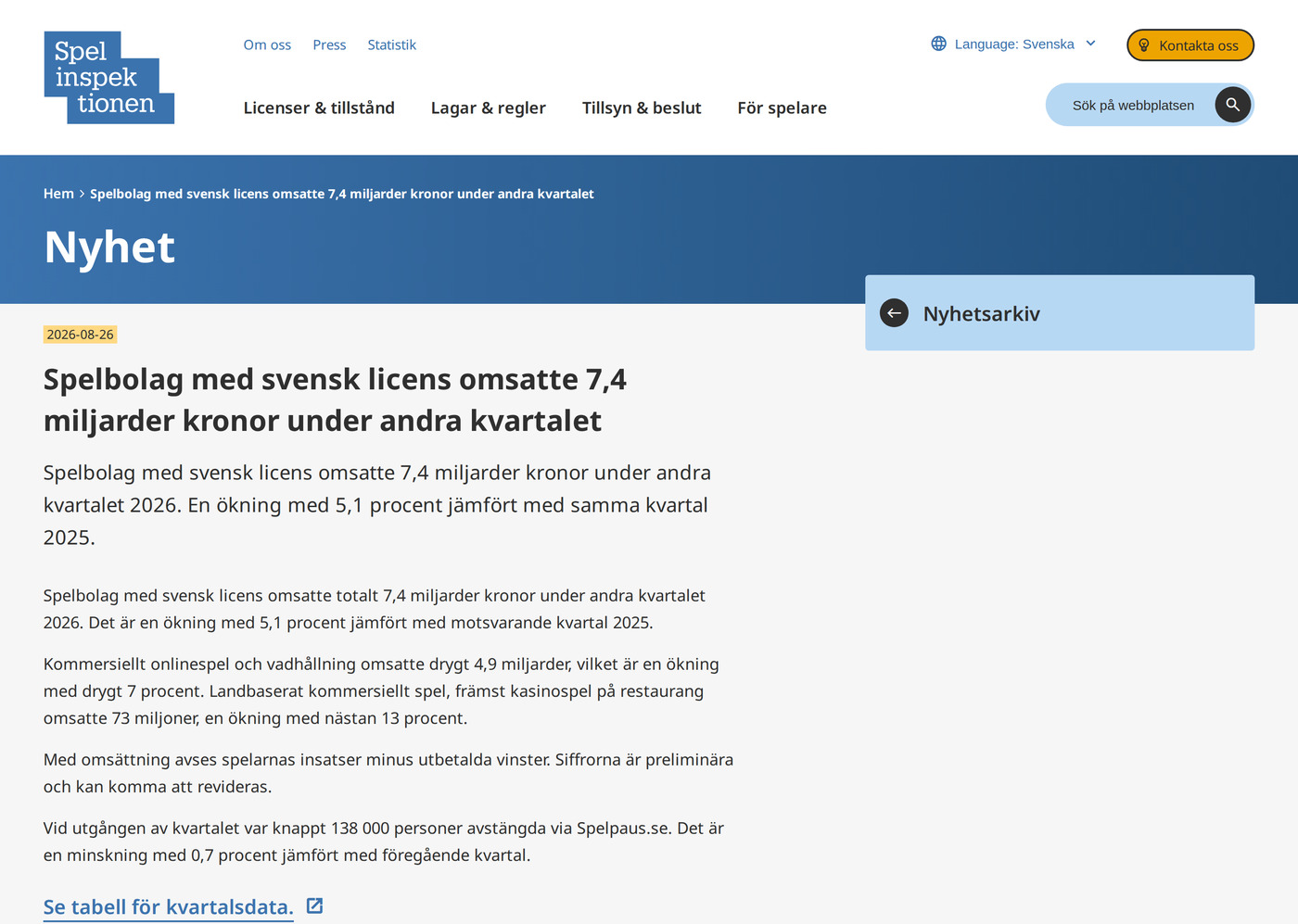
On 26 August the Swedish regulator, Spelinspektionen, released second-quarter figures. Licensed operators took SEK 7.4bn in the quarter, 5.1% more than in the same quarter of 2025. Commercial online gambling and betting accounted for a little over SEK 4.9bn of that, up by more than 7%. Land-based commercial play, mostly restaurant casino, came to SEK 73m, up by nearly 13%.[1]
Turnover here means what players staked less what they were paid in winnings. The regulator marks the figures preliminary and says they may be revised.[1]
At the end of the same release comes the figure this article is about. At the close of the quarter just under 138,000 people were self-excluded through Spelpaus.se, 0.7% fewer than three months earlier.[1]
The comparison that needs care
We covered Portugal's second-quarter figures on Tuesday. There the self-exclusion register stood at 413.7 thousand and had grown 26.8% over the year.[2] Set that beside Sweden's 138,000 and falling and it looks like two countries heading in opposite directions.
Two things have to be fixed before that reading holds. The first is the time period. Portugal's 26.8% is a year-on-year change; Sweden's 0.7% is quarter-on-quarter. Compared like for like, Portugal's register grew 8.7% over the same three months in which Sweden's shrank.[2]
The second is harder, and it does not go away.
One register of people, one register of accounts
Spelpaus is a single national service. A person signs up once and every operator holding a Swedish licence is then required to keep them out, so the figure counts people.[1]
Portugal's regulator counts registos de jogadores — player registrations — and a footnote to its own tables says the same player can be self-excluded at more than one operator.[2] So 413.7 thousand Portuguese registrations is an unknown number of Portuguese people, and it is certainly fewer than 413.7 thousand.
So the two totals cannot be set side by side, however tempting the arithmetic looks. One counts individuals barred everywhere at once; the other counts relationships between a person and a company, and one person can appear in it several times.
What can still be said
Each figure is usable against itself over time, which is where the actual finding sits. Sweden's national register of self-excluded people got smaller last quarter while the money staked with licensed operators got larger. Those two lines moving apart is a real fact about Sweden, and it does not depend on any comparison with Portugal.
Why it shrank is not something the release addresses, and the figures do not allow an outside guess. Spelinspektionen publishes the total and nothing else, so a fall could mean fewer people joining, more people leaving, or both at once. Portugal publishes the two flows separately, which is how its quarter could be split into 60.9 thousand new exclusions against 27.7 thousand ending.[2] Sweden's number cannot be opened up that way.
If you gamble in Sweden
One Spelpaus registration covers every licensed operator at once. It does not reach an operator without a Swedish licence, because nothing obliges that company to check the list.
That last point is the practical one, and it is the same everywhere. A self-exclusion tool only binds companies a regulator can reach — our gambling regulation map covers how to tell whether a site is inside that perimeter, and why the licence draws that line is the subject of a separate article.
Sources
- Spelinspektionen — Spelbolag med svensk licens omsatte 7,4 miljarder kronor under andra kvartalet (26 August 2026, Swedish). Quarterly turnover and its split, the definition of turnover, the preliminary status of the figures, the Spelpaus total of just under 138,000 people and its 0.7% quarterly fall, and how the underlying data is collected.
- SRIJ — Atividade de jogo no 2.º trimestre de 2026 (6 August 2026, Portuguese) and the online activity report linked from it. The 413.7 thousand self-excluded registrations, the 26.8% annual and 8.7% quarterly growth, the 60.9 thousand new exclusions against 27.7 thousand ending, and the footnote stating that one player may be self-excluded at more than one operator.



