

The headline numbers
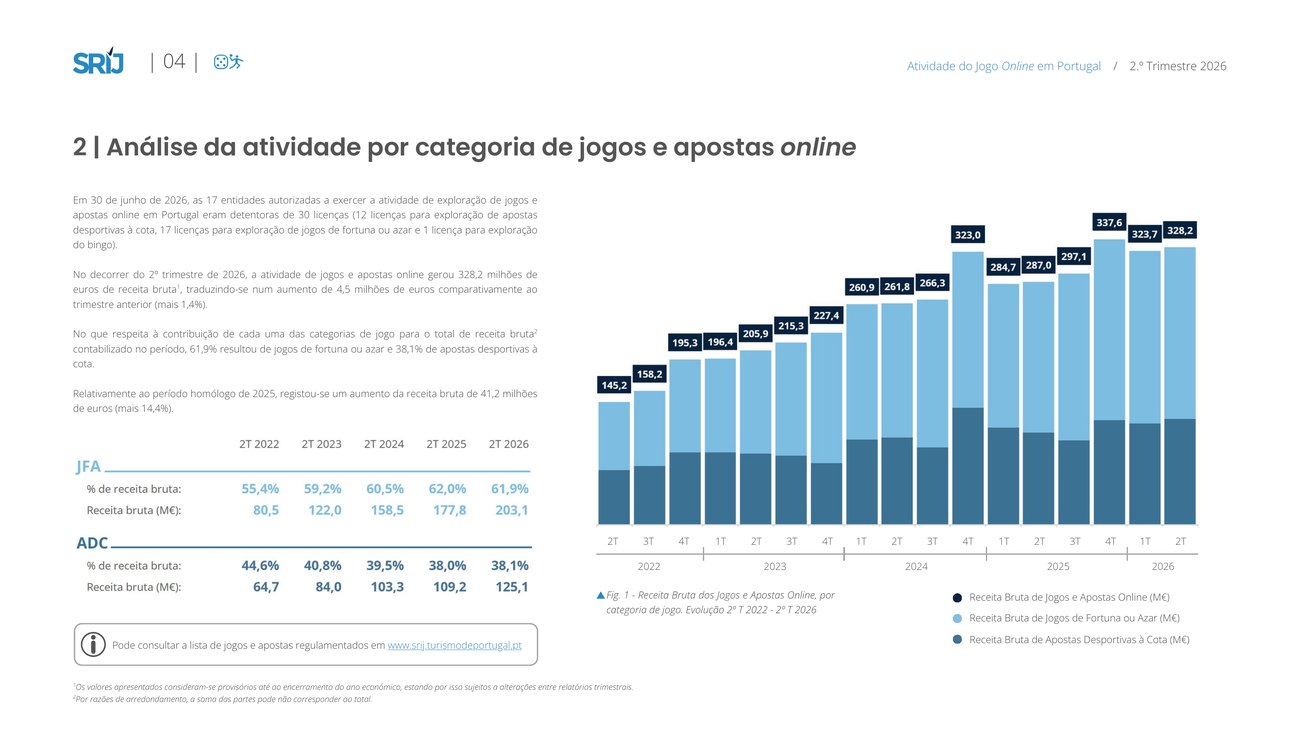
SRIJ, the Portuguese gambling regulator, released the second-quarter reports for online and land-based gambling on 6 August. Seventeen operating entities held 30 online licences at the end of the quarter: twelve for fixed-odds sports betting, seventeen for games of chance and one for bingo.[1]
Online gross revenue was €328.2m, up 14.4% on the same quarter of 2025. Games of chance took €203.1m of that and sports betting €125.1m, a split of 61.9% to 38.1%. The online gaming tax collected came to €92.1m, up 13.4%.[1]
Amounts staked run far above revenue, because winnings are staked again. Players put €5,694.8m through games of chance and €515.6m through sports betting. Land-based results are in a separate report: casino and machine-room revenue up 6% on the year, bingo halls down 0.1%.[1][2]
Self-exclusion is growing faster than the player base
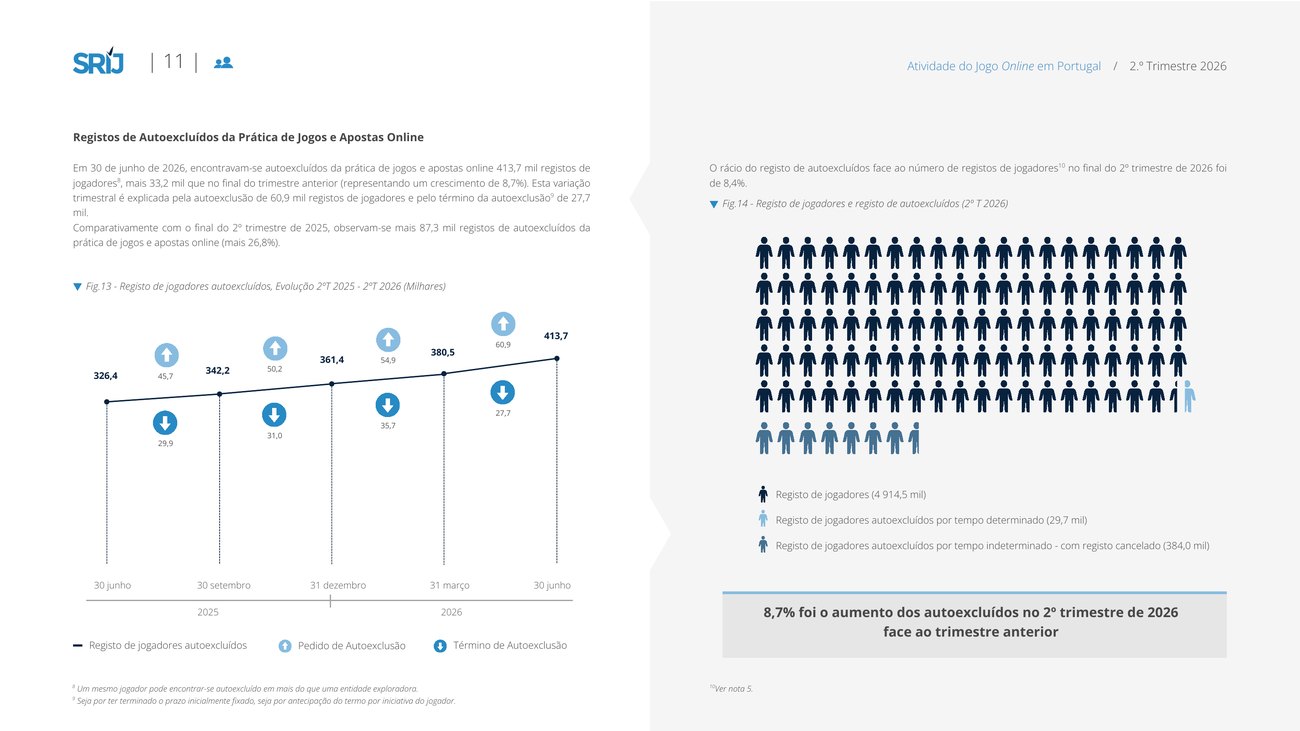
At 30 June 2026 there were 413.7 thousand player registrations self-excluded from online gambling, 26.8% more than a year earlier. Total player registrations reached 4.9 million, up 1.0%. So one line grew by a quarter while the other barely moved.[1]
The flow figures say the same thing. New registrations in the quarter were 248.4 thousand, up 17.7% on the year. New self-exclusions were 60.9 thousand, up 35.9%. Both are rising, and the smaller one is rising about twice as fast.[1]
SRIJ publishes the ratio directly: at the end of the quarter the self-exclusion register stood at 8.4% of the player register, against 4,914.5 thousand registrations in total.[1]
The composition matters more than the total. Of the 413.7 thousand, 29.7 thousand are self-exclusions for a fixed term. The other 384.0 thousand are open-ended, with the player's registration cancelled. So this is mostly not a cooling-off register. It is a record of accounts closed for good.[1]
What these numbers count, and what they do not
SRIJ counts registrations, not people. Its own wording throughout is "registos de jogadores" — player registrations — and a footnote to the self-exclusion figures says plainly that the same player may be self-excluded at more than one operator.[1] So 4.9 million is not 4.9 million Portuguese adults, and 413.7 thousand is not 413.7 thousand distinct self-excluded people. The ratio between them still holds, because both sides are counted the same way.
Self-exclusion also ends. The quarter's net rise of 33.2 thousand is 60.9 thousand new exclusions minus 27.7 thousand that expired or were lifted. A register that grows is not only people arriving; it is people arriving faster than others leave.[1]
Where the betting went
Football took 69.9% of the sports betting stakes, tennis 20.5% and basketball 6.0%. Within football, the FIFA World Cup 2026 alone accounted for 28.3% of stakes, ahead of Portugal's own Primeira Liga on 8.3%. Roland Garros took 21.4% of tennis stakes and the NBA 44.6% of basketball.[1]
Among games of chance, machine games took 81.6% of stakes. Banca francesa followed on 5.7%, French roulette on 4.4% and blackjack on 4.2%. Crash games took 3.0% and poker 1.1%.[1]
Of the 1,214.1 thousand registrations that placed at least one bet, 43.1% did both sports betting and games of chance, 33.5% only games of chance and 23.3% only sports betting.[1]
The enforcement footnote
The same report records what SRIJ did about unlicensed gambling in the quarter: 95 notifications to shut down, 113 sites notified for blocking, and six referrals to the public prosecutor.[1]
Ontario publishes monthly and we have tracked four years of it. Portugal's quarterly series is the same sort of resource, and its self-exclusion pages carry a breakdown the Ontario data does not. If you gamble in Portugal, the register behind that 413.7 thousand is a tool you can use — our article on what a casino licence is worth explains why it reaches licensed sites only.
Sources
- SRIJ — Atividade de jogo no 2.º trimestre de 2026 (6 August 2026, Portuguese) and the online activity report linked from it, Relatório 2.º trimestre 2026 — Registo da atividade de jogo online em Portugal. Licences and operating entities, gross revenue and its split, the online gaming tax, amounts staked, the sport and game breakdowns, player and self-exclusion registrations and the 8.4% ratio, the players-with-activity figures, and the illegal-gambling actions.
- SRIJ — Estatísticas do jogo de base territorial, 2.º trimestre de 2026, published alongside the online report at the same source. The land-based figures: casino and machine-room revenue up 6% on the year, bingo down 0.1%.



