

What the broadcast showed
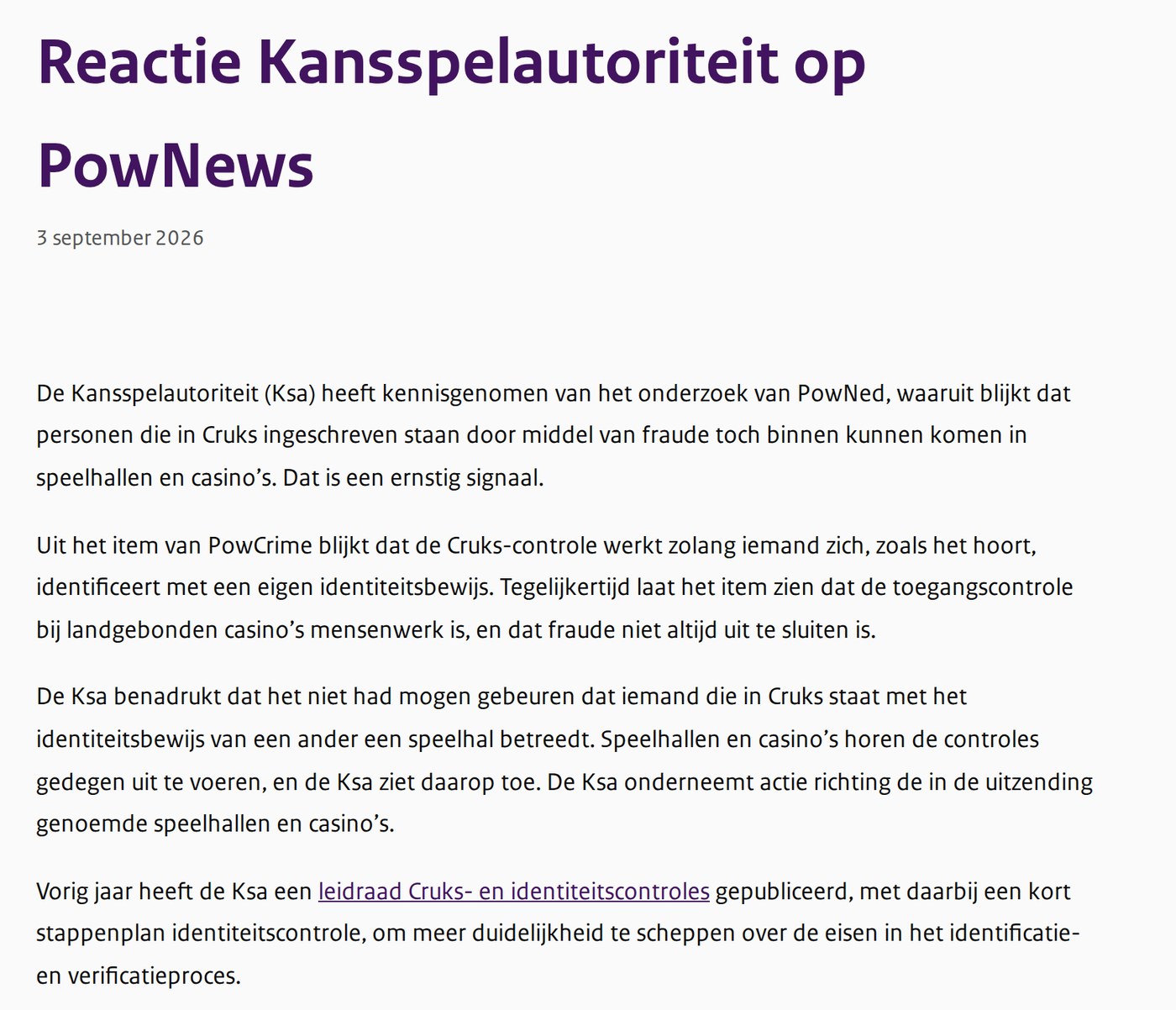
PowNed's investigation put people registered in Cruks, the Dutch self-exclusion system, inside gaming halls and casinos by fraud. The Kansspelautoriteit published a response on 3 September calling it a serious signal.[1]
The regulator watched the same footage and drew a line through the middle of it. The Cruks check works, it says, as long as somebody identifies themselves with their own document. The PowCrime item also shows that access control at land-based venues is done by people, and that fraud cannot always be ruled out.[1]
Two different failures, and only one of them happened
A self-exclusion system can fail in two ways. The register can hold the wrong data, or fail to answer, or let a name through. Or the register can answer correctly and nobody acts on the answer.
This is the second kind. Nothing here suggests Cruks returned the wrong result about anybody. It was asked about the wrong person, because the document handed over belonged to someone else, and it answered about that someone else accurately.
If Cruks itself were broken, the government could repair it once and every hall in the country would be covered. The problem in the broadcast cannot be repaired that way. It has to be put right at the door of each hall, by whoever is checking cards that day.
What the regulator says it will do
The Ksa says plainly that it should not have happened: somebody on Cruks walked into a gaming hall on another person's identity document. Halls and casinos are supposed to carry out those checks properly, and the Ksa supervises that.[1]
It says it is taking action towards the halls and casinos named in the broadcast.[1] Which halls, and what action, it does not say.
The response also points back to guidance the Ksa published last year on Cruks and identity checks. It came with a short step-by-step for the identification and verification process.[1] Guidance that already existed is now being cited in answer to a programme showing it was not followed.
What the response does not say
No number of people appears, and no number of venues. Nobody is named — not the halls, not the casinos, not anyone who got in.[1]
Nor is there a figure for how often this works. Nothing says whether the broadcast found a common weakness or a few unlucky doors. A television programme is not a survey, and the Ksa does not treat it as one.
If you are on Cruks
Your registration is intact and it is doing its job. A borrowed document can defeat a door check, and that is a different thing from your exclusion failing.
The part worth knowing is where the weakness sits. The Ksa's own framing puts it at access control in physical venues, which it calls work done by people. Our article on what a national licence covers explains why a scheme like Cruks reaches licensed sites only. Our gambling regulation map gives the Dutch regulator and the scheme it runs, alongside every other country we have read the law for.
Sources
- Kansspelautoriteit — Reactie Kansspelautoriteit op PowNews (3 September 2026, Dutch). That people registered in Cruks got into gaming halls and casinos by fraud and that the Ksa calls it a serious signal; that the Cruks check works when a person identifies with their own document; that access control at land-based venues is done by people and fraud cannot always be ruled out; that it should not have happened, that venues must carry out the checks properly and the Ksa supervises them; that the Ksa is taking action towards the venues named in the broadcast; and the guidance on Cruks and identity checks it published last year.



