

What was decided
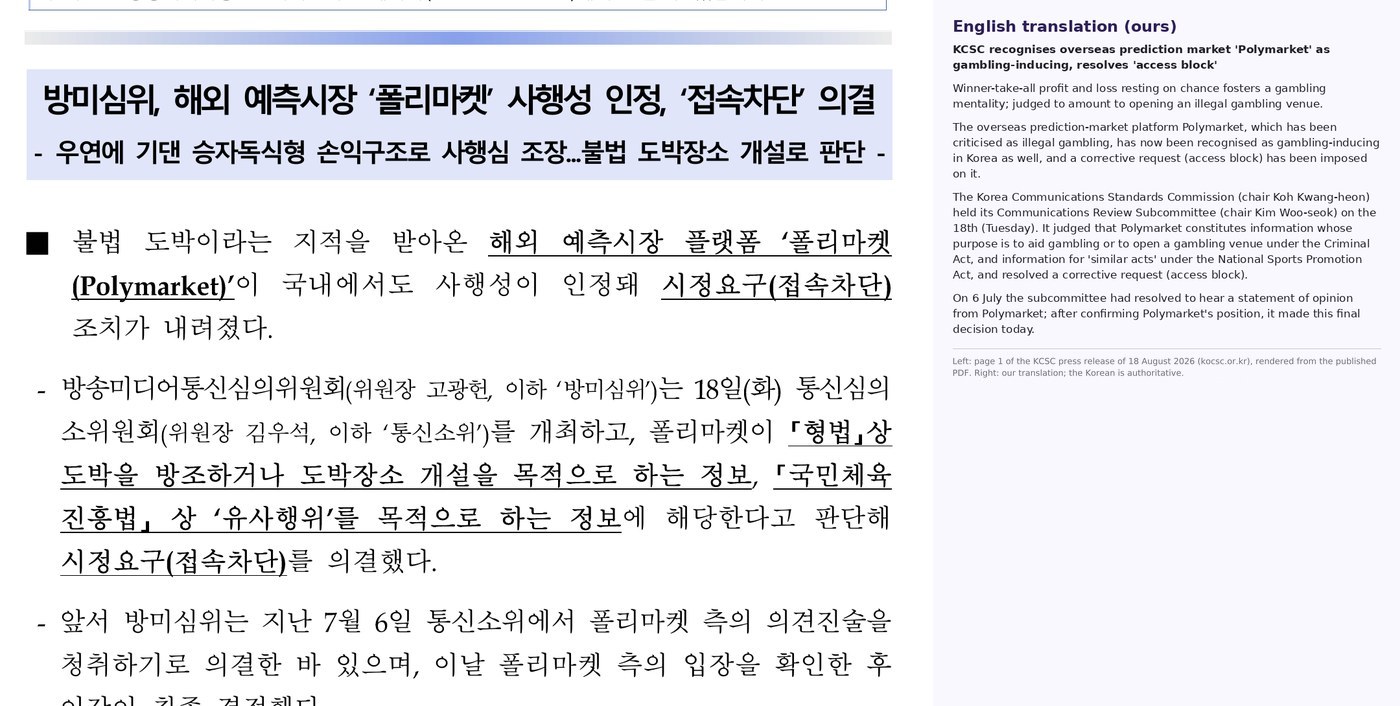
Korea's Communications Standards Commission reviews online content and can tell internet providers to close access to a site. Its communications subcommittee took Polymarket on Tuesday 18 August and resolved a corrective request with access blocking, which is the instruction that reaches the providers.[1]
Two legal hooks are named. Under the Criminal Act the site counts as information that aids gambling or opens a gambling venue. Under the National Sports Promotion Act, which covers unlicensed sports betting, it counts as information for "similar acts".[1]
Polymarket was heard first. On 6 July the same subcommittee voted to take its written position before deciding anything.[1]
Why the commission called it gambling
On Polymarket a user buys shares in whether something will happen. Guess right and the share pays its full face value; guess wrong and it is worth nothing. Markets run on elections, court cases, sports results, the weather. The commission's reading is that this is an all-or-nothing stake on an outcome the user has no hand in, working on the same appetite as any other bet.[1]
Then it looked at what the operator itself does. Polymarket decides which markets open, writes the trading rules, runs the depositing, withdrawing and crypto settlement, and takes a fee on trades. Money comes in from users, money goes back out to users, and the platform earns on the flow. In the commission's account that is what opening a gambling venue means.[1]
Three other bodies were asked before the review: the National Police Agency, the National Gambling Control Commission and the Korea Sports Promotion Foundation. All three said the way Polymarket operates could amount to opening a gambling venue, and to the gambling offences in Korean law.[1]
What Polymarket argued, and why it lost
Polymarket put two points in writing. Its Korean-language service was gone and it takes no payment in won, so Korea's network law should not reach it. And because trades run peer to peer through smart contracts, with the platform never holding the money, it is not the "presiding party" to a bet and issues no sports betting tickets, so the elements of the offences are missing.[1]
Neither point survived. Language and payment currency do not settle whether Korean law applies, the commission said, and neither does the choice between decentralised and centralised plumbing. It then pointed at what was still on the site: markets written for Korea, with the release citing "August rainfall in Seoul". A site running Korean questions for Korean users is, in substance, an illegal gambling environment for them, and on that reading blocking was the only way left to protect users at home.[1]
Korea is not the first. France has blocked Polymarket since 16 July, and Australia and Germany did so in August and September 2025, each treating it as unlicensed gambling or betting.[1]
What it means if you are in Korea
Korean law treats gambling as a crime for the person placing the bet, not only for the business taking it. On the commission's reading, a resident who keeps trading on Polymarket is doing what someone betting with an unlicensed bookmaker does. The police were among the bodies consulted.[1]
The defence Polymarket ran is the one offshore casinos run: drop the local language, refuse the local currency, say the market was never served. Korea's answer was to look at what was actually on offer. A market about rainfall in Seoul, open to people in Seoul, serves Korea. Denmark arrives at the same place by another road — its regulator publishes eight signs that a site is aimed at Danes, and any single one of them is enough, which we set out in last week's blocking story.
Sources
- Korea Communications Standards Commission (방송미디어통신심의위원회) — 방미심위, 해외 예측시장 '폴리마켓' 사행성 인정, '접속차단' 의결 (press release, 18 August 2026; the text is in the attached PDF). The resolution, the reasoning, the agencies consulted, Polymarket's statement, and the note on France, Australia and Germany.



