

Ninety-eight more, and a court behind each one
On 8 July the court in Frederiksberg agreed with Denmark's gambling authority that 98 websites were offering gambling to Danes without a Danish licence. The authority announced it on 19 August. Since 2012 the running total is 870 blocked sites.[1]
Blocking runs through several steps. The authority first asks the operator to stop. If nothing changes, it goes to the telecoms companies and asks them to cut off access. The telecoms companies then ask a court to confirm that the sites really are illegal before they do it. The authority says this makes for a long process between judging a site illegal and Danish players no longer being able to reach it.[1]
The block itself is a DNS block, applied by whichever telecoms company the player uses. Try to open one of the sites and you get a page saying it is illegal and blocked.[1]
What is actually on the list
The authority publishes the 98 domains as a PDF.[2] We counted them.
They are not 98 different businesses. Strip the digits off the end of each name and 98 domains fall into 72 families. Fifty-seven of those families are a single domain. The rest are clusters: one name carries eight addresses, another six, another three, and twelve more names carry two each.
That is the mirror-domain pattern: one brand, a row of near-identical addresses.
Not one of the 98 is a .dk address. Two are skin-betting sites of the kind that grew out of Counter-Strike — the trade our history of esports betting follows from 2010 onwards.[2]
So the number of blocked domains is not the number of blocked operators. Twelve of these names were already running two addresses when the court ruled.
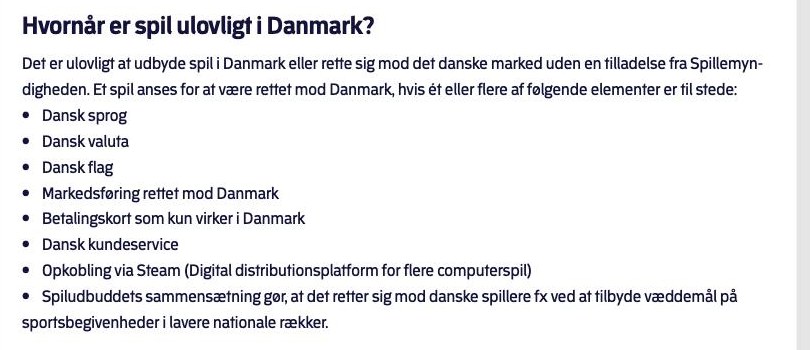
How Denmark decides a site is aimed at Danes
The authority also publishes how it decides. A site counts as targeting Denmark if any one of these is true:[1]
- it is in Danish
- it takes Danish kroner
- it shows a Danish flag
- it markets itself to Denmark
- it takes payment cards that only work in Denmark
- it has Danish customer service
- players can connect through Steam
- the odds on offer point at Danish players — betting on lower Danish sports leagues, for instance
One of these is enough. A site does not have to say it wants Danish players; it only has to behave as though it does.
What this changes for a player
If you are in Denmark, the practical test has not changed and it takes seconds. Every operator licensed there must show the authority's licence mark.[1] The mark is there or it is not.
Outside Denmark the list is still worth reading. It is a public, court-tested record of which addresses one European regulator says are working around its rules. That is the same question our gambling regulation map answers country by country: not “does this site look professional”, but “whose register is it on, and under what name”.
The gap in the process is the part to keep in mind. Between the authority judging a site illegal and the telecoms companies closing it off sit a request, a refusal and a court hearing.[1] The site takes deposits for all of it.
Sources
- Spillemyndigheden — Spillemyndigheden blokerer 98 ulovlige spilsider (19 August 2026). The court date, the count, the 870 total, the blocking procedure, the targeting criteria and the licence mark.
- Spillemyndigheden — Blokerede hjemmesider, juli 2026 (PDF, read 26 August 2026). The 98 domains. The counts of name families and clusters in this article are ours, taken from that list.



