
The whole fight is about what to call it
Buy a contract that pays if a named team wins, and you have taken a position on a sporting result. Whether that is a wager depends entirely on which rulebook you reach for.
Call it a derivative and it belongs to a federal financial regulator, and no American state has standing to interfere. Call it a sports bet and Michigan wants to see a licence, which neither firm holds.
Everything below follows from that one unsettled word.
Kalshi lost the argument about where to have the argument
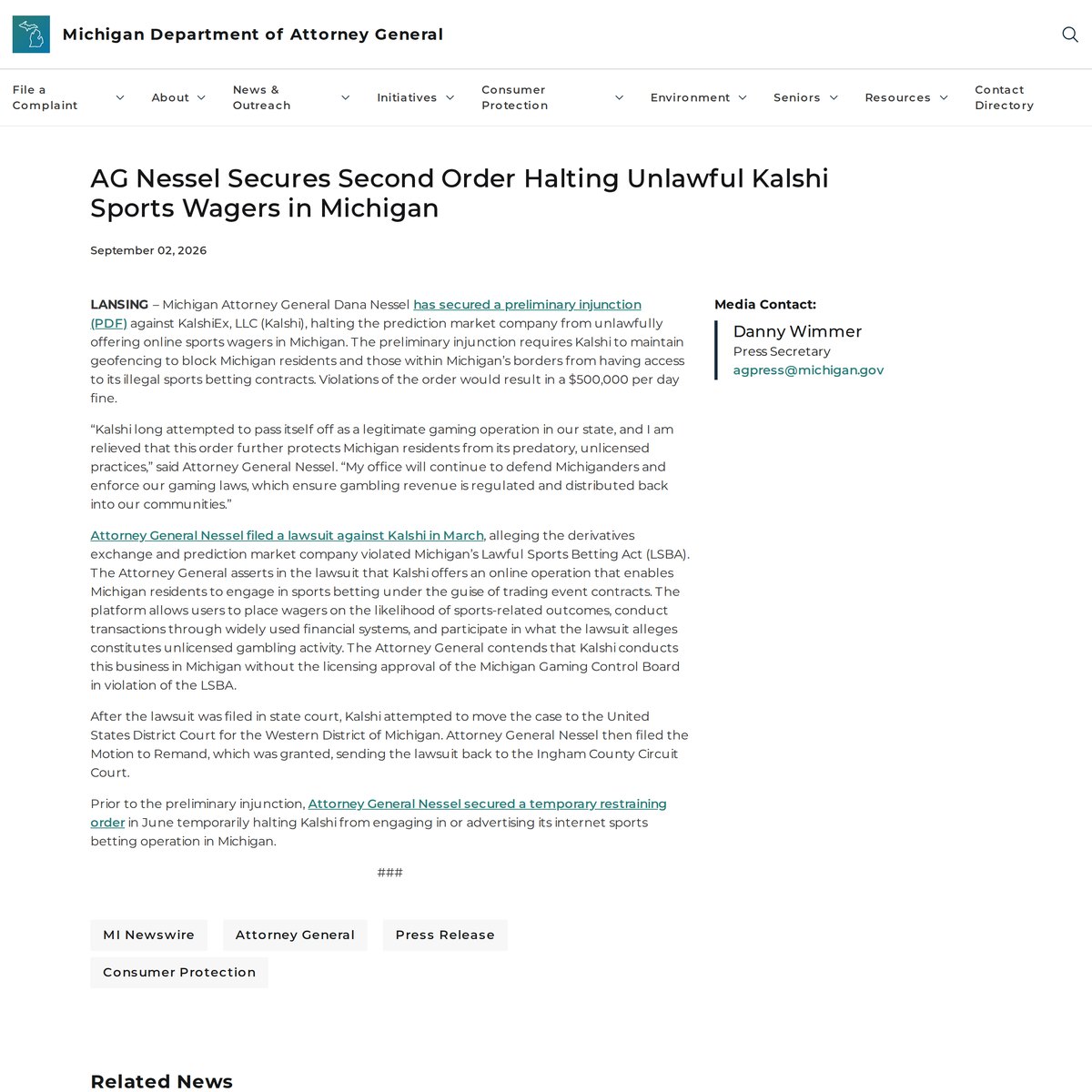
The procedural sentence is the one to read twice. An Ingham County judge issued the injunction after the matter had been sent back down from the federal bench in the Western District of Michigan.[1]
A company whose entire defence is "this is federal business" has just had its case handed to a county courthouse. That is a worse day than any individual ruling, because it goes to whether the defence gets heard at all.
The order itself is narrow. Kalshi must keep its geofencing switched on so nobody inside the state can reach the sports contracts, and slipping carries a penalty of $500,000 a day.[1]
Behind it sits a suit filed in March, a restraining order in June, and an allegation that the firm took sports bets in Michigan without the Gaming Control Board's approval.[1] Attorney General Dana Nessel's own word for what Kalshi had been doing was "predatory".[1]
Robinhood did the arithmetic instead
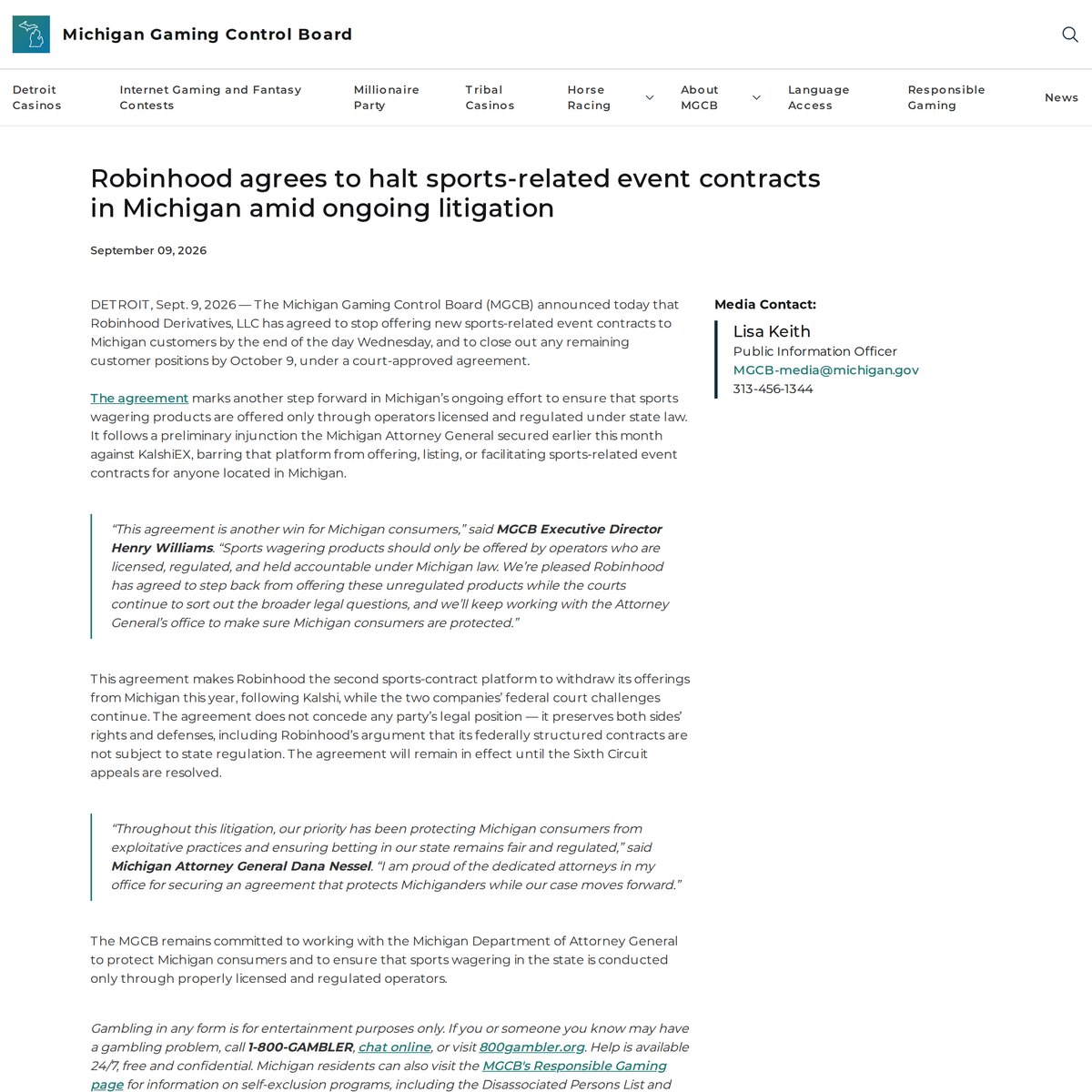
A week on, the trading app agreed to withdraw. No new sports event contracts for anyone in the state from the end of 10 September, every open position squared away by 9 October.[2]
Read what the agreement does not do. It concedes nothing. Both sides keep their legal positions intact, and the arrangement lapses once the Sixth Circuit has ruled.[2] Robinhood still thinks it is right. It has simply decided that being right in Michigan is not worth what it would cost to prove.
Work the numbers from the firm's side. Michigan is a real online betting market but it is one of fifty. Set against it: an exposure of the size Kalshi is now carrying, plus a blemish on the compliance record that every future licence application in every other state will have to explain.
Withdrawing is cheap. Losing is not. The company is the second to reach that conclusion here this year.[2]
The regulator's position, in one line
Henry Williams, who runs the Gaming Control Board, put it as a question of accountability rather than of product: these things should come only from operators that are "licensed, regulated, and held accountable" in Michigan.[2]
Which sidesteps the classification question entirely, and does so deliberately. The board does not need to win the argument about what a sports event contract is. It only needs the platforms gone while somebody else settles it.
Nobody anywhere has decided what these are
Michigan is not an American curiosity. Look at what has happened elsewhere this year and the same product keeps arriving at a different desk.
Seoul treated it as gambling and had Polymarket cut off. Berlin read its own statute and concluded that no licence could cover these bets. And when the four German-speaking regulators compared notes in Bern, prediction markets surfaced in both write-ups as the thing they could not categorise.
A block, a refusal, an open question, an injunction. Four answers, and the only reason they differ is that each regulator had a different rulebook within reach.
What to watch
The Sixth Circuit, because both Michigan arrangements are written to expire when it rules.[2] Whatever it says about federal preemption decides whether states get to treat these contracts as bets at all.
9 October, the deadline for closing out Robinhood's remaining Michigan positions.[2]
And the count. Two platforms have left this state inside a year. Three would stop looking like litigation strategy and start looking like an exit.
Sources
- Michigan Department of Attorney General — AG Nessel Secures Second Order Halting Unlawful Kalshi Sports Wagers in Michigan (2 September 2026, English). That a preliminary injunction against KalshiEx, LLC was granted in Ingham County Circuit Court following remand from the United States District Court for the Western District of Michigan; that the order requires Kalshi to maintain geofencing blocking Michigan residents from its sports betting contracts, with violations carrying a penalty of $500,000 per day; that a temporary restraining order was secured in June 2026; that the lawsuit was filed in March 2026 and alleges a breach of Michigan's Lawful Sports Betting Act by offering unlicensed sports betting without Michigan Gaming Control Board approval; and the quoted remarks of Attorney General Dana Nessel describing Kalshi's practices as predatory and unlicensed.
- Michigan Gaming Control Board — Robinhood agrees to halt sports-related event contracts in Michigan amid ongoing litigation (9 September 2026, English). That Robinhood Derivatives, LLC agreed to stop offering new sports-related event contracts in Michigan by the end of 10 September 2026 and to close remaining customer positions by 9 October 2026; that the agreement preserves both parties' legal positions and remains in effect until the Sixth Circuit appeals are resolved; that this is the second sports-contract platform to withdraw from Michigan this year; the reference to the preliminary injunction against KalshiEX; and the quoted remarks of MGCB Executive Director Henry Williams.



