

In their own words
The Gambling Commission published this research on 20 August. The most useful thing in it is a list of things children said when asked what a VPN does.[1]
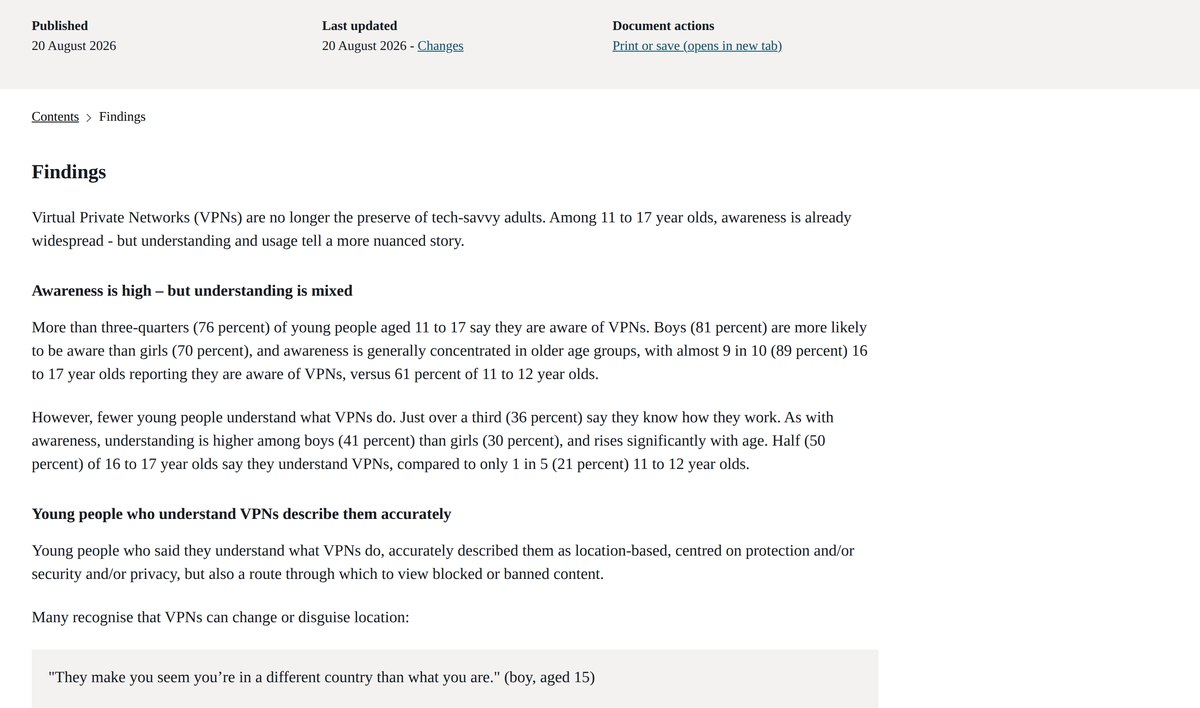
"They make you seem you're in a different country than what you are."[1]
"They let you pretend you're in a different country so you can watch TV from different countries."[1]
"You can get access to game releases not available in your location."[1]
"Overrides me not being able to access the internet on my phone in school."[1]
Others in the same list described hiding an IP address so they could not be traced, or a security tool that keeps hackers away from your data.[1] Television, video games, hackers, the school wifi. That last one is a child describing exactly what the Online Safety Act's age checks are up against, and doing it about a filter on a school network.
Heard of one, could not explain it
Three in four children have heard of a VPN — 76 percent. Only 36 percent say they know how one works.[1]
Boys are ahead on both: 81 percent have heard of one against 70 percent of girls, and 41 percent understand one against 30 percent.[1] Age counts for more. Among 16 and 17 year olds, 89 percent have heard of a VPN and 50 percent say they understand it. Among 11 and 12 year olds it is 61 percent and 21 percent.[1]
One caution. The report gives no sample size for any of those smaller groups, so treat the gaps as a direction of travel rather than a measurement.[1]
They heard it from people, not from the internet
Among children who know what a VPN is, 42 percent first heard about one from friends, 37 percent from family and 36 percent from YouTube or TikTok videos.[1]
Add them up by type and 71 percent came from offline sources against 47 percent online.[1] A tool for hiding what you do online mostly travels by conversation.
Now the number to be careful with
You cannot ask a child "do you use a VPN to bet?" and trust the answer. Some will say yes to please you. Some will not have thought of it until you asked. So the researchers used a trick instead.[1]
They split the children into two groups. One group of 511 saw four statements and said how many of them their friends had done. The four were: spending money in a game without telling a parent, staying up late talking to friends, using someone else's login to watch a stream, and watching sport on an unofficial stream.[1]
The other group of 509 saw the same four plus a fifth, about using a VPN to reach betting sites. Nobody had to say which ones they meant. They just gave a total.[1]
The first group averaged 2.1. The second averaged 2.23. The gap is 0.13, and that gap is the 13 percent.[1]
So what does it measure?
What children think other children do. The question asks about friends and people their own age, not about themselves. The answer is a belief about other people.[1]
The Commission's own methodology page warns against reading it as a count of personal use.[1] The smaller numbers underneath say the same thing. It runs at 20 percent among children who know what a VPN is, 19 percent among 16 and 17 year olds, and 2 percent among 11 and 12 year olds.[1] The more a child knows about VPNs, the more they assume everyone else is using one.
What a VPN actually changes
Go back to the children's answers. "They make you seem you're in a different country than what you are." That is right, and it is the whole of it.[1] A VPN changes the country a website thinks you are in. It does not change who a licensed betting company has already checked you to be, and nothing in this report claims otherwise.[1]
Which is where the real weakness usually sits. Dutch television showed reporters walking into casinos on other people's identity documents while the national self-exclusion register worked exactly as designed. In Ontario, nine people under 19 held accounts and gambled before anyone noticed. The door is the problem more often than the map.
The Commission's reason for asking sits in its first paragraph. Age checks under the Online Safety Act have started to bite, and there are early signs of young people reaching for VPNs to get around them. Gambling is not one of the Act's priority areas.[1] Its conclusion goes no further than calling VPNs one route that can lead people to illegal gambling — adults included.[1]
What the study cannot tell you
Everything in it is self-reported. The report says its results may not represent all 11 to 17 year olds in Great Britain, and it describes no weighting.[1]
The finding with the clearest meaning is the simplest one. Three in four children have heard of a VPN. One in three could tell you what it does. The rest have only the word.
Sources
- Gambling Commission — What do young people really know about Virtual Private Networks (VPNs)? (20 August 2026). Research by Yonder; 1,020 children aged 11 to 17 surveyed online between 30 April and 5 May 2026 with parental and child consent; the verbatim participant descriptions of what a VPN does, quoted here from the findings page; 76 percent aware and 36 percent understanding, with 81 and 41 percent among boys, 70 and 30 among girls, 89 and 50 among 16 to 17 year olds and 61 and 21 among 11 to 12 year olds; sources of awareness at 42 percent friends, 37 percent family and 36 percent YouTube or TikTok, with 71 percent offline against 47 percent online; the list experiment with 511 in the control group and 509 in the treatment group, averages of 2.1 and 2.23, a difference of 0.13 and the resulting estimate of around 13 percent, rising to 20 percent among those aware of VPNs and 19 percent among 16 to 17 year olds against 2 percent among 11 to 12 year olds; the statement that the estimate measures perceptions rather than behaviour and must not be read as a direct estimate of personal use; that results may not be representative; that gambling is not a designated priority area under the Online Safety Act; and the conclusion that VPNs are one of the avenues that can expose people to illegal gambling. No sample size is published for any subgroup.



