
Why the deals are legal today
Advertising gambling that the law does not allow is a crime here. But a site Britain has not licensed stays within the law as long as nobody here can place a bet on it. A club can take its money without breaking the law, so long as the site turns British visitors away.[1]
The consultation says the block does not hold: a VPN, an app that makes a phone look as if it is abroad, gets round it.[1]
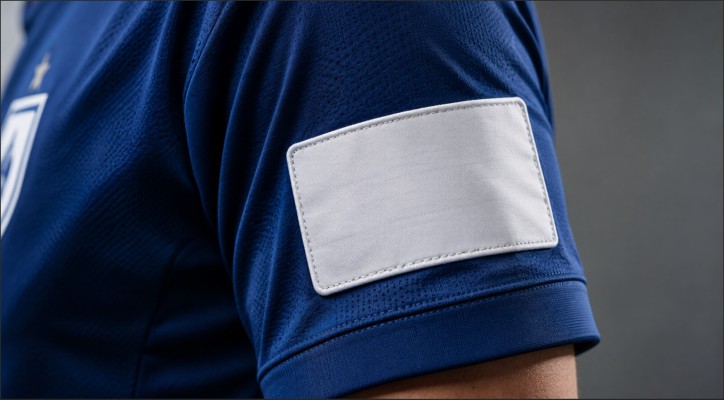
Clubs in England's top division had agreed among themselves to take gambling logos off the chest of the shirt after the 2025/26 season. Sleeves were never part of that deal. A badge there, the government says, still rides along with the country's most-watched league.[2]
How a licensed sponsor became an unlicensed one
Many of these brands used to sit under a licence belonging to somebody else. TGP Europe held one, and ran gambling sites that carried other companies' names, an arrangement the trade calls a white label. A number of those names appeared on shirts in England's top two divisions.[1][3]
In May 2025 the Gambling Commission, Britain's gambling regulator, set out what it would take for TGP to carry on: a £3.3 million penalty and a list of improvements. It had found the firm looking too lightly at the companies it did business with, and falling short on money laundering, the trick of passing criminal cash through a legitimate business. TGP handed back its licence and left instead, and the brands it covered were suddenly outside the British system.[3]
The regulator wrote to five clubs about the risk of carrying an unlicensed brand: AFC Bournemouth, Burnley, Fulham, Newcastle United and Wolverhampton Wanderers.[3]
What the proposal would outlaw
No business in Great Britain, in any trade, could take money to display a gambling brand that holds no licence here. In sport that runs from kit and equipment to pitchside boards, match programmes, fittings inside the ground, and the names of leagues, events and stadiums.[1]
Breaking it would be a criminal matter. The rules would be made under section 328 of the Gambling Act, which sets the maximum at 51 weeks in prison, six months in Scotland, a fine, or both. Each day a banned advert stays on show counts as another offence.[1][4]
England, Scotland and Wales would be covered. Northern Ireland writes its own gambling law.[1]
Internet advertising is left out. The consultation only asks whether to add it, now or in a later law.[1]
Two possible start dates
The government prefers a single date in August 2027, just before the 2027/28 season begins. Every such deal would have to be finished by then, whatever its contract says.[1]
The alternative bars new deals once the law arrives and lets existing ones run out, with a hard stop in August 2028.[1]
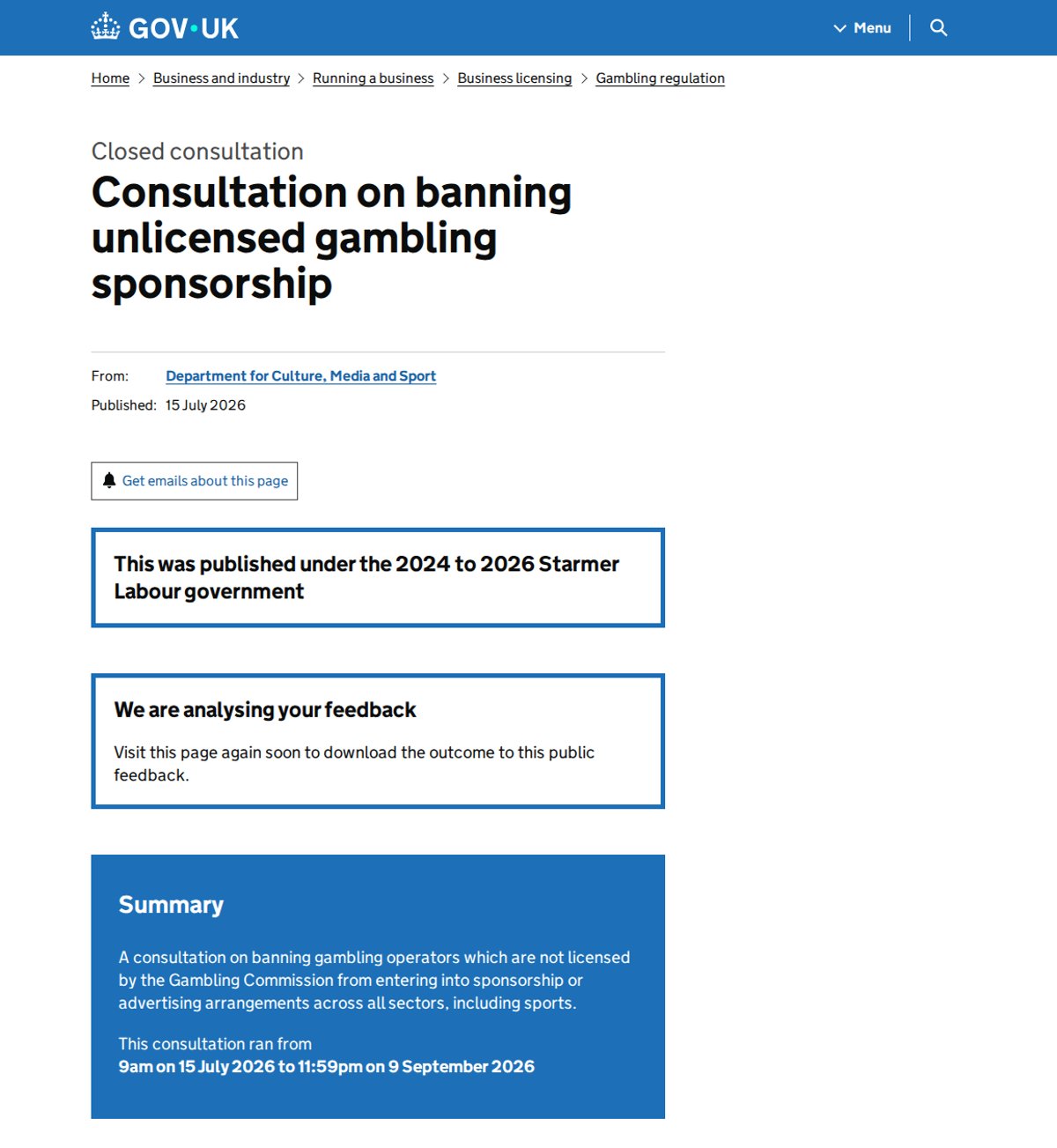
The consultation opened on 15 July. On 20 July Andy Burnham replaced Keir Starmer as prime minister. The government website now labels the page as published under Starmer's government.[1][8] It closed on 9 September. The page says the answers are being analysed. No decision has been published.[1]
Eleven clubs, by Entain's count
For 2025/26 the government put the share at about 40% of the clubs carrying a sponsor or advertiser with no British licence. Entain reads that as 8 of the 20.[1][5]
On 18 September Entain put the figure at 11. One brand, 8XBet, appears at five of them: Aston Villa, Chelsea, Coventry City, Ipswich Town and Newcastle United. Then come Crystal Palace (Chexx.bet), Everton (Stake.com), Fulham (SBOTOP), Nottingham Forest (FUN88) and Tottenham Hotspur (VSBet). The eleventh is Sunderland, newly signed with Shuffle, a firm based in Curaçao.[5]
Entain has a stake in this: it owns Ladbrokes and Coral, and argues the ban should begin now rather than in 2027.[5][6] “Inconvenience is not an excuse for inaction,” said its chief executive, Stella David.[5]
The part of the problem that is online
Entain wants online adverts covered too, and cites evidence from the consultation itself, researched by Frontier Economics for the Betting and Gaming Council.[1][5]
The same release points to a forecast that UK stakes with unlicensed operators will roughly double by 2028.[5] The regulator has declined to put any figure on that market, as we reported in August.
Anyone can check a brand on a shirt: the Gambling Commission's public register lists the licensed companies and the web addresses they use.[7]
Sources
- Department for Culture, Media and Sport (UK) — Consultation on banning unlicensed gambling sponsorship (15 July 2026, English), and its full text. The law, the ban, its timing and the evidence.
- Department for Culture, Media and Sport (UK) — Government to crack down on gambling operator sport sponsorship (23 February 2026, English). The front-of-shirt promise.
- Gambling Commission (Great Britain) — TGP Europe leaves GB market following Commission investigation (16 May 2025, English). TGP Europe's penalty and exit.
- legislation.gov.uk (United Kingdom) — Gambling Act 2005, section 328 (English). The maximum penalty.
- Entain — Entain calls for immediate closure of unlicensed gambling sponsorship loophole in UK sport (18 September 2026, English). The count of 11 clubs and the call for an immediate ban.
- Entain — About Entain (checked 22 September 2026, English). Its UK brands.
- Gambling Commission (Great Britain) — Public register (English). The licensed companies.
- GOV.UK — Prime Minister (checked 22 September 2026, English). The date of the change.



