
The regulator that will not give you a number
Through 2025 the Gambling Commission worked through illegal online gambling in four reports. Why consumers use it. How engagement is trending. What disruption work is under way. And, on 6 November, how large the market is.[1]
The fourth one arrives without a figure, on purpose. You can estimate roughly how many people touch illegal sites. Turning that into how much they spend needs a long chain of further assumptions. Each one widens the error around the last. The Commission concluded it had no "sufficient confidence that results will offer meaningful insight". Ben Haden, its Director of Research and Statistics, likened the problem to the government's estimates of the illegal tobacco tax gap, and wrote that the difficulty "is not an excuse. It is the reality of attempting to objectively measure an activity that is largely hidden."[2]
Two other findings from the series matter for what follows. Where the Commission has collected data, it reports no evidence of sustained growth in engagement with illegal websites. And it points out that money spent on illegal sites is not automatically money the licensed market has lost. Some of the people spending it are self-excluded, or otherwise barred from gambling legally at all.[1]
The number the industry gives instead
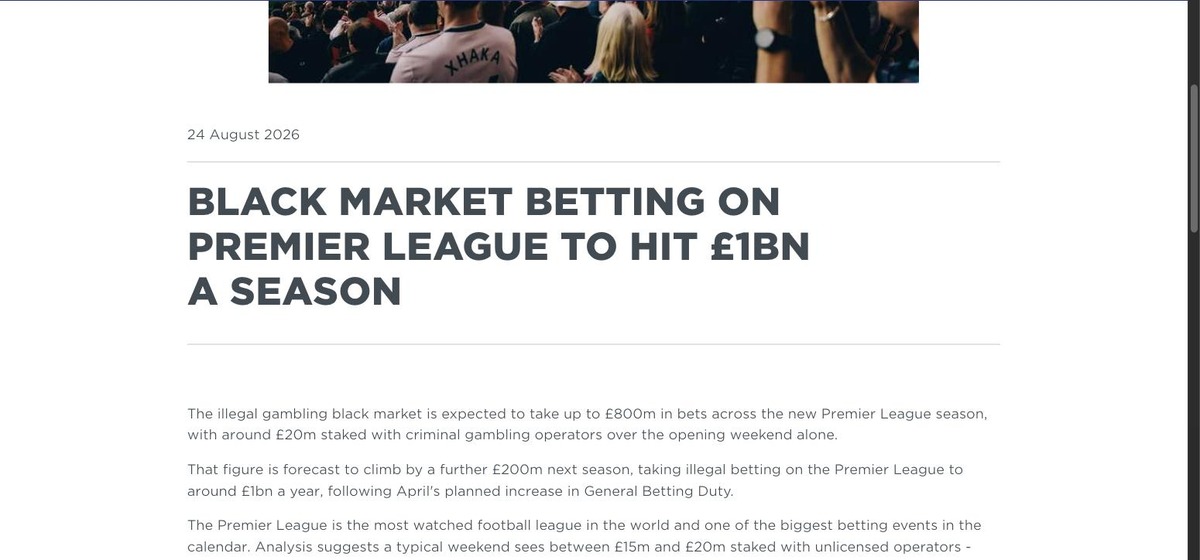
On 24 August the Betting and Gaming Council published a forecast. Unlicensed sites, it says, will take up to £800m in bets over this Premier League season — roughly £20m across the opening weekend, and £15m to £20m in a typical one. Add £200m more next season, once General Betting Duty goes up in April, and you reach the £1bn a year in the headline.[3]
Its chief executive, Grainne Hurst, described operators outside the licensed market as answering to no one. The money they take, she said, is lost to British sport and to the Treasury.[3]
The release also carries two larger figures, and flags neither as its own research. One is attributed to WARC: unregulated operators now account for close to half of UK gambling advertising spend. The other is attributed to H2 Gambling Capital: stakes with illegal operators here roughly doubling, from just under £17bn now to over £33bn in 2028.[3]
Where the £1bn actually comes from
So the trade body is not measuring the illegal market. It is assembling a forecast out of consultancy work — WARC counting advertising, H2 Gambling Capital modelling stakes — and applying it to one football season. The Commission has statutory access to what licensed operators actually do, looked at the same territory, and still would not publish a single figure.
None of which makes £1bn false. It makes it a forecast produced by an organisation whose members stand to gain if the government believes it. Read the release beside its own argument. The same document warns that April's duty rise will drive customers towards the black market. That is a case against taxing the people who paid for the release. Trade associations are supposed to argue their members' corner. The figure simply needs to travel with the name of whoever produced it.
One claim in the release is not a forecast at all. Betting brands have come off the front of Premier League shirts this season, and the government intends to bar clubs from taking sponsorship money from operators that hold no UK licence.[3] Those things either happened or they did not.
What it means if you bet in Britain
You cannot settle the size of the illegal market from this. Neither can anyone else — that is the regulator's own conclusion after a year of trying. What both parties accept is narrower and more useful. A site holds a British licence or it holds nothing. One holding nothing owes you no deposit limit, no self-exclusion, and no complaints process you can appeal.
Checking which one you are looking at takes about a minute. It does not require believing either side of this argument. Our gambling regulation map points at the regulator's own register for each country, where this question has an actual answer.
Sources
- Gambling Commission — Commission concludes four-part series on illegal online gambling (6 November 2025). The four reports, the decision not to publish a single estimate, and the findings on growth and on displaced demand.
- Gambling Commission — Why is it so hard to measure the size of the illegal gambling market? (blog, 6 November 2025, by Ben Haden). The compounding-error argument and the comparison with illegal tobacco.
- Betting and Gaming Council — Black market betting on Premier League to hit £1bn a season (24 August 2026). The £800m and £1bn forecasts, the weekend figures, the WARC and H2 Gambling Capital attributions, the chief executive's remarks, and the shirt-sponsorship and licensing points.



