

Two permits behind one roulette table
A restaurant casino consists of card and roulette tables set up in a restaurant or a hotel. The tables belong to a company with a Swedish gambling licence, while the room belongs to the restaurant. Slot machines in Swedish pubs operate on the same footing.[1]
Swedish law ties one to the other. Gambling of this kind is allowed only at a venue with a licence to serve alcohol, which the municipality grants under the Alcohol Act. The rule sits in chapter 9, section 2 of the Gambling Act for restaurant casinos, and chapter 5, section 3 for the machines.[1]
What the regulator went looking for
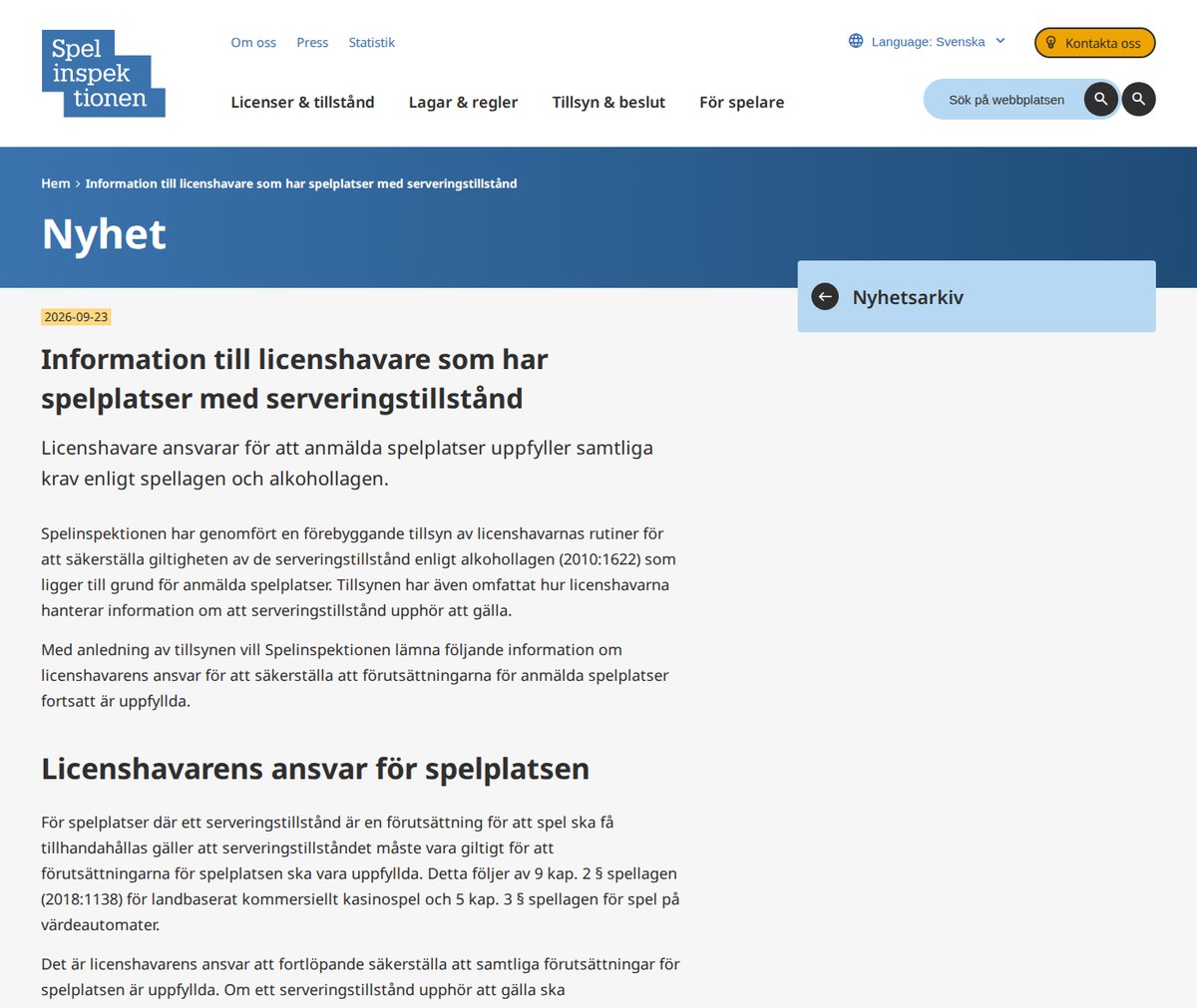
Spelinspektionen, the gambling regulator, ran what it calls a preventive check. It asked licence holders how they make sure the serving licences behind their registered venues are still valid, and what they do when they learn that one has ended.[1]
The regulator has not published findings against any specific company, but it has published a reminder of where the duty sits. That it needed writing down at all says something about the answers received.[1]
The rule, in the regulator's own words
The licence holder must keep checking that the conditions for each venue are still met. If a serving licence stops applying, the gambling must stop immediately. As soon as the company knows, it has to tell Spelinspektionen that the venue has closed, using the official form for ending a venue.[1]
A restaurant that loses its alcohol licence does not get to keep its tables for a while longer. The company that owns the tables is the one responsible for noticing.[1]
How small this corner of the market is
Land-based commercial gambling, mostly restaurant casinos, brought in 73 million kronor in the second quarter of 2026. All licensed operators in Sweden together took in 7,380 million kronor in the same three months.[2]
So the corner being tidied up here accounts for about one krona in a hundred. It is also where gambling sits closest to drinking. Consequently, the licence behind the bar dictates the licence behind the table.
What it means for a guest
If the tables are still open in a place that has lost its serving licence, the game is not a licensed one, regardless of who is dealing. Sweden's licence register lists every company allowed to offer gambling and, for venue-based licences, the specific places registered.[3]
Restaurant casinos also carry ordinary Swedish protections: the operator must hold a licence, and Spelpaus, the national self-exclusion register, applies to them just as it does to websites.
Sources
- Spelinspektionen (Sweden) — Information till licenshavare som har spelplatser med serveringstillstånd (23 September 2026, Swedish). The check, the licence holder's duty, the two sections of the Gambling Act, and what to do when a serving licence ends.
- Spelinspektionen (Sweden) — Statistik (checked 29 September 2026, Swedish). Quarterly turnover by segment, including land-based commercial gambling and the total for licensed operators.
- Spelinspektionen (Sweden) — Licensregister (checked 29 September 2026, Swedish). The licensed companies and their registered venues.



