

Why the regulator wrote it down
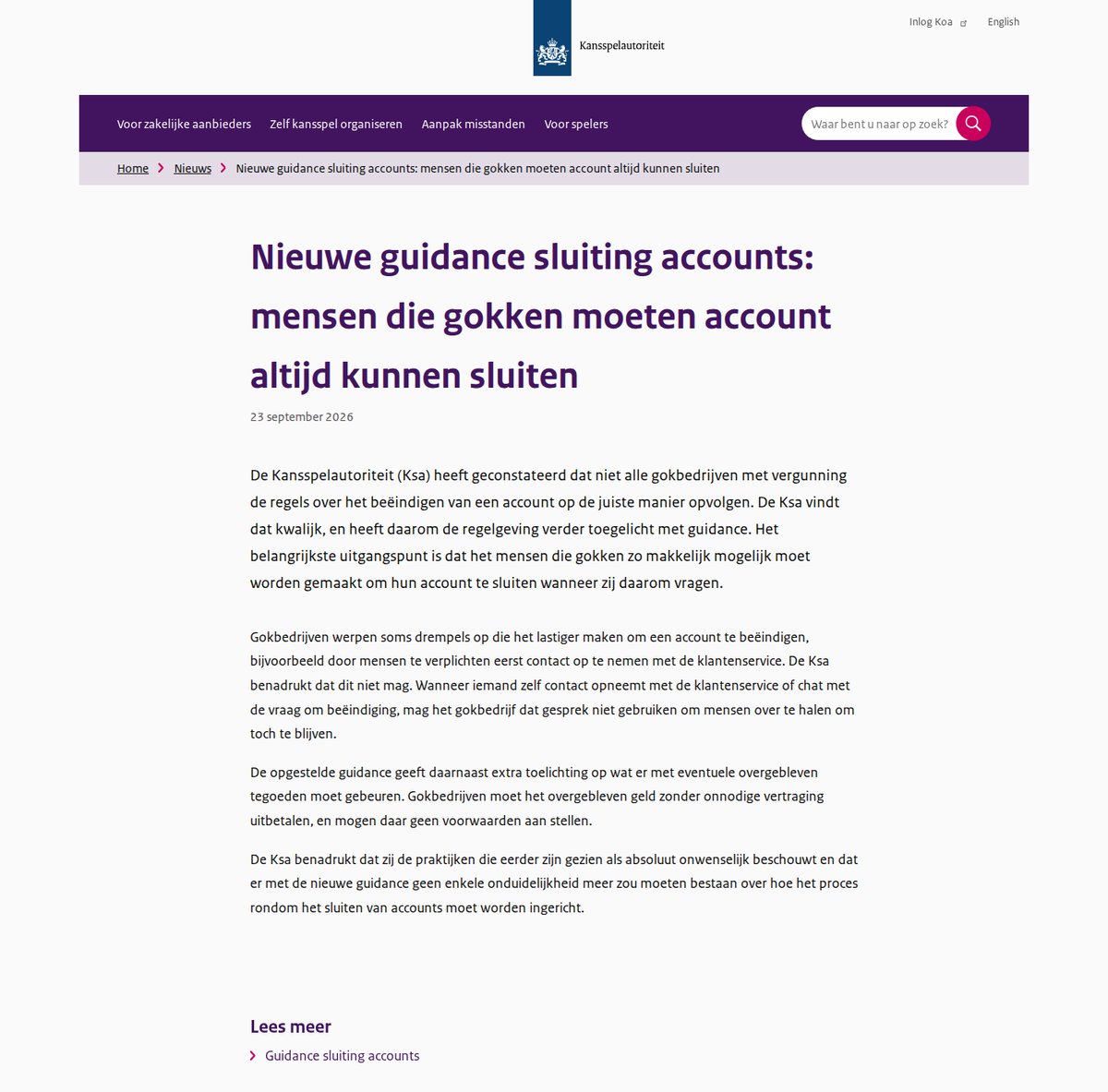
The Kansspelautoriteit (KSA), the Dutch gambling regulator, states that not all licence holders apply the rules on ending registrations consistently. This conclusion is based on operator inquiries, player reports, and the KSA's own supervision.[1][2]
The regulator also found that account closure information on company websites is not always correct, complete, or easy to find.[2]
The guidance introduces no new rules. Instead, it clarifies how the regulator interprets existing regulations, noting that these interpretations will guide future supervision.[2]
Closing means closing
Under Dutch law, a licence holder must end a player's registration immediately upon request. A player can ask to close their account at any moment, and a company may not keep someone registered against their will, regardless of any prior agreement.[2]
Once closed, the player can no longer log in or play with that operator. The decision is final — it is not a pause or a temporary deactivation of the account.[2]
A play pause is not the same thing
Taking a break, self-excluding, or registering with Cruks, the national exclusion register, are tools designed to control gambling behaviour. Closing an account, however, means terminating a contract. The regulator treats these actions as distinct concepts with different purposes.[2]
Therefore, a player who wants to leave does not have to take a pause first, and a company may not offer a pause to avoid closing the account. Explaining the available options neutrally is permitted, provided it does not delay the closure request or attempt to dissuade the player.[2]
What a company may not do
The regulator lists several practices that obstruct a simple account closure:[2]
- forcing you to upload an identity document;
- requiring you to re-verify your bank account;
- demanding answers to questions about why you are leaving;
- making you speak to customer service;
- imposing a cooling-off period before the account is closed;
- offering bonuses or other incentives to change your mind.
Charging a fee for closing an account is also prohibited. If the company sends a confirmation email, the message must solely address the closure: no comeback bonuses, no offers to cancel the request, and no nudges to reconsider.[2]
A player who voluntarily calls customer service or opens a chat remains in the same position. The company may not place any obstacles in their way during the interaction.[2]
Money left in the account
Any remaining balance must be returned to the player's registered bank account without unnecessary delay. The company cannot impose conditions that hold up the payment, nor can it set a minimum withdrawal amount. The player is not required to request the funds separately.[2]
Only one exception applies: an existing suspicion of fraud. However, simply asking to close an account does not constitute grounds for such suspicion.[2]
What happens to your details
Closing an account does not instantly erase all personal data. Dutch rules require companies to retain player information for three years after the registration ends, destroying it afterward unless another legal obligation applies. Records kept for the tax authority or the regulatory control database may have different retention periods.[2]
However, this data retention duty is not an excuse to keep a closed account active or make it easy to reopen. If a person registers again within those three years, the company may use the retained data regarding their earlier play when processing the new registration.[2]
How long it should take
Closure requests must be handled without delay. If there is a valid reason for a delay, the account must be suspended as soon as the request is received, and the player must be informed. The closure request itself does not constitute a valid reason for delay.[2]
Sources
- Kansspelautoriteit (Netherlands) — Nieuwe guidance sluiting accounts: mensen die gokken moeten account altijd kunnen sluiten (23 September 2026, Dutch). That companies were not all following the rules, and the regulator's view of the practices it saw.
- Kansspelautoriteit (Netherlands) — Guidance sluiten accounts (PDF, Dutch). Everything else here: the right to close at any time, self-exclusion as a separate matter, the list of practices that do not fit, the ban on charging, payment of the balance, the three-year retention, and the handling of the request.



