
Gambling is legal in Georgia, and every part of it needs a permit. This article walks you through how that system works: the 2005 law that still runs the whole thing, and what each permit costs. You will see why a casino pays one price in Tbilisi and a much smaller one in Batumi. Online play has rules of its own. There is an age gap too: a Georgian has to be 25, while a foreign visitor only has to be 18. Then come the advertising ban and the operator tax, which doubled between 2022 and 2025. Last of all, what draws Turkish and Azerbaijani players to the Black Sea coast. Everything here is taken from Georgian legislation and from state websites.
Walk the seafront in Batumi and you pass casino after casino. In Tbilisi, slot halls sit on ordinary streets between the shops. Betting counters turn up in both cities without much looking, and nobody hides any of it.
Nearly every rule behind that scene comes from a single law passed in 2005. Below we take it apart: what opening a gambling business actually costs, who may sit down to play, and what Georgia's own figures really mean.
Everything starts in 2005
Its full name is a mouthful: the Law of Georgia on Organising Lotteries, Games of Chance and Other Prize Games. Deputies voted it through on 25 March 2005. Amendments have piled up ever since, yet nobody has replaced it. The text that applies as we write took force on 27 May 2026. [1]
Something did exist before it. Back in 1998 an order from the finance ministry covered licensing for lotteries and prize draws. Then a presidential decree, signed on the final day of 1999, went much further and dealt with casinos by name. It required at least three tables in play, one of them roulette. Cameras had to be running, with ten days of recordings kept. Staff had to be 18 or older. [2]
Both a Georgian version and an English version sit on the state legal portal. The English one for gambling was last refreshed in 2016. Age limits, player registers, online play: on all of those it now tells you something that is no longer true. Only the Georgian text carries legal weight. [1]
What the law counts as gambling
The law lists separate kinds of gambling business. Each kind has its own permit, its own price and its own rules. [1]
A samorine, written სამორინე in Georgian, is simply a casino. In the law it is a house where the owner takes bets on luck, across roulette wheels, card tables and dice. Machines do not belong here, and the wording keeps them out deliberately. [1]
Machines belong somewhere else, in a slot machine salon. One odd condition applies there: a passer-by on the street must not be able to look in and watch the play. A gambling club, or აზარტული კლუბი, is a card room in which players face each other and the venue merely provides the table. You cannot open one at all unless a casino or a salon is already yours. A totalisator handles wagers on the outcome of matches and events. After that come lotto, bingo, lotteries, and promotional draws, whose tickets cost the player nothing. [1]
One category matters more than any of these now. Its legal name is the systemic-electronic form, which covers any game run over the internet, down a telephone line, or on machines built for it. [1]
Lotteries follow a different route entirely. Nobody applies for an open permit here. Instead there is a tender, and whoever wins it gets a decade of exclusivity. [1]
Who says yes, and who gets turned down
One body handles all of this: the Revenue Service, which sits inside the finance ministry. It hands out permits, keeps an eye on the companies that have them, maintains the registers of people who may not play, and can take a permit back.
How long you get depends on the type. Promotional draws: one year. Casinos, salons, totalisators, lotto and bingo: five. A club runs out when its parent casino or salon does, and an online permit attached to a physical venue follows the same clock. [1]
Two conditions matter above the rest. What you buy is tied to a single named address, not to your company at large. And you cannot sell it or hand it to anyone. [1]
Some people are shut out completely. If a manager, a founder or a partner still carries a conviction that has not been spent, the application dies. Money crimes done on purpose count, and so does any grave offence committed knowingly. Tax arrears finish it off too. [1]
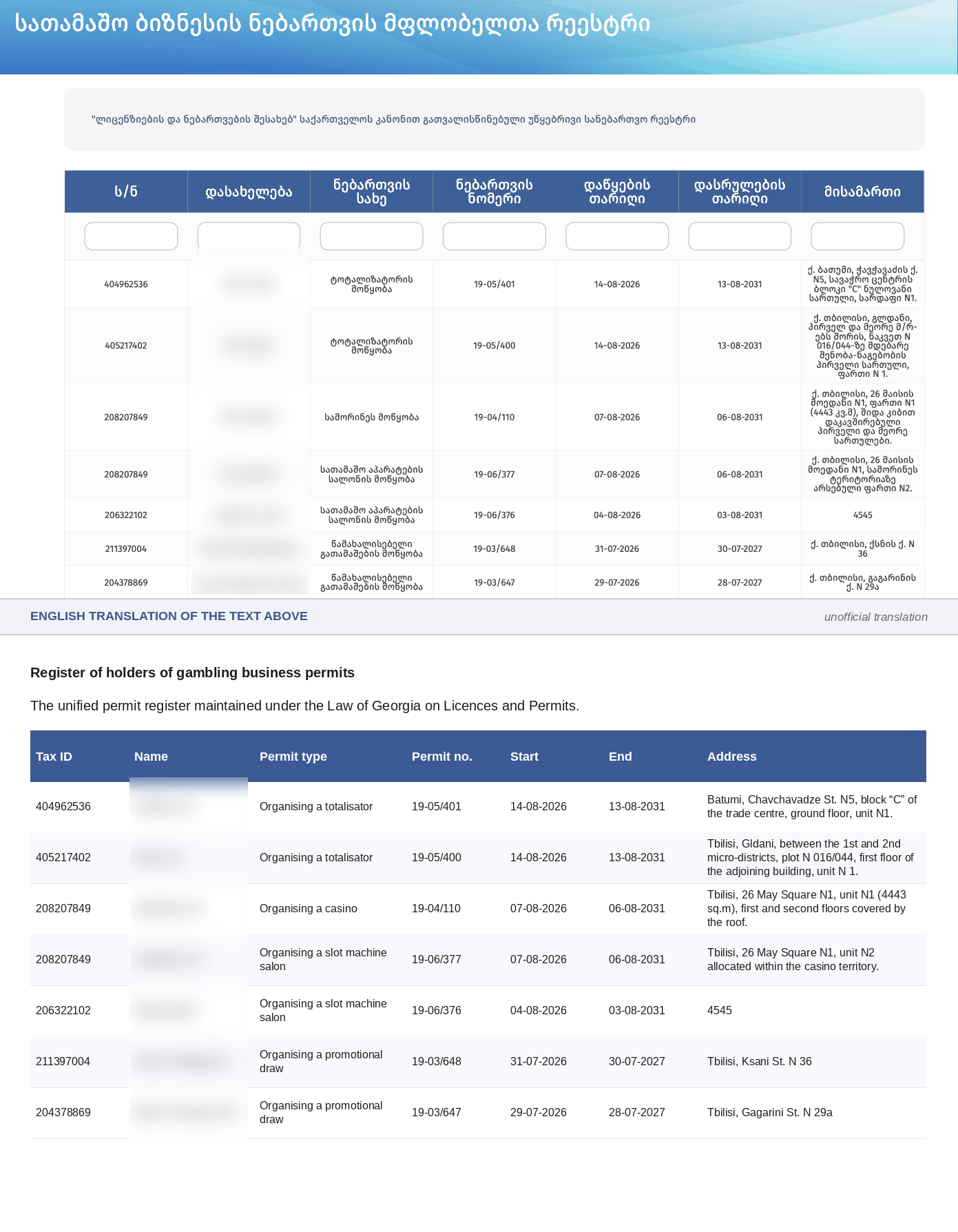
None of this is secret. An open register lists everyone who currently holds one, and anybody may search it. [19]
The price list, and why your town matters
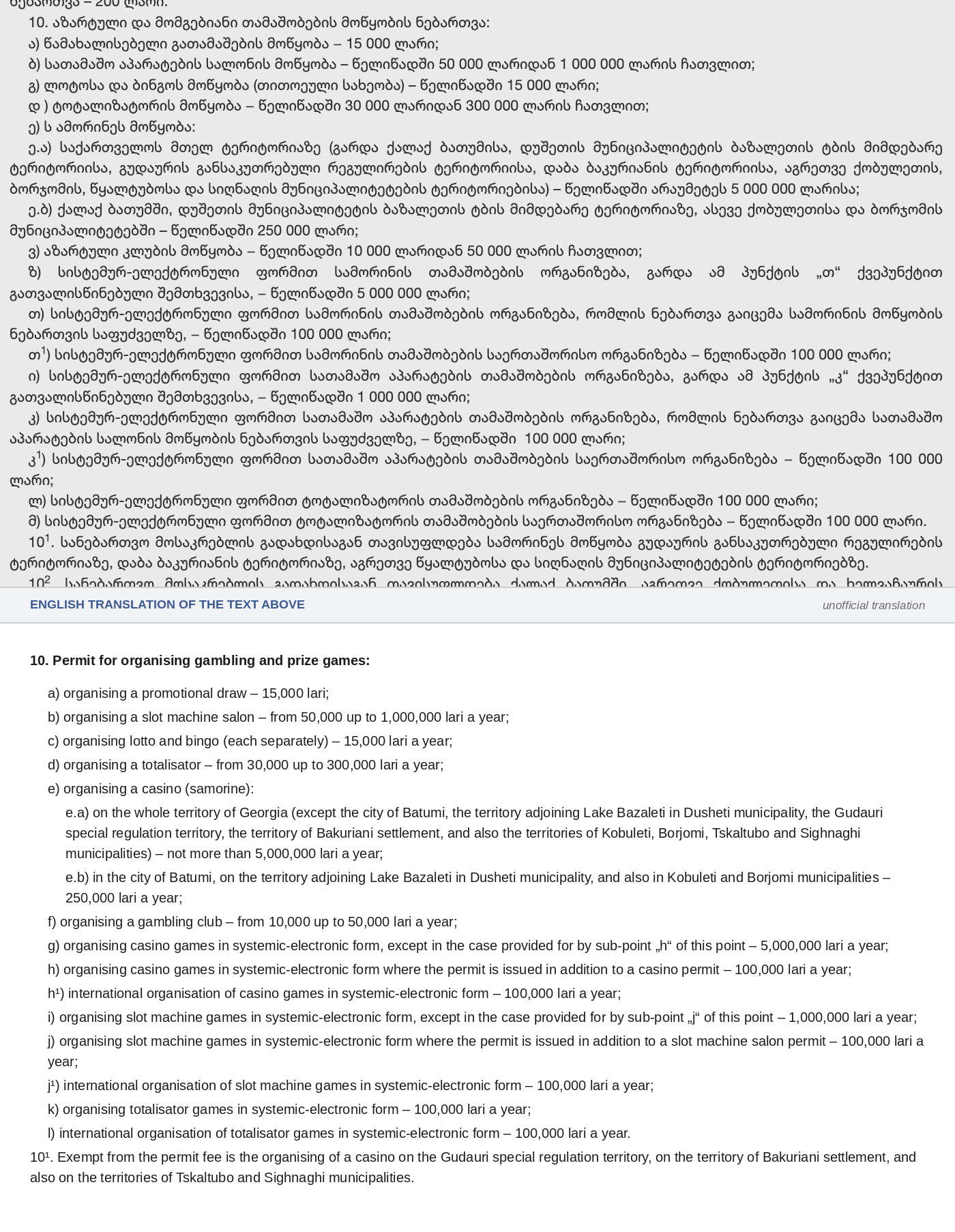
You will not find prices in the gambling law at all. They live in a different statute altogether, the one that sets what licences and permits cost, and that is where Georgia does something unusual. [3]
The figures below are in Georgian lari. We also give a rough figure in US dollars, worked out at 2.6249 lari to the dollar. That was the official rate of the National Bank of Georgia on 4 August 2026. [28]
A promotional draw permit costs 15,000 lari a year. Lotto and bingo cost 15,000 lari each. A slot machine salon costs between 50,000 and 1,000,000 lari. A totalisator costs between 30,000 and 300,000 lari. A gambling club costs between 10,000 and 50,000 lari. [3]
A casino is where it gets interesting. The law sets a ceiling of 5,000,000 lari a year, about 1.9 million US dollars. That ceiling is what applies in Tbilisi and everywhere else not named below, and the Government of Georgia sets the exact figure underneath it. But the same permit costs 250,000 lari a year, about 95,000 US dollars, in the city of Batumi, in Kobuleti, in Borjomi and by Lake Bazaleti. And in four places it costs nothing at all. A casino permit in the ski resort of Gudauri, in the settlement of Bakuriani, in Tskaltubo municipality or in Sighnaghi municipality is free. [3]
The pattern is easy to read. A permit is cheapest, or free, in the places Georgia wants tourists to go. The same law adds a ten year exemption from the fee for newly built hotels. A hotel needs at least 100 rooms in Batumi, Kobuleti or Khelvachauri, or at least 80 rooms in Anaklia or Ganmukhuri. The same article holds one more break. Hold a casino permit in Tbilisi and you may open three clubs anywhere in the country, club fee waived. [3]
Where a range appears instead of a single figure, the number inside it is chosen by the national government, not by the town. [3]
February 2023 brought online permits into the same fee list, with the prices starting on 1 June 2024. A standalone online casino permit costs 5,000,000 lari a year. Standalone online slot machines cost 1,000,000 lari. But if you already hold the land-based permit, the online version on top of it costs 100,000 lari. An online totalisator costs 100,000 lari. [4]
And then it happens again every quarter
Buying the permit is only the beginning. Four times a year a second charge arrives, counted on each table and each machine you own, and a separate statute governs it. [5]
This quarterly charge is a local one. Deputies in Tbilisi fix only the upper and lower limits. Each town's assembly then chooses its own figure between them, writes it into a decree, and keeps the proceeds for the town budget. Lotteries are the exception, and their money goes to the state instead. [6][5]
The ranges are wide. Every casino table costs between 20,000 and 40,000 lari a quarter. Every gaming machine costs between 2,000 and 4,000 lari. Every gambling club table costs between 4,000 and 14,000 lari. Put a cash desk outside the permitted venue and wire it into the central system, and that desk costs between 1,500 and 20,000 lari. Online casino games, online slot machines and online betting are charged separately, each between 250,000 and 300,000 lari a quarter. Promotional draws are billed at 10 percent of the prize fund. Lotteries pay 10 percent of what the tickets brought in, once the prize fund is deducted. Lotto and bingo pay nothing whatsoever. [5]
Marneuli, close to the Azerbaijani border, wrote its own numbers into a decree in August 2020. Its casino table was set at 35,000 lari a quarter, a machine at 2,100, a club table at 9,000, an outside cash desk at 10,000. For online games the town chose 250,000 lari, the very bottom of what Parliament allows. [7]
Put the two bills together and the numbers get heavy fast. Take a casino with twenty tables, priced at the top of both ranges. The permit costs up to 5,000,000 lari. The four quarterly bills add up to another 3,200,000 lari. That is before the business pays any tax at all.
When the casino is on your phone
A phone screen changes none of this. To run games electronically a company must already own a casino or a salon. Failing that, it buys one of the standalone online permits priced above. [1][3]
The rules that shaped today's market came in one law passed on 25 June 2020. It was brought in by stages over the following fourteen months, finishing on 1 September 2021. [8]
Today one permit covers exactly one website on one domain, and nothing more, so an operator can no longer spread itself across a whole family of brands. Play machines are banned from the offices of an electronic gambling firm, which stopped the habit of running a web casino out of a back room lined with terminals. Winnings may be sent only to an account carrying the player's own name, which shuts the door on cash moving under a borrowed identity. Accounts opened before all this had to be signed up again, properly identified. The bill was published with an explanatory note attached, so you can read in the drafters' own words what they thought they were repairing. [9]
The identification itself is governed by a finance ministry order that has applied since 1 March 2021. Opening an account means handing over your name, your date of birth, your personal number, an identity document with a photograph on it, a phone number and an email address. Registration will not finish until you type in a one-time code sent by text. After that the operator must confirm you are really you, and it may choose how. A photo of you holding the document will do. So will a video call, a face-to-face check, or software that matches your face against a state database. Your name is run against the sanctions list, and the Revenue Service can see inside the operator's player system. [10]
Who is not allowed to play
Georgia has two age limits rather than one. A citizen of Georgia has to be 25 to enter a gambling venue or take part in a game. A foreign national, or a person with no citizenship, has to be 18. Promotional draws are the one thing left out of this rule. [11]
So a 22 year old from Turkey can walk into a Batumi casino. A 22 year old from Batumi cannot. Parliament passed this on 22 December 2021, and it took effect on 1 March 2022. [11]
The same law created two lists, both kept by the Revenue Service, and both of them apply only to Georgian citizens. [11]
The first is the list of dependent persons. You can put yourself on it by your own application, or a judge can put you on it. Once you are listed you stay listed for five years. You can only come off it early if you lose Georgian citizenship, or if a judge orders it, and no judge can order it until three years have passed. [11] Georgian citizens sign up for this online through the Revenue Service, with biometric identity checks. [13]
The second is the list of prohibited persons, and nobody chooses to be on it. A government resolution from February 2022 sets out who goes on automatically. Everyone employed by a budget organisation, which takes in public officials and political office holders. Everyone working for the national communications regulator or the energy and water regulator. Everyone working for the National Bank of Georgia. And every member of a household registered in the state database of socially vulnerable families. [12]
The Revenue Service builds that list from the employee registry, from social service records, from Treasury lists of budget organisations, and from school and preschool lists. The operator checking you at the door is told one thing only: barred, or not barred. It never sees why. [12]
A further law from February 2023 makes operators show the age rules and the register notice in Georgian on their gambling website, so nobody can say they were not told. [14]
Why you barely see any adverts
You can travel the whole country and barely notice a gambling advert, because they are outlawed. Under the Law on Advertising nobody may promote betting, lotto, bingo, chance games or the firms that run them, in any shape, through any channel, online included. [15]
Four exceptions follow, and only four. [15]
A company may promote itself on its own licensed gambling website. It may appear at a sports ground or on a sports club in return for sponsorship money. Even then it must be a picture only, and only on the banners ringing the inner perimeter or across the players' shirts. It may hang a single visual advert on its own gambling building, which must stay within ten square metres. Finally, it may advertise inside an international airport and at border and customs crossing points. [15]
So the one place a Georgian gambling company may advertise to a crowd is where people arrive from abroad.
The tax that doubled in three years
The tax on gambling operators went from 10 percent to 20 percent in three years, and the changes came fast.
The baseline was set at the end of 2021 and applied from 1 January 2022. Online gambling operators paid 10 percent. Land-based slot salons paid nothing on their gaming income. Two percent was withheld from any amount a player took out of a gaming account. Dividends paid out by gambling companies were taxed at 5 percent. [16]
On 1 June 2024 the operator rate went from 10 percent to 15 percent, and the withholding on player withdrawals went from 2 percent to 5 percent. Land-based slot salons lost their exemption and were brought in at 15 percent of what they keep after paying prizes. The explanatory note Parliament published with that bill expected an extra 400 million lari in 2024, about 152 million US dollars. Of that, 250 million was to come from electronic operators and 150 million from slot salons. [17]
On 1 January 2025 the rate went up again, from 15 percent to 20 percent. The note published with that bill expected another 115 million lari a year. At the same time the tax on dividends paid out of gambling profits was cut to zero for profits earned from 2025 onwards. [18]
So in three years the headline rate doubled, while the tax on paying the profits out to shareholders went the other way and disappeared.
Batumi, and the visitors from Turkey and Azerbaijan
Turkey shut its casinos on 11 February 1998. At the time it was a business worth about 1,000 million US dollars, employing around 20,000 people. Turkey today allows the state lottery and state-run sports betting, and treats every other form as criminal: players are fined, operators go to prison. [26]
Batumi lies on the Black Sea coast, a short drive from that border. Georgia's own fee table says the rest: 250,000 lari a year for a casino permit in Batumi, against as much as 5,000,000 in Tbilisi. [3]
The visitor numbers show what arrived. Georgia's statistics office counted 6.9 million visits by foreign visitors in 2025, up 6.2 percent on the year before, and 15,000 million lari of spending, about 5,700 million US dollars. Russia sent the most people, with 1.6 million visits. Turkey came second with 1.2 million, which is 16.9 percent of everyone who came. Adjara, the region Batumi is the capital of, was visited 2.7 million times. That is 25.7 percent of all the visits recorded across Georgia's regions, second only to Tbilisi. [24]
The tourism administration's own figures fill in the shape of those trips. In 2023 Turkey sent 1,396,660 visitors, up nearly 51 percent in a year, and Azerbaijan sent 199,835, up nearly 31 percent. Batumi featured in 44 percent of international trips that year, behind Tbilisi's 50 percent. [25]
The administration's 2024 survey of international visitors adds the detail that matters. Turkish visitors stay an average of 2.3 nights, the shortest stay of any major market, and 75.8 percent of them have been to Georgia before. Azerbaijani visitors return even more often, at 92.3 percent. [25]
These are short trips, repeated often, by people from two countries where the games are not available at home.
The trend is not steady, though. In the second quarter of 2026 traveller trips to Georgia were down 4.9 percent against the same quarter a year earlier. [24]
Where the numbers come from
Georgia's statistics office reports business figures by sector. Gambling sits inside the section it calls arts, entertainment and recreation. In 2025 that section reported turnover of 88,624.4 million lari. In the fourth quarter of 2025 alone it reported 25,101.0 million lari. That was more than wholesale and retail trade managed in the same quarter, at 23,020.3 million. On that measure the section that holds gambling was the largest part of Georgia's business sector by turnover that quarter. [20]
That is where the enormous figures you see quoted come from. Before you repeat them, read what the statistics office itself says about them.
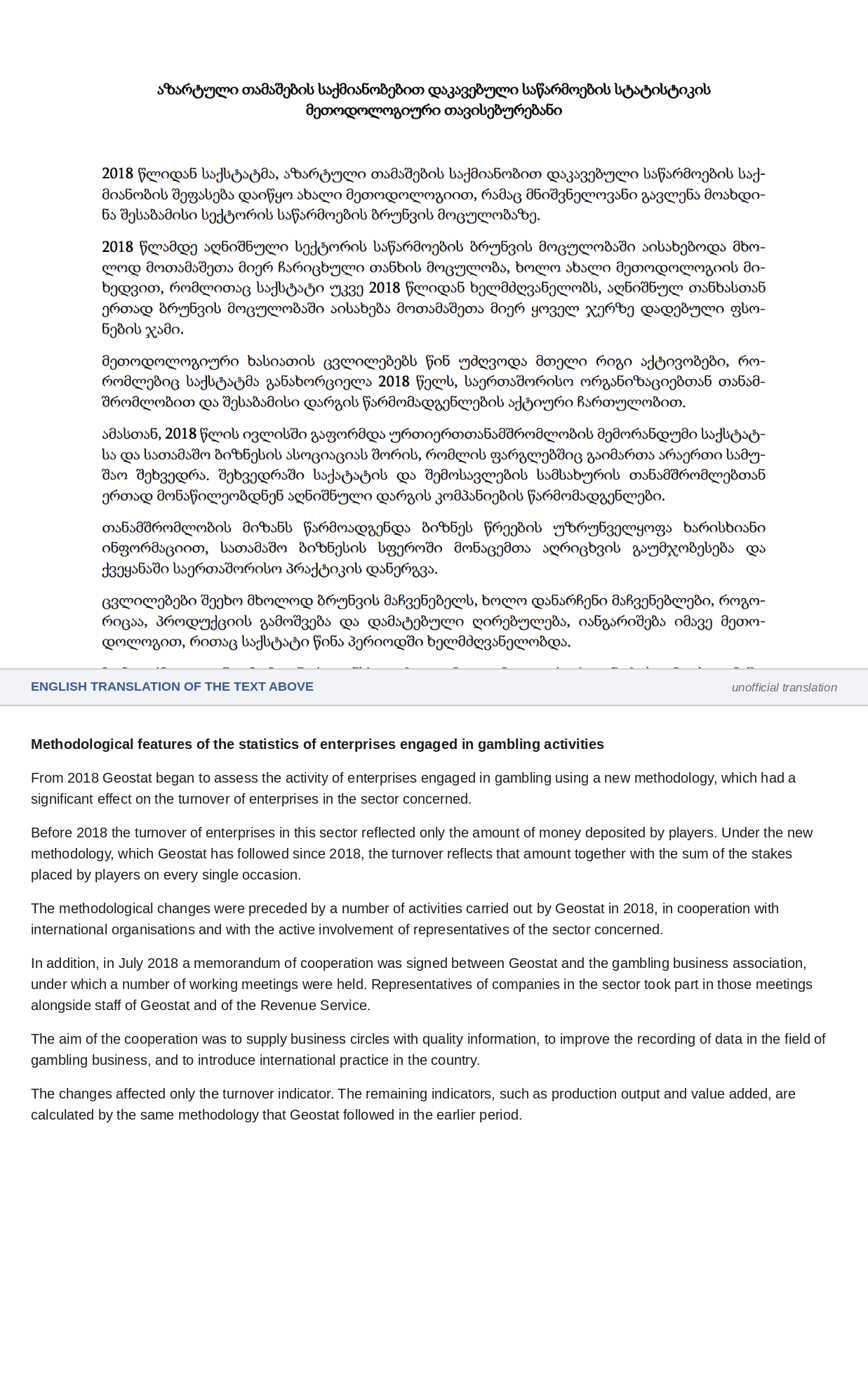
It publishes a separate methodology note on gambling statistics, which tells you what those turnover figures actually count. The note is unusually blunt. Since 2018, gambling turnover has been counted as the sum of every stake, every time it is placed. If a player wins and stakes the winnings again, that counts again. And again. So the turnover figure counts the same money many times over, as it is staked, won and staked again. The note adds that figures from 2018 onward cannot be compared with earlier years, and that going back to recalculate them is impossible. Then comes the line that really matters. If you want the size of the sector, use production output, which is what remains after winnings are handed back. [21]
Measured the way its own statisticians advise, then. Production value for 2025 reached 4,090.4 million lari, near enough 1,560 million US dollars, or about one twenty-second of that turnover headline. At the close of 2025 the sector had 21,553 people on its books, roughly 2.6 percent of everyone employed in business. [20]
Neither figure is fake. They simply count different things, and only one answers what people believe they are asking. A further caution: this section carries the label arts, entertainment and recreation, so gambling is not all that sits inside it. [20]
One set of figures is neither churn nor guesswork, and it beats both. Municipalities publish what the quarterly gambling fee actually paid them. Tbilisi's city assembly reported 52.8 million lari collected in 2024, about 20 million US dollars, which was 75.4 percent of what the city had budgeted for, and of that sum 24.5 million came from gaming machines, 4.0 million from promotional draws and 2.1 million from online gaming. The same assembly's earlier report shows 36.7 million lari in 2021, and only 4.5 million in 2020, when the borders were shut. [22] Batumi's budget shows the same shape at a smaller scale: 1.7 million lari in 2020, then 15.9 million in 2021. [23]
Those sums landed in a municipal bank account and somebody signed for them. They sit far below the headline turnover, and they are the only figures here you can hold up against an audited document.
One last thing, on the sources people usually reach for. The English-language encyclopedia entry on gambling in Georgia is a short stub, and most of its numbers come from a single report published by a non-government organisation in 2014. Its claims that gambling has been legal since 1990, and that gaming venues existed in 1921, appear nowhere in the state legal database, whose gambling records begin in 1998. We could not confirm either claim, so neither appears above. [27] The same goes for the English text of the gambling law on the state portal, quoted widely and untouched since 2016. [1]
What this means for you
In Georgia, gambling is permitted, priced and written down. The state says how much a casino permit costs in each town, which of its own citizens may not play, where an advert may hang, and how big that advert is allowed to be.
What that gives you as a player is a real check you can make. Look up whether the site or the venue holds a Georgian permit before you put money anywhere. Other countries answer the same questions very differently. We went through how gambling became legal in Ukraine and why Mexico's casinos run on permits under a ban.
Sources
- Legislative Herald of Georgia — Law on Organising Lotteries, Games of Chance and Other Prize Games (law №1180 of 25 March 2005, consolidated text in force from 27 May 2026). The founding law: the types of gambling, the permits, their length, and who may hold one. The state's English translation of the same law is frozen at the 2016 text and is out of date.
- Legislative Herald of Georgia — Presidential Decree №704 of 31 December 1999 on organising and licensing lotteries, casinos, gambling and other prize games. The pre-2005 rules, including the three tables, the roulette table, the cameras and the ten day recording. It ran alongside a Ministry of Finance order №62 of 10 March 1998 on licensing lotteries and prize games, which lost force in 2003.
- Legislative Herald of Georgia — Law on Licence and Permit Fees (law №2937 of 12 August 2003). Article 7 carries every annual permit price, the zero fee resort zones, the 250,000 lari towns, the 5,000,000 lari ceiling, the hotel exemption and the three free clubs for Tbilisi casino holders. The current consolidated text is also published as a PDF. An English translation of this law is published separately and lags behind the Georgian text.
- Legislative Herald of Georgia — Law №2586 of 9 February 2023. Added the online permit fees to the fee law, in force from 1 June 2024.
- Legislative Herald of Georgia — Law on Gambling Business Fee (law №4250 of 29 December 2006). The quarterly fee: the ranges for tables, machines, club tables, cash desks and online games, and the rule sending the money to the municipal budget.
- Legislative Herald of Georgia — Law on Local Fees (law №1401 of 29 May 1998). Makes the gambling business fee a local fee and lets each municipal assembly set and differentiate the amount.
- Legislative Herald of Georgia — Marneuli municipal assembly decree №19 of 7 August 2020. A real municipality picking its own numbers inside the statutory ranges.
- Legislative Herald of Georgia — Law №6487 of 25 June 2020. The online framework: one website per domain per permit, no play computers on the premises, payouts only to the player's own bank account, and re-registration of existing accounts.
- Parliament of Georgia — explanatory note to the 2020 online gambling bill. What the drafters said the law was meant to fix.
- Legislative Herald of Georgia — Minister of Finance Order №43 of 26 February 2021. Player registration, identification and verification: the data collected, the one-time code, the photographic document, the accepted verification methods and the sanctions check.
- Legislative Herald of Georgia — Law №1185 of 22 December 2021. Sets the age at 25 for Georgian citizens and 18 for foreign nationals from 1 March 2022, and creates the register of dependent persons and the register of prohibited persons.
- Legislative Herald of Georgia — Government Resolution №86 of 23 February 2022. Who goes on the list of prohibited persons automatically, how the Revenue Service assembles it, and the rule that operators are told only whether a person is barred.
- Revenue Service of Georgia — self-exclusion registration. The page where a Georgian citizen adds themselves to the list of dependent persons.
- Legislative Herald of Georgia — Law №2584 of 9 February 2023. Requires operators to publish the age rules and the register notice in Georgian on their gambling website.
- Legislative Herald of Georgia — Law on Advertising. Article 8³ bans gambling advertising in any form and lists the four exceptions, including the ten square metre limit on a sign at the venue.
- Legislative Herald of Georgia — Law №1191 of 22 December 2021. The 2022 tax baseline for gambling operators, player withdrawals and dividends.
- Parliament of Georgia — explanatory note to the 2023 tax bill. The increase that took effect on 1 June 2024, with the government's own expectation of 400 million lari in extra revenue.
- Parliament of Georgia — explanatory note to the 2024 tax bill. The increase to 20 percent from 1 January 2025, expected to add 115 million lari a year, and the cut in the dividend tax.
- Revenue Service of Georgia — register of gambling permit holders. The official list of who currently holds a permit.
- Geostat — Activities of Enterprises, first quarter 2026 (PDF). Turnover, production value and employment by sector, including the quarter in which arts, entertainment and recreation passed wholesale and retail trade.
- Geostat — methodology note on gambling statistics (PDF). The statistics office explains that turnover counts every stake each time it is placed, that figures from 2018 are not comparable with earlier ones, and that production output should be used to judge the sector.
- Tbilisi City Assembly — 2024 budget execution report (PDF). Gambling fee receipts for 2024 broken down by machines, promotional draws, online gaming and lotteries. The earlier report gives the 2020 and 2021 figures.
- Legislative Herald of Georgia — Batumi city budget for 2022. Gambling fee receipts for 2020 and 2021 under revenue code 142213.
- Geostat — Inbound Tourism Statistics 2025 (PDF). Visitor numbers, spending, the share from each country and the share of regional visits going to Adjara. The second quarter 2026 release shows the recent decline.
- Georgian National Tourism Administration — Georgian Tourism in Figures 2023 (PDF). Visitor trips by country of origin and Batumi's share of international trips. Its international visitors survey for 2024 gives the average length of stay and the repeat visit rate by country.
- Wikipedia — Gambling in Turkey. The 1998 casino ban, the size of the business at the time, and what Turkey allows today.
- Wikipedia — Gambling in Georgia (country). The short public summary of the subject, whose 1921 and 1990 claims we could not match to any state source.
- National Bank of Georgia — official exchange rates. The lari to US dollar rate used for every conversion in this article.



