

Casinos have been against the law in Mexico since 1947. Even so, the country is full of gaming halls and betting shops. This article shows you how that happens. We look at the old law, the 2004 rules that let the halls open, the office that hands out the permits, how many casinos there are, what the law says about playing online, where the figures you read elsewhere really come from, and what is changing now. Every fact here comes from Mexico's own laws and from official government pages.
People often ask if gambling is legal in Mexico. The answer has two halves. Casinos have been banned for more than seventy years, and that ban is still on the books. But you can still walk into a gaming hall in Monterrey or place a bet in Tijuana, because the government gives out permits that let those places open.
Below we go through how Mexico got here, who is in charge today, and what is about to change.
The old casino days in Tijuana
In the 1920s the United States banned alcohol. Money and film stars crossed the border into Mexico to drink and to play. The grandest place was the Casino de Agua Caliente in Tijuana. It opened in 1927 with a hotel, a racetrack and gaming rooms, and for a few years it was one of the most famous resorts on the continent. [20]
It did not last long. In 1935 President Lázaro Cárdenas banned games of chance in the whole country. Agua Caliente was closed, and the buildings later became a school. [20] That choice set the pattern for everything after it. Twelve years later the ban was written into a national law that is still in force today.
The 1947 law that is still in force
The law is called the Ley Federal de Juegos y Sorteos. It was published on 31 December 1947. Its very first line says that games of chance and games with betting are banned in the whole country. [1] That one line is the reason Mexico has no casino in the legal sense of the word.
The law does allow some things. Games of skill are allowed. So are sporting events and races, and lotteries and raffles. Betting is allowed only where the government says so, as it has long done for horse racing. [1] One office decides who may run any of this. It is the Secretaría de Gobernación, the interior ministry, and almost everyone calls it SEGOB. Nobody may open a betting hall or run a lottery without a permit from it. [1]
The 1947 law has barely changed since it was written. The record of changes kept by the Mexican Congress is very short. [12]
How gaming halls came back in 2004
For many years the 1947 ban kept big gaming out of Mexico. That changed in 2004. The government of President Vicente Fox did not touch the old law. Instead it wrote a new set of rules for how the law should be applied. These rules are called the Reglamento, and they were published on 17 September 2004. [2]
The Reglamento listed the kinds of places SEGOB could now give a permit to. Racetracks and jai alai courts were on the list (jai alai is a fast ball game played in a walled court, where players throw and catch a hard ball with a curved basket strapped to the arm). So were remote betting centres, which are the sports betting shops you see today. And so were number draw halls, which is the name used for rooms with bingo and slot style machines. [2] The word casino is not on that list at all. The places everyone calls casinos are, on paper, number draw halls and betting shops. [2][4] That is how modern gaming came back to Mexico without the 1947 ban ever being lifted. The name on the paper and the real business are not always the same thing.
Who gives out the permits
Inside SEGOB there is a unit called the Dirección General de Juegos y Sorteos. It decides who may run a gaming hall or a betting shop. It checks that they follow the rules, and it can take a permit away.
SEGOB sets clear conditions on the places that hold a permit. They must keep out anyone under 18. They must also keep out anyone who is drunk, armed or carrying drugs. Their adverts have to be clear and have to say that betting is not for minors. [4]
A permit belongs to the company that was given it. SEGOB says a permit cannot be sold, handed to someone else, rented out or used as security for a loan. [4] If a permit holder gives false information, or passes the permit on, SEGOB can cancel it. [4]
How many casinos there are, and where
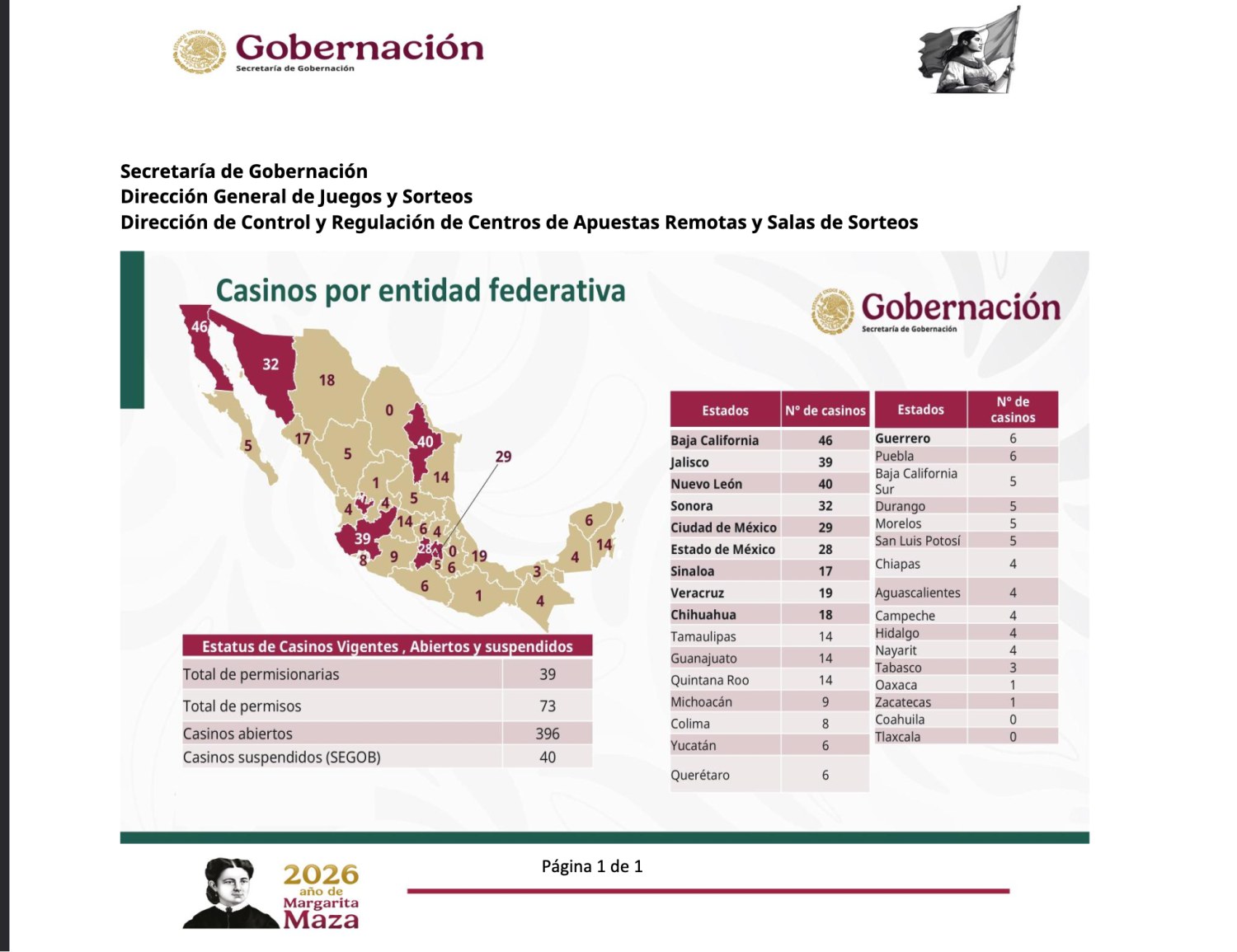
You do not have to guess at this. SEGOB counts the halls itself and puts the count on its own website. In the middle of 2026 the picture was this. Thirty nine companies held permits. Between them they held 73 permits. Under those permits 396 casinos were open, and another 40 had been shut down by SEGOB. [5]
One permit can cover many venues. That is why 73 permits are enough for almost four hundred halls. A few of the permit holders run dozens of places each.
The halls are not spread evenly across the country. Baja California has the most with 46. Then come Nuevo León with 40, Jalisco with 39, Sonora with 32, Mexico City with 29 and the State of México with 28. Two states, Coahuila and Tlaxcala, have none at all. [5]
SEGOB also names the companies. It publishes the full list of all 39 permit holders next to their permit numbers, on the same page as the count. [6]
Someone else checks these figures too. Mexico's federal audit office went through SEGOB's books for 2023. It found 51 permits held by 36 companies, and 34 of those companies were running 422 halls at the end of that year. The same audit records that SEGOB stopped approving new casinos in 2022. [8]
Playing online from Mexico
Mexico has no separate licence for online casinos or betting sites. There is only the one permit system. A company that already holds a SEGOB permit for a betting shop or a number draw hall may offer the same games online under that same permit. [2][4]
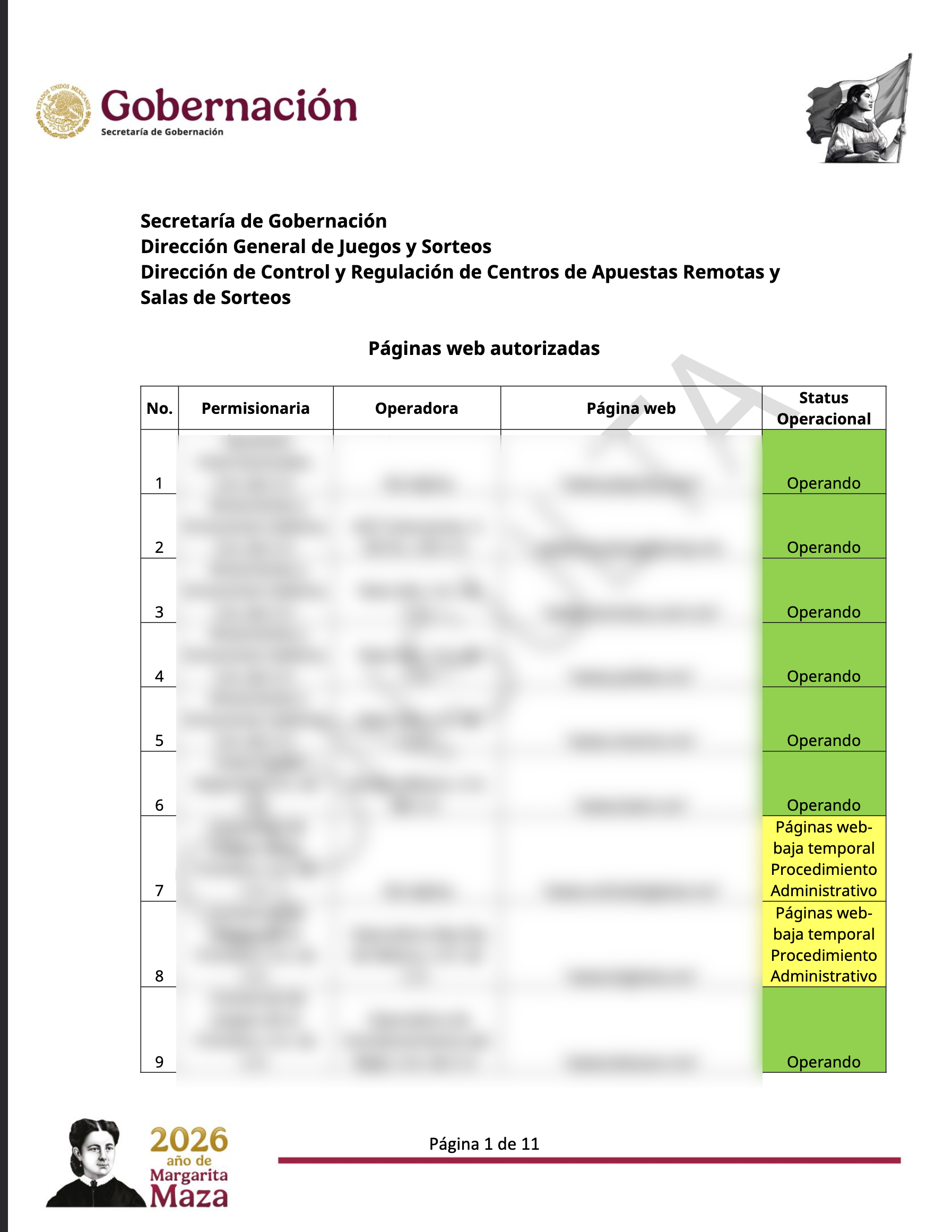
This is the part most people miss. SEGOB publishes the list of betting websites it has approved. In June 2026 that list held 136 web addresses, and 86 of them were marked as working. Every line shows the address, the company that holds the permit, and the company that runs the site. [7]
That list is the one thing worth checking before you put money anywhere. If a site takes players in Mexico and is not on it, then no Mexican permit stands behind it. Sites on the June 2026 list include Caliente, Codere, PlayCity, Winpot, Big Bola and Strendus, along with foreign names such as bet365, Betano, Betway and William Hill, which work through a Mexican permit holder. [7]
That still leaves a wide gap. Many other sites take players from Mexico while holding only a licence from another country, and they sit outside the Mexican permit system altogether. Mexican rules do not reach them. If something goes wrong with your money on one of those sites, SEGOB is not the office that can help you. [4]
The rules are written for the companies that run the games, not for the people who play. You have to be 18 to play. [4]
The 2023 decree on slot machines
In late 2023 the government moved to shrink the whole business. On 16 November 2023 President Andrés Manuel López Obrador published a decree that changed the 2004 rules. [3] It did three things. It said that slot machines and table style betting games can no longer be counted as draws, which took away the legal ground the machines stood on. It stopped SEGOB from giving out any new casino permits. And it limited the permits that already exist to fifteen years, with no renewal after that. [3]
This is a slow wind down and not a sudden closure. The halls that are open today keep working for now. But no new ones can open, and the machines that bring in most of their money are on the way out. [3]
How much money is in it
The figures below are in Mexican pesos. We also give a rough figure in US dollars, worked out at about 17.5 pesos to the dollar, which is the rate in the middle of 2026.
The national statistics office, INEGI, counts these businesses in its economic census. It files them under a heading it calls other games of chance, because Mexican law does not use the word casino. For the year 2023 it counted 462 of them. They employed 24,329 people and took in 21,447 million pesos, or about 1,200 million US dollars. [9]
The tax record tells the same story from the other side. Mexico's tax office collected 3,385 million pesos in betting tax in 2024, about 190 million US dollars. [10] The budget law for 2026, written after the tax rate went up, expects 5,025 million pesos, about 290 million US dollars. [11]
Where the numbers about Mexican casinos come from
Look up Mexican casinos anywhere else and you will find numbers that do not match the ones above. You will read that there are 425 halls. You will read that the business gives work to 50,000 people, or to 38,000, or to far more than that. We went looking for where those numbers start. What we found is worth showing you.
Mexico's Congress puts every bill online, and it prints the footnotes with them. So anyone can walk the trail back.
In December 2025 a bill went before the Chamber of Deputies. It said the sector has around 425 halls, 50,000 direct jobs and 120,000 indirect ones. Its own footnote points to a newspaper article. [13]
Two months earlier a different bill gave different figures. It said 38,000 direct jobs and 140,000 indirect ones. Its footnote points to an opinion column in a newspaper, written by a man named Miguel Ángel Ochoa Sánchez. [14] He is not from a statistics office. He heads AIEJA, the association of the companies that hold the casino permits, and SEGOB's own legislative service records him in that job. [16] So a figure about the industry came from the industry.
The government leans on the same kind of figure. In September 2025 the president's office sent its tax plan to Congress. That document says 60 percent of the betting websites serving Mexico do not follow Mexican rules. It credits the figure to AIEJA in the text, and gives no source for it at all. [15]
None of this means those numbers are invented. It means nobody counted them. They are estimates, made by people who have a reason to care how big the business looks, and they get repeated until they sound official.
Now put them next to the numbers that were counted. SEGOB counted 396 halls open. The federal audit office counted 422 at the end of 2023. INEGI counted 462 businesses with 24,329 people working in them. [5][8][9] The counted staff figure is about half of the smallest figure that gets repeated.
One more thing confuses people. You will see it said that there are more than 5,000 of these places, and that they take in 42,000 million pesos, about 2,400 million US dollars. [15] Those numbers are real, but they cover a wider group. Mexican statistics put casinos, lotteries and other games of chance in one basket, and most of that basket is people selling lottery tickets. The narrower figures we used above leave the lottery out. [9]
The same thing happens in other countries. So before you trust any number about gambling anywhere, ask one simple question. Did somebody count this, or did somebody guess it and everyone else copy the guess?
What is changing now
Two newer changes matter, and they are easy to mix up, so keep them apart.
The first one is about online play. On 16 October 2025 President Claudia Sheinbaum said her government is preparing a change to the 1947 law so that online betting can be regulated. Her point was that the aim is not to ban it but to regulate it properly. [19] By the middle of 2026 this was still being written, and Congress had not passed it. So treat it as a plan and not as a done deal.
The second change is already law. Mexico has a special tax on betting and raffles, and it is called the IEPS. It went up from 30 percent to 50 percent as part of the 2026 budget. The lower house of Congress approved it in October 2025. [17] The Senate backed it in November 2025. [18] For the first time the tax is written so that it also reaches foreign online sites with no office in Mexico, and part of the money is set aside to help people who have a gambling problem. [17][18]
What this means for you
Mexico is a good example of something we see in country after country. Asking whether a place is legal only gets you half the answer. The 1947 ban is still there. The 396 halls you can walk into run on permits that are now being wound down. And most of the sites that take your money online answer to a regulator on the other side of the world. The ground can move under your feet.
If you play, the advice is the same as always. Check the licence behind the brand before you put money in. And if you want to see how the same story of a ban, then a licence, then a reform played out somewhere else, we went through how gambling became legal in Ukraine.
Sources
- Cámara de Diputados — Ley Federal de Juegos y Sorteos (published in the DOF, 31 December 1947). The founding law: the ban on games of chance and betting, the activities that are allowed, and SEGOB's role.
- Cámara de Diputados — Reglamento de la Ley Federal de Juegos y Sorteos (DOF, 17 September 2004; last reform 16 November 2023). The 2004 permit rules and the types of venue they cover.
- Diario Oficial de la Federación — Decree changing the Reglamento de la Ley Federal de Juegos y Sorteos (16 November 2023). The rule on slot machines, the stop on new permits, and the fifteen year limit.
- SEGOB, Dirección General de Juegos y Sorteos — official pages on casinos and permits. The regulator's own account of what a permit holder may and may not do.
- SEGOB, Dirección General de Juegos y Sorteos — Casinos por entidad federativa (PDF, 2026). SEGOB's own count: 39 permit holders, 73 permits, 396 casinos open, 40 suspended, broken down by state.
- SEGOB, Dirección General de Juegos y Sorteos — Permisos Federales autorizados (PDF). The named list of all 39 permit holding companies with their permit numbers.
- SEGOB, Dirección General de Juegos y Sorteos — Páginas web autorizadas (PDF, June 2026). The official list of approved betting websites, showing the address, the permit holder and the operating company. Both lists are published on SEGOB's page for number draw halls and remote betting centres.
- Auditoría Superior de la Federación — audit 2023-0-04100-07-0315-2024 of SEGOB's control of games and draws (PDF, Cuenta Pública 2023). The federal audit office: 51 permits held by 36 companies, 422 halls in operation at the end of 2023, and no new casino approvals since 2022.
- INEGI — Censos Económicos 2024, tabulados interactivos (SAIC). Class 713299, other games of chance, for the year 2023: 462 businesses, 24,329 people employed, 21,447 million pesos of income.
- SAT — Informe Tributario y de Gestión, fourth quarter 2024 (PDF), table 8. Net IEPS collected on betting and draws in 2024: 3,385 million pesos.
- Cámara de Diputados — Ley de Ingresos de la Federación para el Ejercicio Fiscal de 2026 (PDF), article 1. The 2026 budget line for betting and draws: 5,024.7 million pesos.
- Cámara de Diputados — record of changes to the Ley Federal de Juegos y Sorteos. The official list showing how little the 1947 law has been amended.
- Cámara de Diputados, Gaceta Parlamentaria — bill amending article 129 of the Ley de Amparo (PDF, 9 December 2025), number 6935-II-1. The bill states around 425 establishments, 50,000 direct jobs and 120,000 indirect ones, and its footnote 7 credits a newspaper article for the figures.
- Cámara de Diputados, Gaceta Parlamentaria — bill for a new Ley Federal de Juegos con Apuesta y Sorteos (PDF, 7 October 2025), number 6891-II-4-1. The bill states more than 38,000 direct jobs and 140,000 indirect ones, and its footnote 24 credits an opinion column by Miguel Ángel Ochoa Sánchez.
- Cámara de Diputados, Gaceta Parlamentaria — the federal government's 2026 tax package, initiative on the IEPS (PDF, 8 September 2025), number 6871-E. In the section on betting and draws the government credits AIEJA with the estimate that 60 percent of betting websites do not meet Mexican requirements, and gives no further source. The same section reports 42.2 thousand million pesos of income for the wider branch of casinos, lotteries and other games of chance.
- Secretaría de Gobernación, Dirección General de Información Legislativa — Noticias Legislativas, 1 September 2014 (PDF). A government bulletin naming Miguel Ángel Ochoa Sánchez as president of AIEJA, the association of permit holders, operators and suppliers of the betting and entertainment industry in Mexico.
- Cámara de Diputados, Comunicación Social — the lower house approves the IEPS reform (October 2025). The official record of the tax rise on betting and raffles.
- Senado de la República, Comunicación Social — the Senate backs the IEPS reform (November 2025). The Senate vote on the same tax package.
- Presidencia de la República — official transcript of the president's press conference, 16 October 2025. President Sheinbaum on the plan to regulate online betting.
- Wikipedia — Casino de Agua Caliente. Backs the 1927 opening in Tijuana and the 1935 closure under President Cárdenas.



