

What a report is
Anyone covered by Denmark's Money Laundering Act — including banks, estate agents, accountants, and gambling companies — must notify the Money Laundering Secretariat as soon as they suspect money laundering or terrorist financing and cannot dispel that suspicion.[2]
The secretariat publishes a quarterly report tallying these notifications.[2] Denmark's gambling regulator highlighted this most recent report, noting that the number of filings from gambling companies had fallen significantly and that it tracks such developments carefully.[1]
The number halved
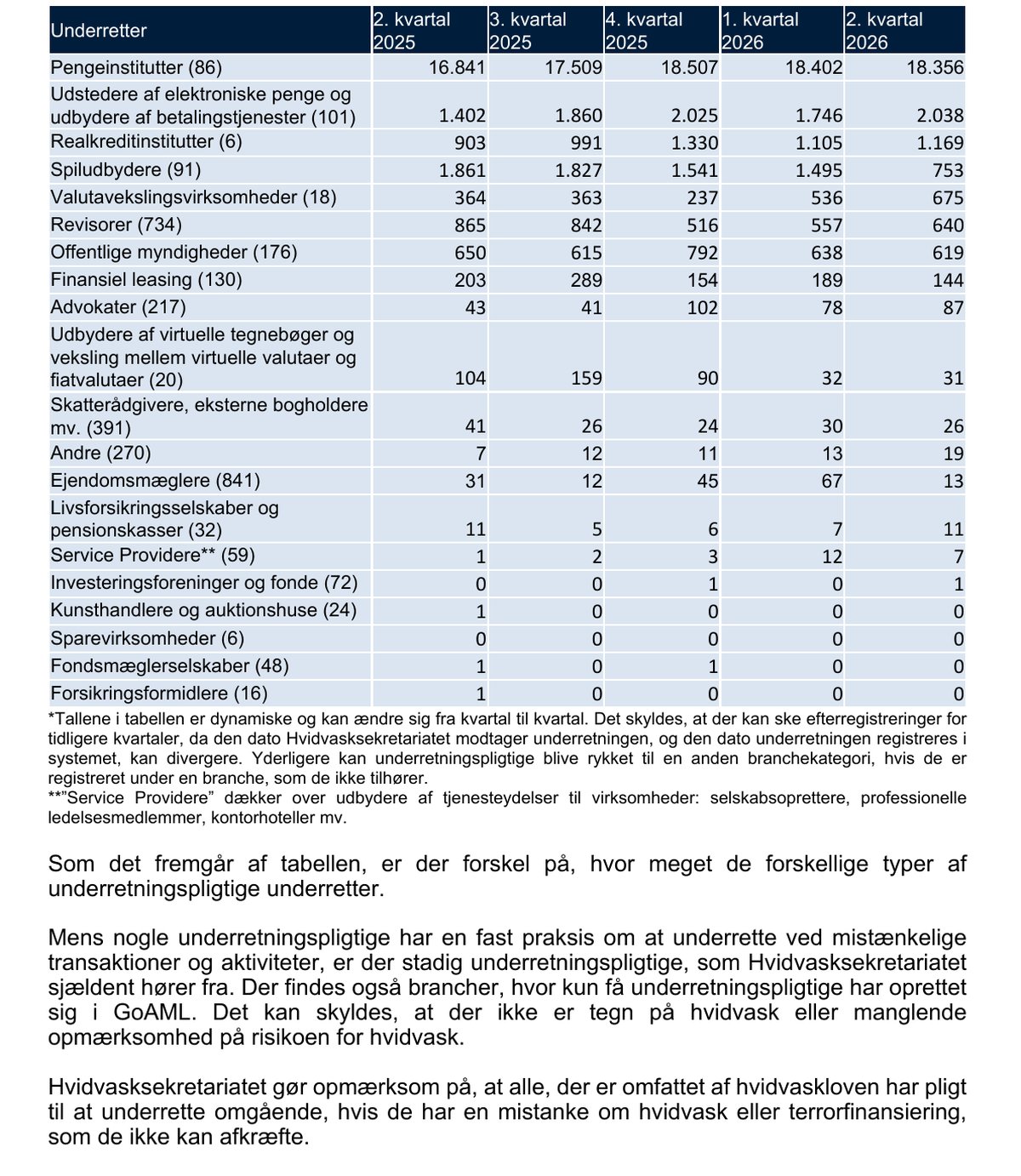
Gambling companies submitted 753 reports in the second quarter of 2026. In the first quarter, they submitted 1,495, and a year earlier, in the second quarter of 2025, they filed 1,861.[2]
The secretariat provided a reason for the broader trend: while finance leasing firms, estate agents, and corporate service providers also sent fewer reports, electronic money issuers, payment services, and currency exchanges actually sent more.[2]
However, the dramatic drop in the gambling sector rests mostly with that single operator. It is also worth noting that while 91 gambling companies are registered to file reports in Denmark, being registered does not mean a company has necessarily ever sent one.[2]
Small numbers in a big pile
Across all industries, the secretariat received 24,589 reports during the quarter. That is 318 fewer than in the first quarter, but about 1,250 more than the same period a year earlier. Over the last twelve months, the unit has taken in more than 99,000 reports in total.[2]
Banks submit the vast majority of all notifications. Gambling companies come fourth, a long way behind them, and just ahead of currency exchanges and accountants.[2]
What a falling count does and does not mean
A report represents a suspicion, not a proven crime. The overall count fluctuates based on how alert an industry is, how strictly its monitoring systems are tuned, and the size of its active customer base. Therefore, a drop could mean there is less dirty money circulating, fewer compliance staff looking for it, or simply that one major company adjusted a risk threshold in its software.
This context is why the secretariat's note about a single company is crucial. If one firm's actions can halve a whole industry's reporting volume, it means the industry's previous baseline rested heavily on that single firm.
Neither the secretariat nor the regulator has named the company, and neither has stated that the sudden change in reporting behaviour was necessarily wrong or non-compliant.[1][2]
Where a player fits in
Money laundering reports are strictly confidential, and a customer is never informed if one is filed about them. A player only experiences the front-end checks: questions about where their money came from, requests for identity documents, and sudden account limits. Danish law requires licensed companies to know their customers, and these police reports are generated behind the scenes when a player's answers simply do not add up.[2]
Notably, Denmark's regulator brought land-based casinos fully under the scope of its money laundering rules at the start of September.
Sources
- Spillemyndigheden (Denmark) — Hvidvasksekretariatet har udgivet en ny kvartalsrapport for 2. kvartal 2026 (23 September 2026, Danish). That the regulator sees a significant fall in reports from gambling companies and is following it closely.
- Hvidvasksekretariatet, National enhed for Særlig Kriminalitet (Denmark) — Kvartalsrapport, 2. kvartal 2026 (September 2026, PDF, Danish). The duty to report, the quarterly totals, the table by industry including the 91 registered gambling companies, the reason given for the fall, and which industries rose.



