

What changed
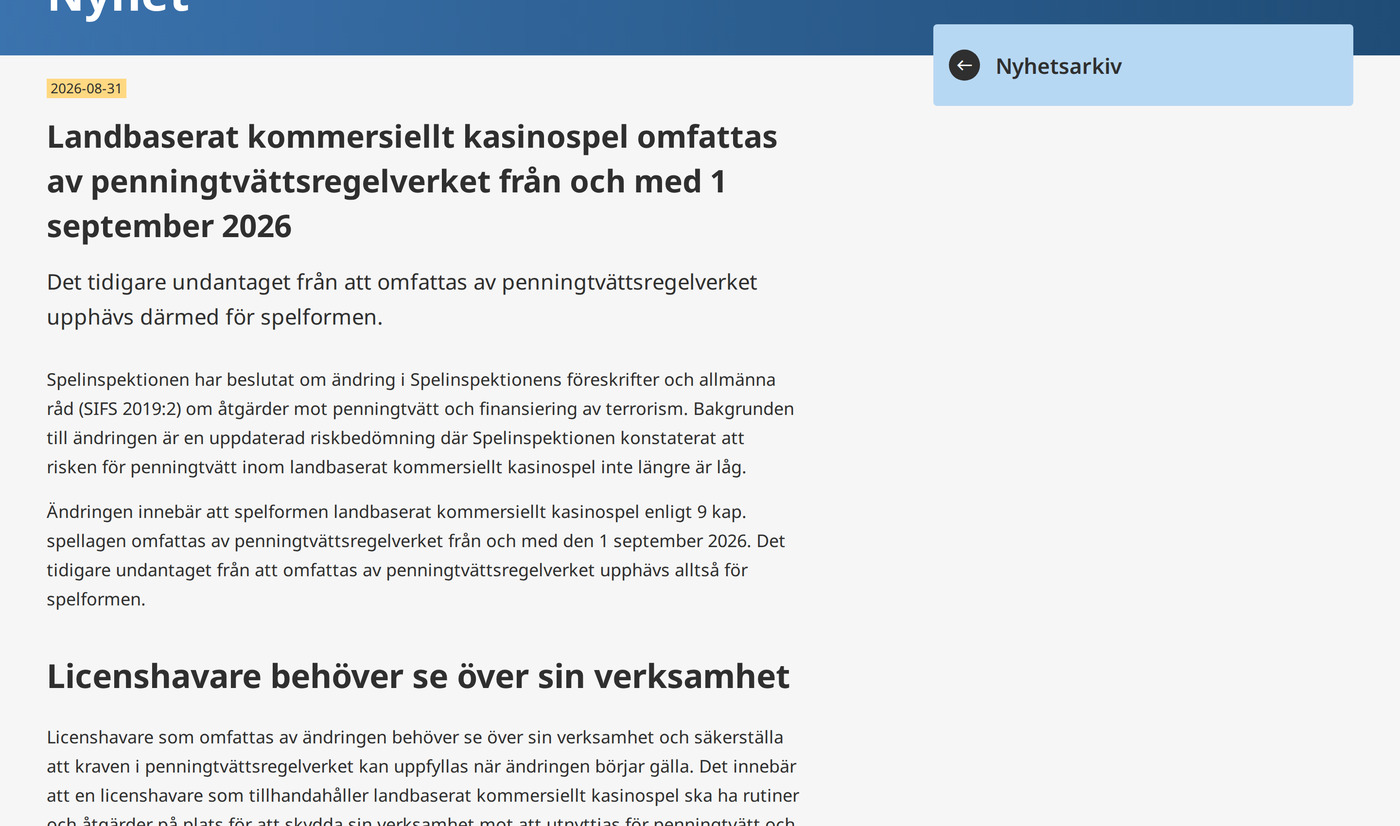
On 31 August Spelinspektionen announced an amendment to SIFS 2019:2, its regulations on measures against money laundering and terrorist financing. From 1 September, land-based commercial casino play under chapter 9 of the Gambling Act falls under the money-laundering framework. The exemption that game form used to hold is lifted.[1]
The reason given is an updated risk assessment. In it, Spelinspektionen concluded that the risk of money laundering in land-based commercial casino play is no longer low.[1] The rule changed in the same month that finding was made.
What a licensee has to do now
Licensees covered by the change have to review their operations and make sure they can meet the requirements when it starts to apply. In the regulator's words, a licensee must have routines and measures in place to protect the business from being used for money laundering or terrorist financing.[1]
The approach it asks for is risk-based. A licensee has to identify, analyse and assess the risks of being exploited. It then concentrates its heaviest and widest-ranging measures where it judges the risk highest. The regulator sets that out as a way of thinking, on the grounds that the risks differ case by case and move over time.[1]
Two rulebooks, one customer
One exemption did not go. Licensees offering land-based commercial casino play stay exempt from the Gambling Act's requirement to register players.[1] That is a separate exemption and it survives.
The money-laundering requirements now sit on top of it. Spelinspektionen says so directly: not having to register customers under the gambling rules does not rule out registering them some other way to meet customer due diligence.[1] A venue can be under no duty to log who walks in and still under a duty to know who they are.
What the announcement does not say
No figure appears for how many licensees or venues the change touches. Nothing is said about any case of laundering at a Swedish casino, and the risk assessment itself is not published with the announcement.[1] The finding that the risk is no longer low is stated as a conclusion, without the evidence behind it.
Nor is any enforcement announced. The regulator points licensees to its own guidance and collected material on anti-money-laundering work.[1] No compliance deadline is set beyond the date the rule starts to apply.
The bigger rulebook arriving behind it
The same announcement flags what comes next. A new anti-money-laundering framework starts to apply from 10 July 2027. It is run by a new EU authority, AMLA, which coordinates supervision and writes common standards across the EU.[1]
It has three parts. A regulation establishes AMLA and sets its powers. A money-laundering regulation replaces the greater part of the fourth directive and applies directly in every member state. A sixth directive covers what that regulation does not absorb.[1] So a Swedish casino adapting on 1 September is adapting to a rulebook already due for replacement in under two years.
If you gamble in Sweden
Walking into a licensed casino, you may be asked where your money comes from. From 1 September that question has a legal basis it did not have in August. A venue asking for documentation of your income or assets is doing what the rules now require.
These rules bind companies a Swedish regulator can reach. Our gambling regulation map covers how to check which regulator stands behind a venue or a site.
Sources
- Spelinspektionen — Landbaserat kommersiellt kasinospel omfattas av penningtvättsregelverket från och med 1 september 2026 (31 August 2026, Swedish). The amendment to SIFS 2019:2, the 1 September date, the finding that the risk is no longer low, the risk-based approach required of licensees, the surviving exemption from player registration under the Gambling Act and the statement that customer due diligence may still require registering customers another way, and the 10 July 2027 EU framework with its three instruments.



