

From licences to a ban
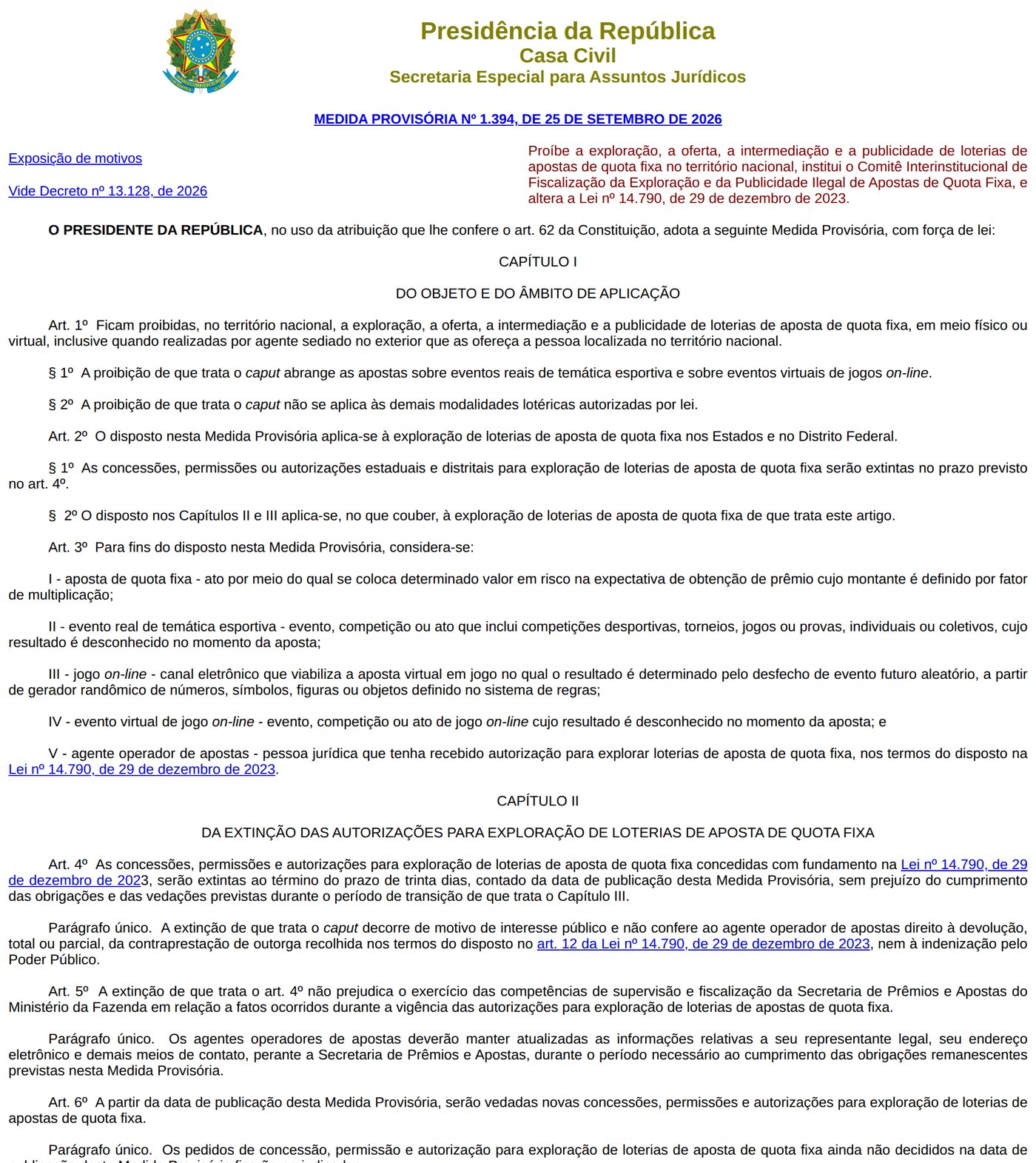
Brazil first allowed fixed-odds betting in a 2018 law, and a second law in 2023 set up the licences that operators have worked under since.[4] Provisional Measure 1.394 of 25 September takes that system apart.[1]
Under the measure nobody may run, sell, broker or promote fixed-odds bets in the country, whether over a counter or on the internet, and a company based abroad is caught as soon as it takes a bet from someone in Brazil. Two kinds of betting are named: wagers on real sporting events, and online games of chance whose results come from a random number generator: slots and other casino-style games. Brazil's other legal lotteries are untouched. Betting licences issued by the states go the same way as the federal ones.[1]
The measure counts as law from the moment it is published. It then needs Congress: lawmakers have 60 days, which can be extended once by another 60, to pass it as a law, and if they do not, it stops having effect.[5]
The dates that matter
Deposits were cut off on 25 September. Until 23:59 on Monday 5 October players could still take their money out themselves. On 6 October the sites and apps had to become unreachable.[1][2]
On 6 and 7 October each operator passes its banks a list of what every customer is owed. Customers are identified by their CPF, Brazil's personal tax number, and the list gives the bank account the deposits came from. The banks pay out between 9 and 14 October. From 14 October, any refund a bank cannot complete goes through Caixa Econômica Federal.[2]
The licences themselves expire 30 days after publication, on 25 October. Operators will not get back the fee they paid for them, and the state owes them no compensation.[1]
Getting the money back
Players do not have to chase the refund; the duty sits with operators and banks. Within two days of going dark an operator must have the cash ready and send each of its banks the customer list with amounts and source accounts. Every day it is late costs it R$200,000.[1]
A bank that receives the list has seven days to pay. The refund goes to the account the money came from, as long as that account is still open and belongs to the player. If not, any other account in the player's name will do.[1]
A bet that had not been decided when the sites shut is void: the stake comes back in full, with nothing deducted. If a bet was settled before the cut-off and won, the winnings are paid in full.[1]
Anything the banks fail to return is moved into a special account at Caixa, where each sum stays recorded against its owner under Finance Ministry supervision.[1] The ministry's betting secretariat added its own deadlines on 2 October: operators had until 7 October to report each customer's closing balance at 23:59 on 5 October, and until 15 December to clear everything they owe the state.[3]
Advertising, payments and app stores
Every form of betting advertising, marketing and sponsorship is now forbidden, on any medium, and existing material had ten days to disappear. The one exception is content from before 25 September in which betting advertising only appears in passing.[1]
Banks and payment companies can no longer handle betting transactions, apart from the ones needed to wind the business up and repay customers.[1] Brazil had already gone after payments to unlicensed betting sites in September, through an ordinance we covered at the time.
Online platforms have a duty to keep betting promotions from spreading, app stores must remove betting apps, and the government may ask Anatel, the telecoms regulator, to order sites blocked. Platforms that ignore these duties risk a fine of up to 10% of their group's revenue in Brazil. A platform with no revenue there can be fined R$10 to R$1,000 for each registered user, up to R$50 million per breach.[1]
The government's reasons
The memorandum that went to the president with the measure says the licensed market's safeguards had not protected people's health, consumers, children or family finances. It points to studies estimating that Brazilian households may have transferred, net, tens of billions of reais to betting platforms in 2025, and it connects betting with anxiety, depression, debt and a higher risk of suicide.[4]
In September we looked at the three separate blocklists Brazil used to keep people off its licensed betting sites.
Sources
- Presidência da República (Brazil) — Medida Provisória nº 1.394, de 25 de setembro de 2026 (25 September 2026, Portuguese). What is banned and for whom, the end of the licences after 30 days, the deposit stop, the ten days to go offline, the refund duties of operators and banks, the R$200,000 daily fine, the Caixa account, and the rules on advertising, payments, platforms, app stores and blocking.
- Ministério da Fazenda (Brazil) — Bets: prazo para retirada voluntária de recursos termina nesta segunda-feira (5/10) (5 October 2026, Portuguese). The day-by-day timetable from 25 September to 14 October.
- Ministério da Fazenda (Brazil) — Secretaria de Prêmios e Apostas regulamenta obrigações das empresas após proibição das bets (5 October 2026, Portuguese). Ordinance 3.005 of 2 October: the balance report due on 7 October and the 15 December deadline.
- Presidência da República (Brazil) — Exposição de Motivos nº 2114/2026 (24 September 2026, PDF, Portuguese). The laws of 2018 and 2023, and the government's reasons for the ban.
- Presidência da República (Brazil) — Constituição Federal, art. 62 (Portuguese). How long a provisional measure lasts before Congress must turn it into law.



