

The three registers
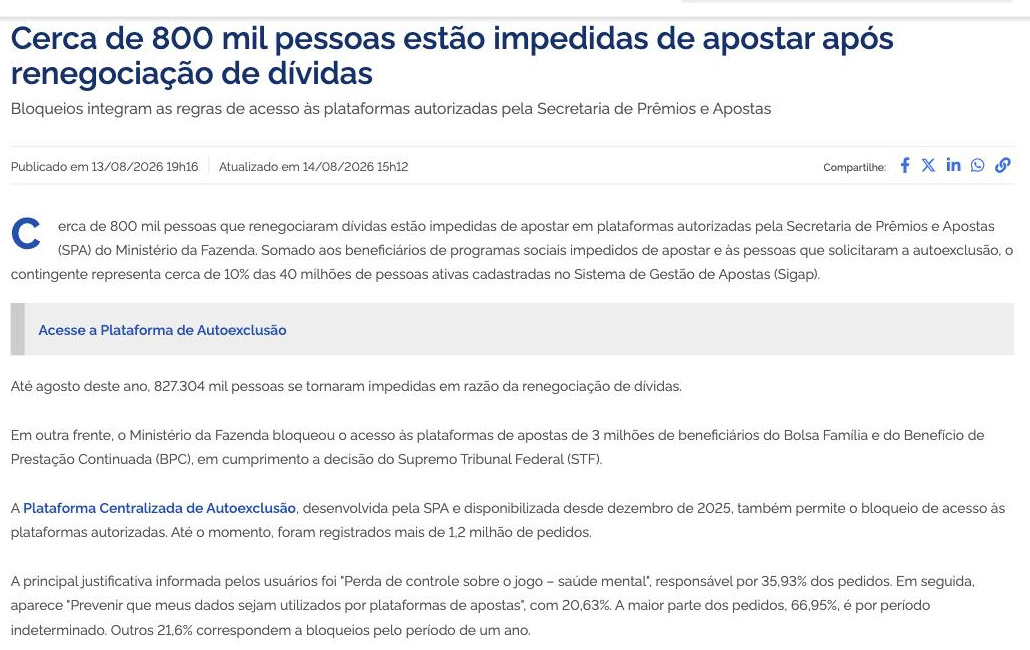
On 13 August the Ministry of Finance said around 800,000 people who renegotiated debts are barred from betting on authorised platforms. Those platforms are the ones licensed by its Secretariat of Prizes and Betting. Up to August this year the figure it gives is 827,304.[1]
Separately, the ministry blocked 3 million recipients of Bolsa Família and the Benefício de Prestação Continuada, complying with a Supreme Federal Court decision. We covered that block when it landed.[1]
The third is voluntary. The centralised self-exclusion platform, built by the secretariat and available since December 2025, has recorded more than 1.2 million requests.[1]
Why the three do not add up to 5 million
Each register runs on a different trigger. Debt renegotiation is a consequence of a financial process, the welfare block follows a court decision, and self-exclusion is a request a person makes. Nothing in the release says whether one person can appear in more than one.[1] Someone who renegotiated a debt and then asked to be self-excluded would plausibly be in two.
The ministry gives one combined measure, and it is a proportion rather than a headcount. The three together represent about 10% of the 40 million people actively registered in the betting management system, Sigap.[1] A total of distinct blocked people is not published.
The release also writes the renegotiation figure as "827.304 mil pessoas", which reads as 827,304 thousand. Set against its own headline of around 800 thousand, the number meant is 827,304 people.
What people say when they block themselves
The self-exclusion platform records a reason, and the ministry published the split. "Loss of control over gambling — mental health" accounts for 35.93% of requests, the largest single reason. "Prevent my data being used by betting platforms" follows at 20.63%.[1]
Those two are the top two and they leave 43.44% of requests under reasons the release does not name. The percentages are of requests rather than of people.
Duration is published too. 66.95% of requests are for an indeterminate period and another 21.6% are blocks for one year.[1] Two thirds of these requests are not for a cooling-off period.
What sits alongside the blocking
The platform carries free courses for consumers and bettors, including a module on behavioural and financial aspects that covers over-indebtedness. A mental-health self-test is also available, with information on risks and the contact points of the public health system.[1]
Debt renegotiation itself is open to families, students with Fies financing, companies and family farmers.[1] The betting block attaches to the renegotiation rather than being applied for.
What the release does not establish
No enforcement figure appears, and no statement that any operator failed to apply a block. Nothing is said about how the three registers are checked against each other, or what happens to a balance held by someone who becomes blocked mid-account.[1]
The 10% proportion rests on the 40 million active registrations in Sigap, and a registration is not the same as a person.
If you bet in Brazil
Renegotiating a debt through one of those programmes blocks you from authorised platforms as a consequence, without a separate application. If you want the block without the debt process, the self-exclusion platform is the route, and it covers every authorised site at once.[1]
None of it reaches a site operating outside the secretariat's authorisation, because nothing obliges an unlicensed operator to check any of these registers. Our gambling regulation map covers how to tell which sites are inside that perimeter.
Sources
- Ministério da Fazenda — Cerca de 800 mil pessoas estão impedidas de apostar após renegociação de dívidas (13 August 2026, updated 14 August, Portuguese). The 827,304 barred through debt renegotiation, the 3 million welfare recipients blocked under the Supreme Federal Court decision, the self-exclusion platform's availability since December 2025 and its 1.2 million requests, the 35.93% and 20.63% reasons, the 66.95% indeterminate and 21.6% one-year durations, the courses and the mental-health self-test, the eligibility of families, Fies students, companies and family farmers, and the statement that the three groups together are about 10% of the 40 million active registrations in Sigap.



