

What the police took away
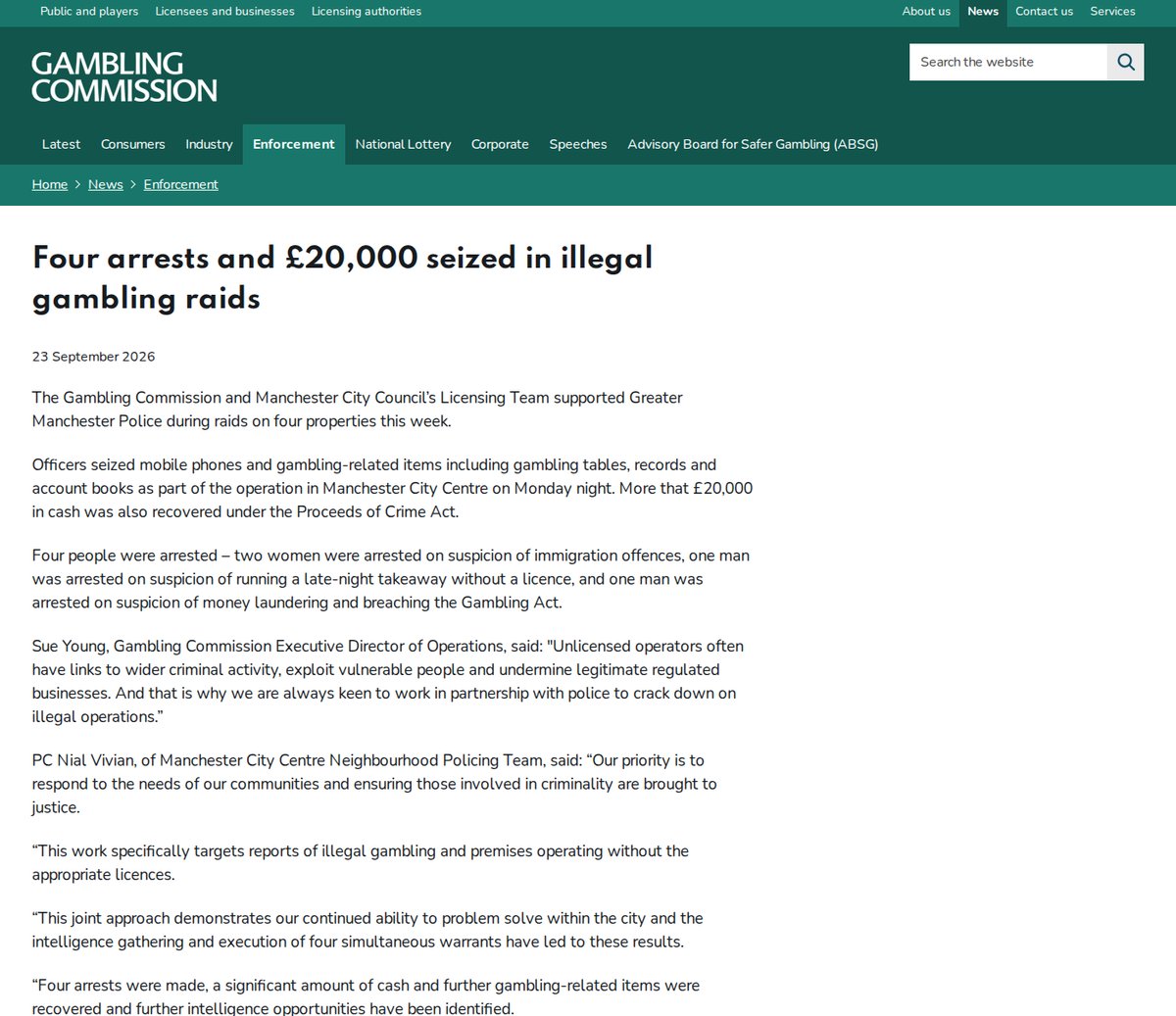
Greater Manchester Police ran the operation. Officers went into four addresses in the middle of the city at once, late on a Monday night. The force said intelligence gathered beforehand is what allowed it to move on all four together.[1]
What came out of those four buildings was the ordinary furniture of a back-room gambling business: tables to play on, the ledgers recording who owed what, and mobile phones. For the banknotes — £20,000 worth and more, by the regulator's count — the police used a power of their own, set out in the Proceeds of Crime Act, and not the warrant that got them through the door.[1]
Licensing officers from the city council were there as well. The Gambling Commission set out what had happened in a notice on 23 September, two days after the night in question.[1]
Four arrests, and what they are about
Of the four people held, one arrest was about gambling in the strict sense. A man is suspected of laundering money and of providing gambling that no licence covered — an offence under the Gambling Act. The second man taken in was a licensing matter: a takeaway said to be serving late at night without the licence that needs. Behind the remaining two arrests, both of women, lies immigration law rather than gambling law.[1]
Sue Young, who directs operations at the Commission, made the same point in the notice: where gambling goes on without a licence, other crime is usually close by. Three of the four arrests in Manchester bear that out, since each concerned something other than gambling.[1]
As far as the official notice states, nobody has been charged yet, and nothing has been brought before a court. No names have been released, and there is no word on whether the premises will remain shut.[1]
Why cash can be carried off before a trial
Section 294 of the Proceeds of Crime Act is what lets an officer pick up banknotes on the spot. The test is whether there is reasonable ground to suspect that the money came out of crime, or that somebody means to spend it on crime.[2]
That first hold runs for 48 hours, and weekends and bank holidays do not count towards it. Anything longer has to go before magistrates, who may sign off six months at a time; two years from the first order is the outside limit.[3]
Keeping the money for good is a further step again. Before any of it is forfeited a court has to be satisfied that the cash came out of crime or was intended for use in crime. While that question is open, the notes stay in police custody.[4]
The law being tested here
Running a game of chance for other people is a criminal offence in Britain unless somebody holds a valid licence for it, or the game fits one of the narrow exceptions written into the Gambling Act — such as private games between friends, some club games, or prize gaming.[5]
On conviction before magistrates the penalty can be a fine, up to 51 weeks inside, or both.[5]
The regulator joins these operations because a venue running games without a licence is rarely breaking only that one rule.[1]
What a back-room game does not have
A licensed casino in Britain must verify that players are 18 or over, adhere to tested rules, allow players to bar themselves, and provide an accountable party when a customer complains. A table in a back room offers none of that. Any money placed on it has no protection, and the person running the game dictates everything.
Two public registers settle whether a business is licensed. The Gambling Commission's register covers companies and the websites they run.[6] Premises are a separate matter, licensed by the local authority, and it was the city council's licensing officers who joined Monday's operation.[1]
Sources
- Gambling Commission (Great Britain) — Four arrests and £20,000 seized in illegal gambling raids (23 September 2026, English). The raid, what was seized, the four arrests, the partners involved, and both quotations.
- legislation.gov.uk (United Kingdom) — Proceeds of Crime Act 2002, section 294 (English). When cash may be seized.
- legislation.gov.uk (United Kingdom) — Proceeds of Crime Act 2002, section 295 (English). The 48 hours, the court orders, and the two-year limit.
- legislation.gov.uk (United Kingdom) — Proceeds of Crime Act 2002, section 298 (English). Forfeiture, and what a court must be satisfied of.
- legislation.gov.uk (United Kingdom) — Gambling Act 2005, section 33 (English). The offence, its exceptions and its maximum penalty.
- Gambling Commission (Great Britain) — Public register (English). The licensed companies.



