

Caps on minutes and money
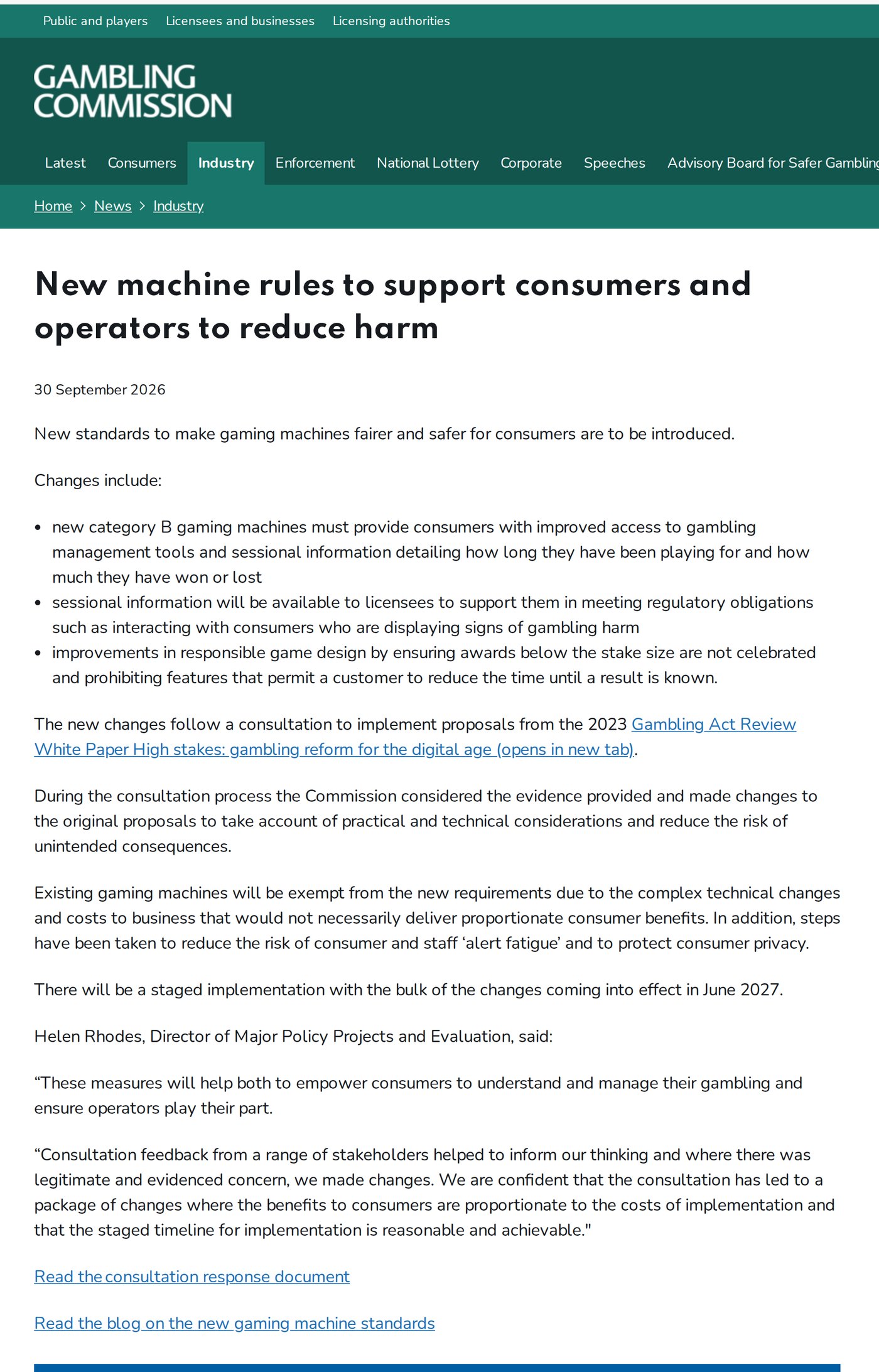
Before a machine reaches a British venue it has to satisfy standards written by the Gambling Commission, the body that licenses gambling in Great Britain. The final text of its latest changes was published at the end of September, twenty months after the Commission first asked for views.[1][2]
A player at a newly approved B machine chooses between personal caps and the machine's defaults, which are twenty minutes or a net loss of £150. Personal caps can go up to an hour and £450 of net loss.[2]
Once a cap runs out, or is altered before it does, play stops for half a minute at least. On the default time setting the first two stops are briefer: 10 seconds at the twenty-minute mark and 20 seconds at forty.[2]
All through the session the display keeps two figures in view, time elapsed and net position, meaning the player's running profit or loss. The operator gets those figures too, so that staff can spot someone in difficulty and talk to them.[1][2]
No fake wins, no turbo
Getting back your own stake, or less, will no longer set off the lights and jingles of a win on a newly approved machine. It may still say what it paid, flash the line for a moment and give a short sound.[2]
Anything that hurries the outcome is out as well. The Commission lists the turbo setting, quick spin and slam stop, and says such features make play more intense and feed the mistaken belief that the player's timing changes what comes up.[2] Both design rules reach machines in categories A to C.[2]
Why B machines, and when
B machines take most of the money machines make. In the financial year to March 2025 they kept £2.29 billion from players. The Commission puts that at 88.5% of the £2.6 billion taken by all machines in licensed premises.[2]
Older machines stay as they are
Machines in place today are exempt. Converting them, the Commission concluded, would cost operators, small firms and social clubs above all, more than it would help players. A phase-out after five or ten years was considered and rejected as too complex.[1][2]
It is counting on turnover instead. Most machines run compendiums whose games operators replace often, and the regulator expects new games to bring around 90% of the machines in scope under the rules quickly.[2]
Helen Rhodes, who leads the Commission's largest policy projects, said the changes would help people understand and manage their own play while making operators do their part.[1]
Sources
- Gambling Commission (Great Britain) — New machine rules to support consumers and operators to reduce harm (30 September 2026, English). The summary of the changes, the exemption for existing machines, and Helen Rhodes's comments.
- Gambling Commission (Great Britain) — January 2025 Consultation on proposed changes to the GMTS, Testing Strategy and LCCP: Consultation Response (30 September 2026, English). The default and maximum limits, the pauses, the two design rules and the machine categories they cover, the three dates, the machine revenue figures, the rejected five- and ten-year options, and the expected 90% coverage.



