
What this regulator counts, and what it does not
One raid in May took 169 illegal gaming machines, and the board put the figure in its own headline.[2] By March its chief executive was giving a running total of more than 6,000 machines seized across many districts.[3]
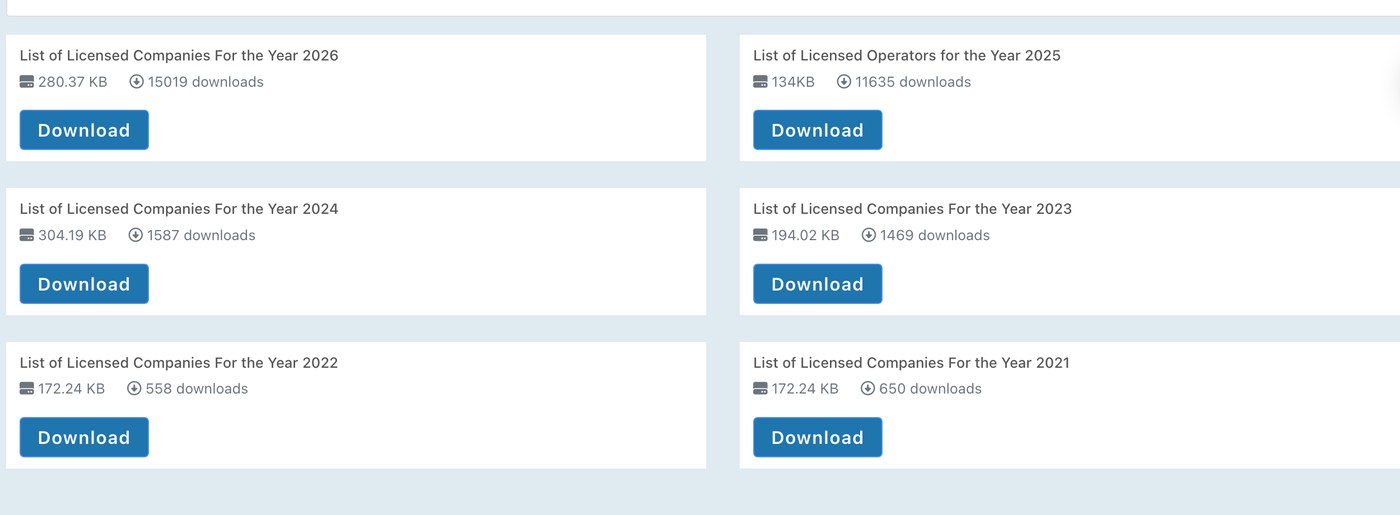
It counts other things too, right down to the trivial. Its list of licensed companies for 2026 sits on the website with a live download counter beside it. On 9 September it read 14,899. A day later it read 15,019 — 120 more copies in twenty-four hours. The 2025 list stands at 11,635.[4] Somebody thought those numbers were worth publishing, and plenty of people are reading them.
Now the item posted on 14 August. It contains no figures at all. Not how many illegal sites exist, not how many have been found, not how many were blocked last year, and not how many the board hopes the phone companies will flag.[1]
A machine can be picked up and put in a van. A blocked website leaves a line in somebody else's system, and Uganda publishes no running total of those. Australia does — its regulator has blocked 1,788 gambling and affiliate sites and prints the running total. Against that, the Ugandan silence stands out.
The three requests
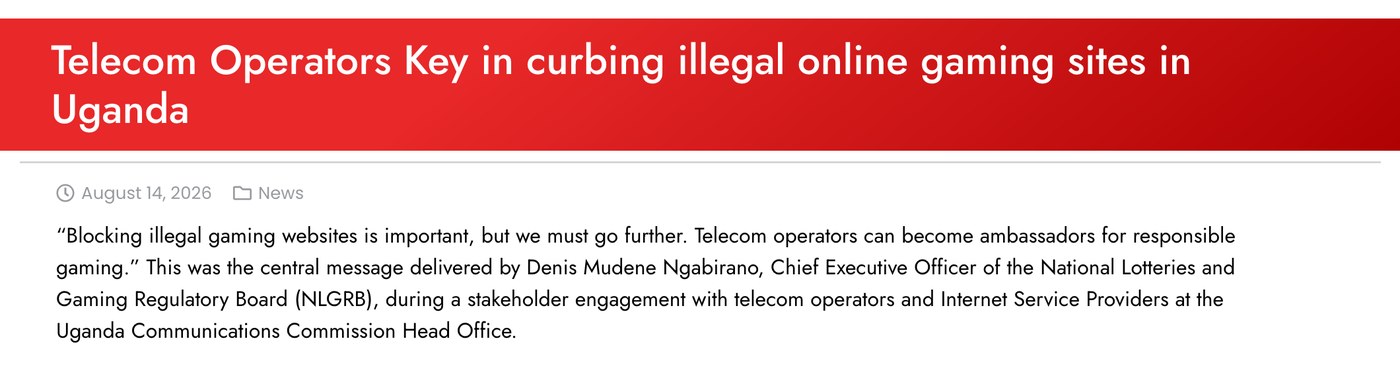
The board's chief executive, Denis Mudene Ngabirano, spoke to phone companies and internet providers at the head office of Uganda's communications regulator. His remarks went up on the board's website on 14 August, opening with the line the item leads on: "Blocking illegal gaming websites is important, but we must go further. Telecom operators can become ambassadors for responsible gaming."[1]
He asked them to take up that role — "Responsible Gaming Ambassadors" — and named three jobs. Watch the traffic heading to betting sites more closely. Flag anything suspicious quickly. Tell customers what an unlicensed platform costs them.[1] A fourth followed, about company internet connections, where an office network may reach betting sites unchecked.[1]
Nobody agreed to anything
Look at what the item says happened. The chief executive commended, called on, and highlighted.[1] No company is reported as replying, and none is named.
There is no signed agreement, no undertaking, no deadline, and nothing that happens to a company which says no. The ambassador role is voluntary and the item never defines it further.[1]
Nor does anything explain what "closer monitoring of internet traffic" would mean in practice. No method, no threshold, no reporting channel, no frequency.[1] There is no follow-up meeting, no working group and no review date.
The system that already exists
The item does describe how blocking works in Uganda today. The board finds a site. The communications commission orders it cut off. The phone companies do the cutting off.[1]
That system is called essential, but reactive — the point of the meeting was to reach for something less passive.[1] The chain still runs through the communications regulator, though, and nothing here changes who gives the order.
The board's own authority comes from the Lotteries and Gaming Act No. 7 of 2016, which it cites on every page of its site.[4] The 14 August item cites nothing at all — no provision for blocking, and none for the three requests.[1]
The money behind the request
In an interview the board republished in March, Ngabirano put annual gaming revenue at roughly UGX 50.6 billion for the 2019/20 year, rising to about UGX 323 billion by 2024/25.[3] Those are numbers he gave an interviewer rather than a published statistic, and we treat them that way.
The board's licence categories already cover the internet. General betting covers online as well as land-based sports betting. The bingo licence covers remote and online bingo. The casino licence includes virtual or online platforms.[5]
So the rules describe the internet perfectly well. It is the enforcement record published alongside them that counts hardware.
For anyone betting in Uganda that gap has a practical edge. A site being reachable tells you nothing about whether it is licensed. A site being blocked is a decision taken somewhere you cannot see. The licensed-companies list is the part you can see — published yearly, downloadable, going back to 2021.[4]
Missing from the record
No date for the meeting itself. No list of who attended. No named company and no named official from the communications commission.[1]
Sources
- National Lotteries and Gaming Regulatory Board — Telecom Operators Key in curbing illegal online gaming sites in Uganda (14 August 2026). The stakeholder engagement at the Uganda Communications Commission head office; Denis Mudene Ngabirano's title and his quoted remark that blocking illegal gaming websites is important but they must go further and that telecom operators can become ambassadors for responsible gaming; the "Responsible Gaming Ambassadors" role and the three areas of closer monitoring of internet traffic, timely flagging and consumer sensitisation; the point about corporate users; the description of the existing routine in which the board identifies sites, the commission issues a directive and operators comply by blocking access, called essential but reactive; and the absence of any figure, named operator, meeting date or legal citation.
- National Lotteries and Gaming Regulatory Board — National Lotteries and Gaming Regulatory Board Intensifies Cracks Down on Illegal Gaming with Major Enforcement Operation (29 May 2026). The seizure of 169 illicit machines.
- National Lotteries and Gaming Regulatory Board — Ugandan regulator on keeping pace as gaming revenue grows sixfold (12 March 2026). An interview given to SiGMA News and republished by the board, in which Ngabirano gives annual gaming revenue of approximately UGX 50.6 billion in FY 2019/20 rising to about UGX 323 billion by FY 2024/25, and says more than 6,000 illegal gaming machines have been seized across multiple districts.
- National Lotteries and Gaming Regulatory Board — Licensed Companies (read 9 September 2026). The yearly lists of licensed companies from 2021 onward with their live download counts. The page was archived on 9 September 2026, when the 2026 list read 14,899 downloads and the 2025 list 11,614, and captured again on 10 September, when they read 15,019 and 11,635. Both readings are in the bundle's
_evidence/. Also the board's statement of its mandate under the Lotteries and Gaming Act No. 7 of 2016. - National Lotteries and Gaming Regulatory Board — Categories of Licenses (read 9 September 2026). That the general betting licence covers online and land-based sports betting, the bingo operating licence covers remote bingo and online bingo, and the casino operating licence includes virtual or online platforms.



