

Who was asked
Spelinspektionen, the Swedish gambling regulator, published the survey on 18 September.[1] The polling firm Verian ran it online between 22 April and 5 May 2026, and the report itself is dated 22 May.[2]
Of the 1,939 young people who answered, 1,303 had gambled for money at least once in the previous twelve months. Most of the questions went only to them.[2]
Lotteries and number games such as Keno were the most common, played by 33% of everyone asked. Online casino games and slots came next, at 20%.[2]
What "risky" means in this survey
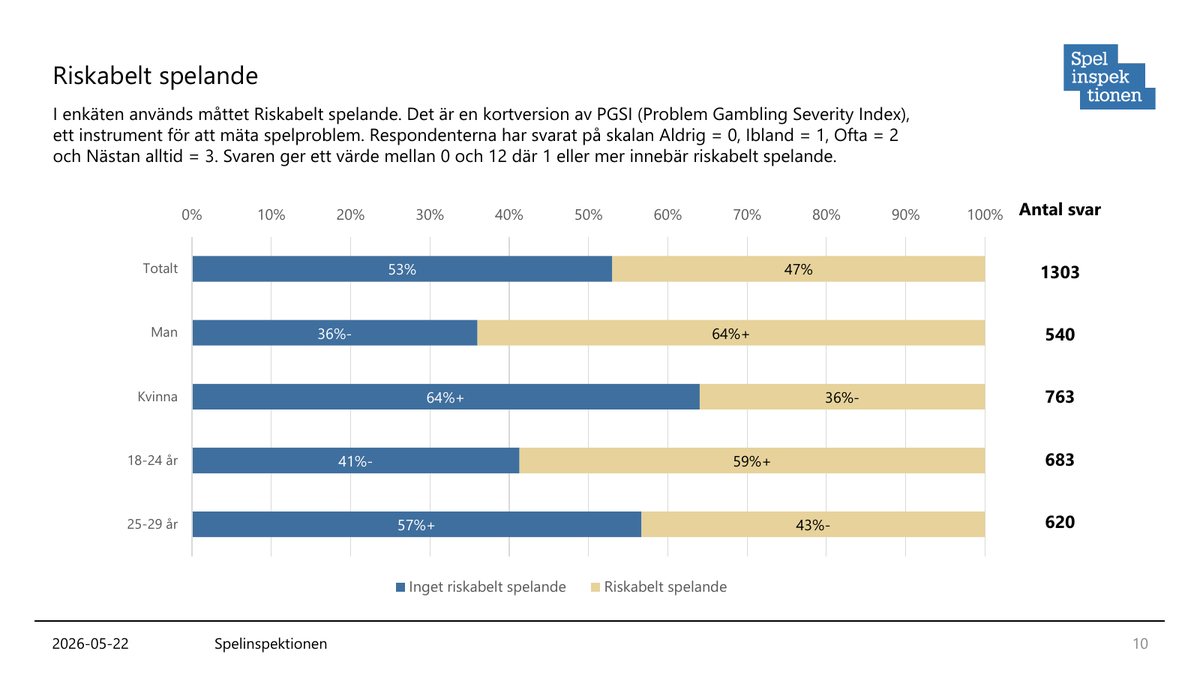
The survey uses a short version of a standard questionnaire about gambling problems. Each answer scores from 0 for "never" to 3 for "almost always", and the scores add up to a total between 0 and 12.[2]
Anyone who scores 1 or more counts as gambling riskily. So a person who says a gambling problem happens to them "sometimes" is in that group.[2] It is a wide net, meant to catch early warning signs, and it is not a diagnosis of addiction.
By that measure, 47% of the young people who had gambled were gambling riskily. Among men it was 64%, and among women 36%. Among 18 to 24-year-olds it was 59%, and among 25 to 29-year-olds 43%.[2]
Loot boxes bought as a child
The survey asked when people bought their first loot box. The regulator describes these as boxes of randomly chosen virtual items, sold inside video games.[1]
The earlier someone started, the likelier they were to show risky gambling now. Among those who bought their first loot box at 12 or younger, 75% did. Among those who did not know what a loot box was, 30% did.[2]
The regulator calls this a clear link between early exposure to loot boxes and risky gambling later.[2] A survey like this one cannot say which comes first. A young person drawn to risk may simply do both.
Skins and streams
Skin gambling uses items from video games, such as weapon designs, as the stake or the prize.[1] Of the young people who had bought and opened loot boxes, 51% had also gambled with skins. For those who bought their first loot box at 13 to 15, it was 61%.[2]
Among the risky gamblers, 63% had watched or streamed casino content every month or every week during the past year.[2]
Where the money came from
Most young gamblers paid with their wages, 64% of them. But 21% said they had used their student finance, 6% money borrowed from family or friends, 5% a consumer loan and 5% a payday loan.[2] The regulator says the loot-box groups were more likely to fund their gambling with borrowed money or student finance.[2]
Adverts from companies they never joined
Nine in ten of everyone asked, 91%, had seen or heard gambling advertising in the past year. Social media was the most common place, at 62%, followed by video sites such as YouTube and TikTok, at 57%.[2]
Of those who had seen advertising, 41% had received an email or text message from a gambling company they were not registered with.[2] The regulator points out that the survey cannot say whether those messages came from licensed companies or from ones without a Swedish licence.[1]
The Swedish government has already set up an inquiry into gambling by children and young adults, due to report in 2028. This survey is the regulator's own snapshot while that inquiry runs.
Sources
- Spelinspektionen (Sweden) — Spelinspektionen har undersökt ungas spelande (18 September 2026, Swedish). The survey of 18 to 29-year-olds, its main findings, the regulator's descriptions of loot boxes and skin gambling, and its note that the survey cannot tell whether marketing came from licensed or unlicensed operators.
- Spelinspektionen (Sweden) — Ungas spelvanor 2026 (report dated 22 May 2026, PDF, Swedish). The full survey by Verian, fieldwork 22 April to 5 May 2026: 1,939 respondents, 1,303 of whom had gambled in the past 12 months; how risky gambling is measured; and every figure in this article, including the results by sex, age and age at first loot-box purchase, skin gambling, streaming, how gambling was paid for, and exposure to marketing.



