
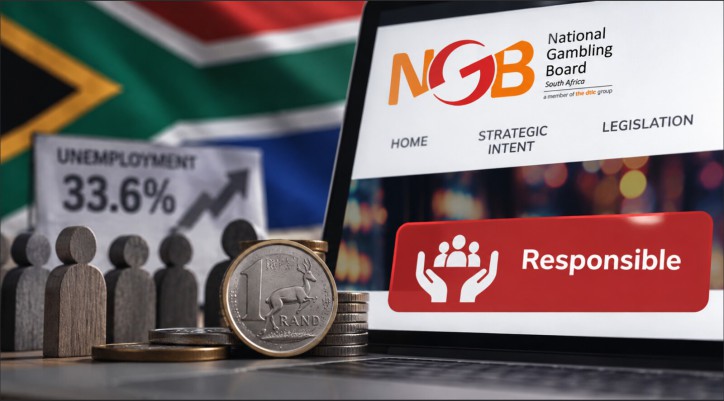
The advice, in full
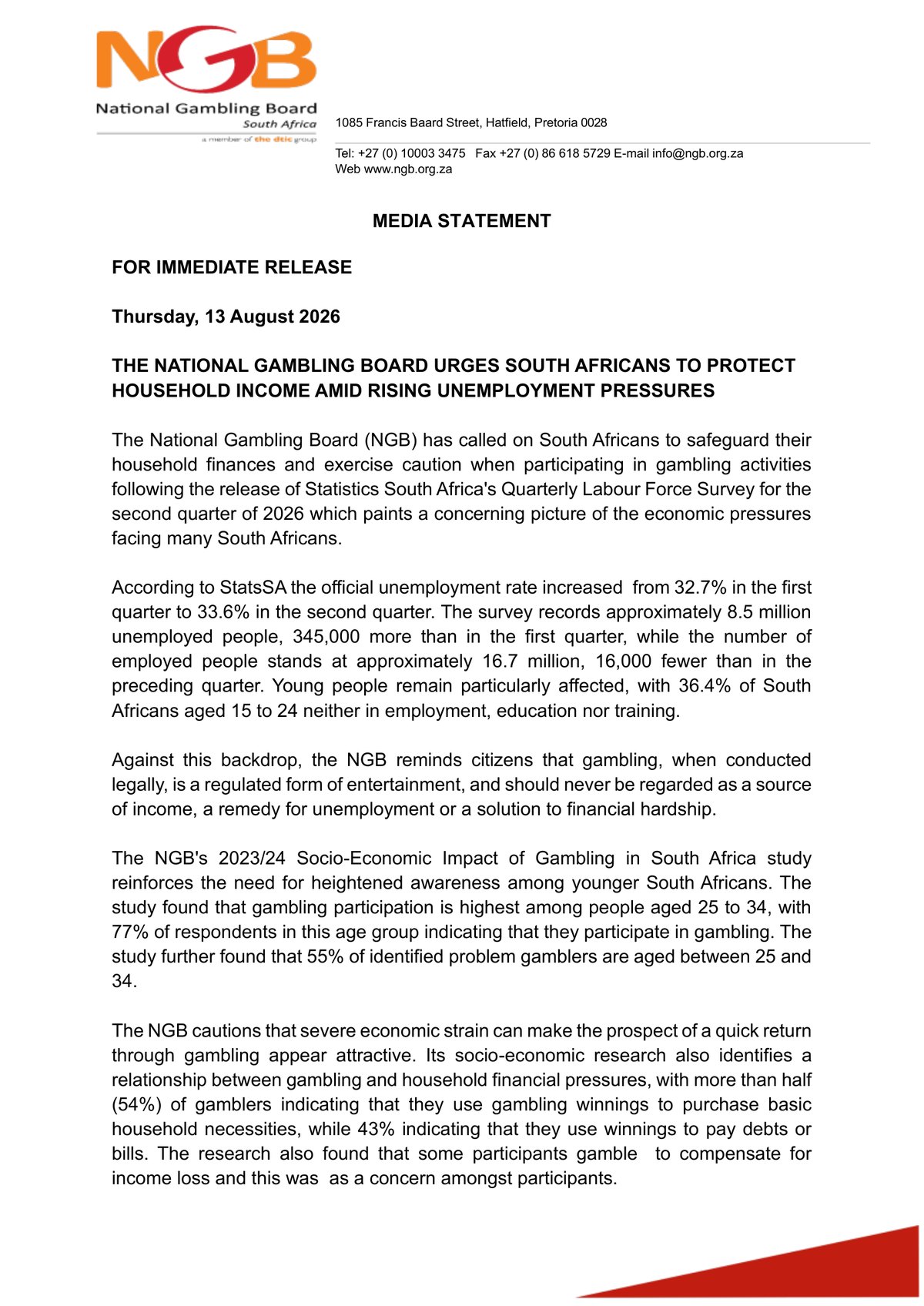
The National Gambling Board put out a media statement on Thursday 13 August, signed off by its acting chief executive, Lungile Dukwana.[1]
"The latest figures highlight the difficult circumstances facing many South African households and, during times such as these, every rand matters," he said.[1]
Then the instruction. It is an order of payment in all but name. Rent, food, transport, school fees and debts get paid first. Whatever survives that list is the only money that may be gambled — and then, in his words, "only gamble what you can afford to lose".[1] "Protect the money you have to sustain your family."[1]
On young people he added that the message "is not one of judgement, but of protection".[1]
And on what gambling is for: "It should never replace the pursuit of sustainable employment, education or other legitimate opportunities for economic participation."[1]
The unemployment figures it leans on
Statistics South Africa released its second-quarter labour survey on 11 August. The official unemployment rate rose from 32.7 percent to 33.6 percent, a jump of 0.9 of a percentage point.[2]
Underneath that: 345,000 more people out of work, taking the total to 8.5 million, and 16,000 fewer in work, taking that total to 16.7 million. Among 15 to 24 year olds, 36.4 percent are in neither a job, nor education, nor training.[2] The board quotes all four of those numbers, and all four match the release.[1]
One thing it leaves out. Statistics South Africa publishes four different measures of how much labour is going unused, not one. The board quotes the narrowest. The broader measure, which counts people who want work but have stopped looking, stands at 43.8 percent.[2]
What it stops short of claiming
The statement puts unemployment and gambling next to each other and then stops. Its strongest wording is that hardship can make a quick return through gambling "appear attractive".[1] That is a sentence about how something looks, not about what causes what.
No data is offered showing that betting rose as unemployment rose, and none is claimed. On the second quarter of 2026 the board publishes nothing here at all.
The gambling number that is missing
The board does publish gambling figures. They come once a year, audited. The most recent set covers the year to 31 March 2025 and was released on 9 October that year — seventeen months before this statement.[3]
In that year South Africans staked just over R1.5 trillion. Gross gambling revenue, meaning the share operators kept, was R74.5 billion. That was up 25.6 percent on the year before, and betting alone made up 69.8 percent of it.[3]
There is no figure yet for the year to March 2026. So on official data, nobody can say what gambling did while unemployment was climbing. "Every rand matters" arrives without the rand figure attached.
Its own research on who plays
The statement draws on the board's 2023/24 study of the social and economic impact of gambling. Participation peaks among 25 to 34 year olds, where 77 percent say they gamble, and 55 percent of identified problem gamblers sit in that same age band.[1]
Two findings land closest to Dukwana's argument about the household. Among gamblers, 54 percent put winnings towards basic necessities, and 43 percent towards debts or bills.[1] Those are the study's numbers as the board reports them; we have read the statement, not the study.
Advice, and nothing behind it
No policy follows. No rule, no consultation, no deadline. Nothing on advertising, deposit limits or affordability checks, and no company is named or criticised.[1] There is no helpline call volume, no self-exclusion count, and no measure of how many people are struggling now rather than in 2023/24.[1]
The board had in fact acted the day before — its new task team raided five premises in Limpopo — and this statement does not mention it. Enforcement on Wednesday, advice on Thursday, and no thread drawn between them.
The practical part is still worth keeping. Essentials first, and only money you can lose after that. The board points to its own portal for checking whether a company is licensed, which you can do before you deposit anywhere.[1] Free counselling runs 24 hours a day through the National Responsible Gambling Programme, on 0800 006 008.[1]
Sources
- National Gambling Board — The National Gambling Board urges South Africans to protect household income amid rising unemployment pressures (media statement, Thursday 13 August 2026). The call to protect household income; the labour figures it quotes; all four quotations from acting chief executive Lungile Dukwana used above, reproduced verbatim from the statement; the 2023/24 socio-economic study figures of 77 percent participation among 25 to 34 year olds, 55 percent of identified problem gamblers in that band, 54 percent using winnings for household necessities and 43 percent for debts or bills; the verified-operators portal; and the National Responsible Gambling Programme helpline.
- Statistics South Africa — Quarterly Labour Force Survey, Q2 2026 (P0211) (released 11 August 2026). The official unemployment rate of 33.6 percent against 32.7 percent in the first quarter, a rise of 0.9 of a percentage point; 345,000 more unemployed to 8.5 million and 16,000 fewer employed to 16.7 million; 36.4 percent of 15 to 24 year olds not in employment, education or training; and the four labour-underutilisation measures, of which the broader LU3 stands at 43.8 percent.
- National Gambling Board — National Gambling Statistics, financial year ending 31 March 2025 (published 9 October 2025). Total turnover of R1 500 660 968 064, total gross gambling revenue of R74 498 495 925 against R59 306 767 610 the year before, growth of 25.6 percent, and betting at R51 974 933 051 or 69.8 percent of gross gambling revenue. No report has yet been published for the year ending 31 March 2026.



