

Eleven names, in four groups
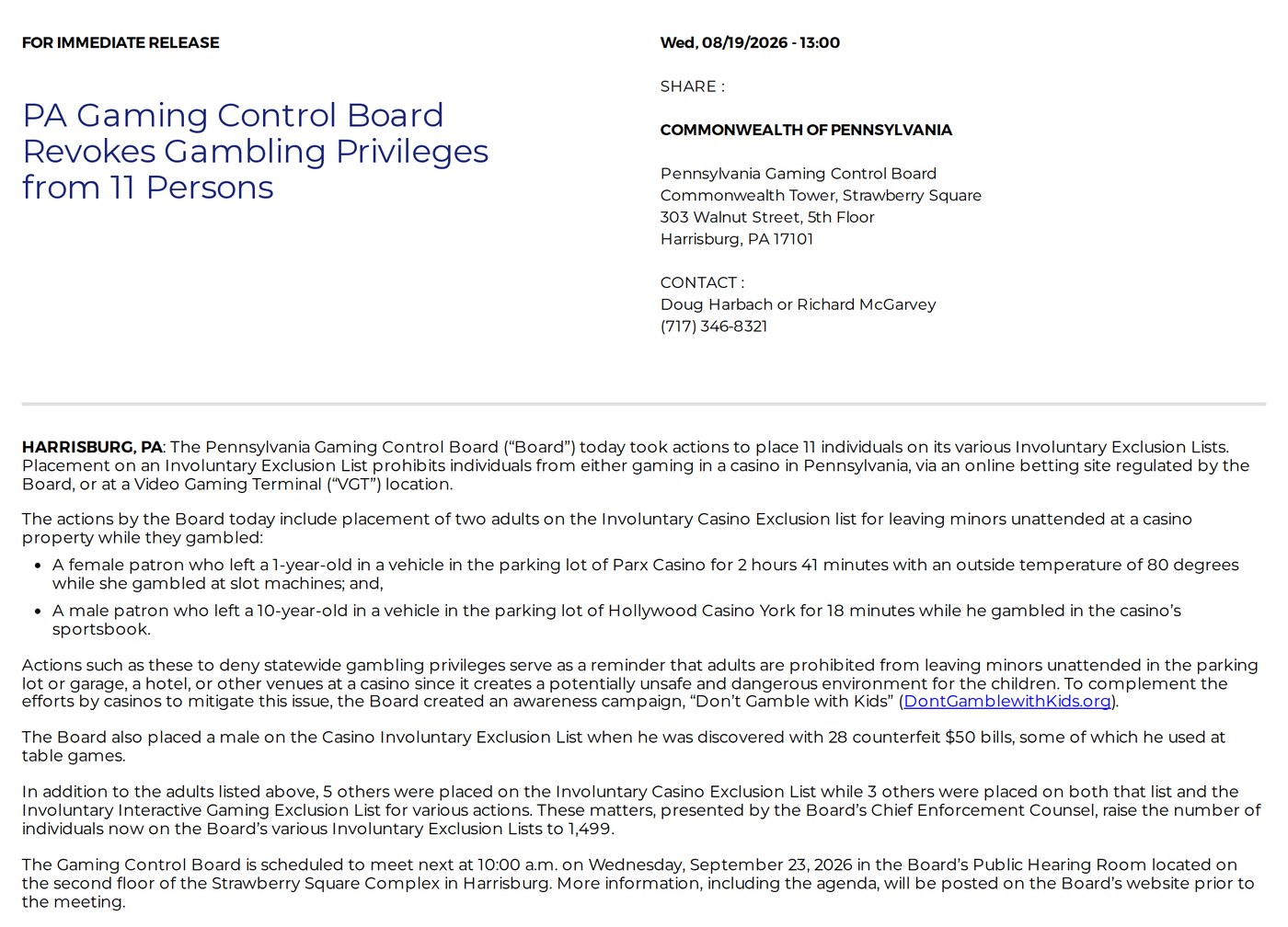
The Pennsylvania Gaming Control Board placed eleven people on its involuntary exclusion lists on 19 August. Being on one bars a person from every venue the Board reaches: a Pennsylvania casino, a betting site it regulates, a video gaming terminal in a truck stop.[1]
The release breaks the eleven into four groups, and they add up. Two adults left children unattended, and one man was caught with counterfeit money. Of the remaining eight, five went on the casino list and three on both that list and the interactive gaming list.[1] What those eight did is given only as "various actions".
The two cases the Board timed
A woman left a one-year-old strapped in a car at Parx Casino while she played slot machines. It was 80 degrees outside, and the child was there for 2 hours 41 minutes. At Hollywood Casino York a man left a ten-year-old alone in a car, 18 minutes of it, while he used the sportsbook.[1]
Both durations come from the Board. It publishes them because eighteen minutes and two hours forty-one are not the same offence. The Board runs an awareness campaign on this, "Don't Gamble with Kids", built with the casinos rather than against them.[1] A regulator that has a standing campaign for a problem is telling you the problem recurs.
Twenty-eight fifties
A third man went on the casino list after being found with 28 counterfeit $50 bills. Some of them he had already used at table games.[1]
No fraud figure is attached and no criminal proceedings are mentioned. The exclusion is a regulatory act on its own, separate from whatever a court does later.
Involuntary is not self-exclusion, and the difference matters
These are two different systems that share a word. Self-exclusion is something a person asks for. Involuntary exclusion is something a regulator does to them, and the name is the Board's own.[1]
So the 1,499 figure is not a measure of how many Pennsylvanians decided to stop. It counts people the Board decided to stop, one hearing at a time. Anyone comparing it with a self-exclusion register in another state is comparing a disciplinary record with a waiting list.
What the release does not say
No names are published in it, and no ages beyond the two children. Nothing says how long a placement lasts or whether it can be lifted. Nor is there a route for a person who thinks they should not be on the list.[1]
Nor does it say how a barred person is actually kept out, at the door or at the login. The Board's next public meeting is on 23 September.[1]
The scale it sits inside
Pennsylvania regulates 18 land-based casinos, and alongside them online casino play, sports betting on and off the internet, truck-stop terminals and fantasy sports contests. Board-regulated gambling produced nearly $3.1 billion in tax and fee revenue in the 2025/26 fiscal year.[1]
Against a market that size, eleven people is a rounding error. But 1,499 is the whole list as it stands, not a year's work. Few gambling regulators publish a running total about individuals rather than about money.
If you gamble in Pennsylvania
An involuntary exclusion is not something you can arrange, and self-exclusion is. If stopping is what you want, the route is the Board's own self-exclusion scheme, which you enter by asking rather than by being caught. Our article on licences and self-exclusion explains why a scheme like that reaches licensed sites only.
Both schemes only reach operators the Board licenses. A site outside that perimeter checks neither list. Our gambling regulation map covers how to tell which side of it a site sits on. We looked at the same distinction from the other end when Britain fined an arcade operator for staying out of a self-exclusion scheme.
Sources
- Pennsylvania Gaming Control Board — PA Gaming Control Board Revokes Gambling Privileges from 11 Persons (19 August 2026). The eleven placements and their breakdown into two, one, five and three; what an involuntary exclusion list bars a person from; the 1-year-old at Parx Casino for 2 hours 41 minutes at 80 degrees and the 10-year-old at Hollywood Casino York for 18 minutes; the "Don't Gamble with Kids" campaign; the 28 counterfeit $50 bills used at table games; the running total of 1,499; the 23 September meeting; and the 18 land-based casinos and nearly $3.1 billion in tax and fee revenue in fiscal year 2025/26.



