

The order
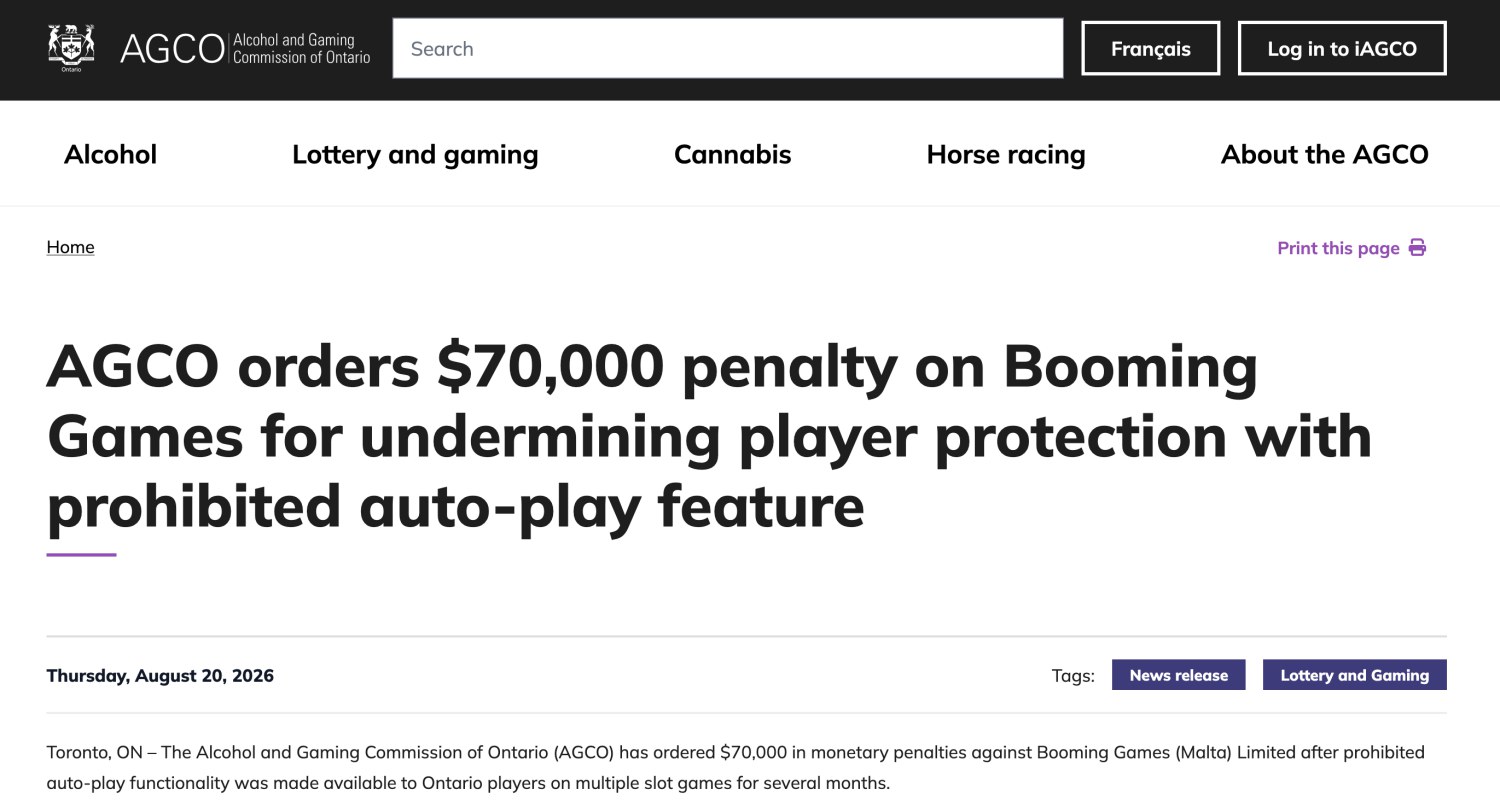
Booming Games (Malta) Limited holds a supplier registration in Ontario, and on 20 August the province's regulator used it against the studio. The bill came to $70,000, across two standards, over a feature its slots were never allowed to ship with.[1]
The order lands on the studio that built the games, not on the site where Ontario players found them. Registration is what makes a supplier answerable for how its titles behave once they are live.[1]
A button, and why the province took it away
The feature at issue takes the player's hand off the game. Start it and the reels keep going, wager after wager, with no further decision from whoever is sitting there.
Ontario's case against that is mechanical rather than moral. Every spin you have to start yourself is a decision point, a chance to — in the AGCO's phrase — "assess their play". A slot left running deletes those points one after another.[1] Put the press back and the game acquires what the regulator calls a "deliberate pause" between one wager and the next. That gap is where it expects awareness and control to hold.[1]
A rule built around a second or two is unusual. It treats the shape of a game as a safety control, not a design choice left to whoever writes the code.
Two standards, one with reach
Both breaches sit in the Registrar's Standards for Internet Gaming. Requirement 2 of Standard 2.16 is the narrow one: slot titles must not carry the feature at all.[1]
Requirement 3 of Standard 4.09 is the one other suppliers should read. Monitoring and testing have to run for as long as a gaming system is in service. Here they did not, so the games could not be shown to be behaving the way they had been approved to behave.[1]
Sign-off at launch, in other words, is not a closed file. A title that drifts away from its approved behaviour is in breach even if it went live clean. The province markets this rulebook as strict, and alongside the auto-play ban it sets a floor on how quickly one spin may follow another.[1]
Nobody reported it
There is no complaint behind this file. The AGCO credits its own targeted compliance work, and the feature was switched off on the affected titles once it told the operator carrying them.[1]
What the investigation found was a failure spread across configuration, testing and monitoring — before those games reached Ontario, and while they were running.[1] Both halves of that duty belong to the supplier.
What the release does not say
No count of players, spins or money appears anywhere in it. "Several months" is the whole of what Ontario will say about duration, with no start date attached.[1]
The games are not named and neither is the operator, and nothing records a player as harmed or repaid. Booming Games has 15 days to take the order to the Licence Appeal Tribunal;[1] whether it has done so is not stated.
If you play slots
An auto-play button on a slot served to you in Ontario means the game is not set up the way the province requires. The regulator treats that as the supplier's failure, not yours. In many other licensed markets the same button is perfectly legal. Its presence marks which rulebook a site works under, not whether the site is honest.
Which rulebook applies comes back to which regulator licenses the site. Our gambling regulation map covers how to check, and our article on what a licence from elsewhere is worth explains why the answer matters.
Sources
- Alcohol and Gaming Commission of Ontario — AGCO orders $70,000 penalty on Booming Games for undermining player protection with prohibited auto-play feature (20 August 2026). The $70,000 total against Booming Games (Malta) Limited, its registration as a gaming supplier, the games available for several months, both quoted phrases and the reasoning around them, the description of Ontario's game-design standards including the auto-play prohibition and the minimum time between spins, both cited standards, the finding that the fault came from the AGCO's own proactive compliance work and that auto-play was then disabled, and the 15-day route to the Licence Appeal Tribunal.



