

Ten spins on a Monday
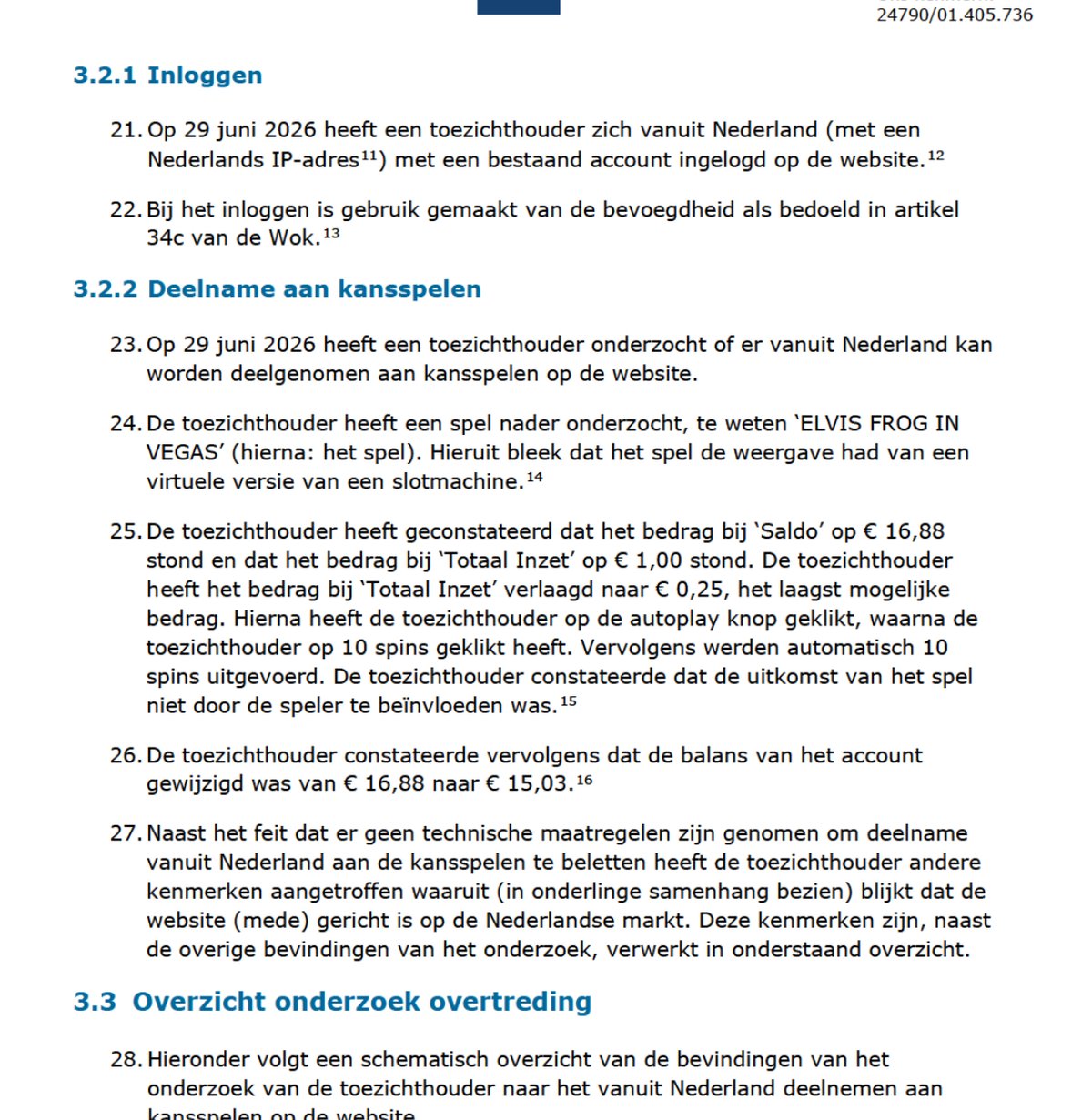
On 29 June, an inspector at the Kansspelautoriteit (KSA), the Dutch gambling regulator, accessed the site from a Dutch internet address, exercising a specific investigatory power granted under the Dutch Gambling Act.[2]
The game was a slot machine called Elvis Frog in Vegas. The account held €16.88. The stake was initially set at €1.00, but the inspector lowered it to 25 cents — the lowest the game allowed — before pressing autoplay for ten spins. The ten spins ran automatically, requiring no further input from the player. When they finished, the balance read €15.03.[2]
That constituted the entirety of the offence: a game of chance was offered to someone in the Netherlands by a company without a Dutch licence. Nothing prevented Dutch players from taking part, and the regulator found further indications that the site was actively targeting the Dutch market.[1][2]
What the order says
The company has four weeks from the decision date to halt operations and ensure they remain stopped. That requires closing off every avenue for playing from the Netherlands: the specific site the inspector used, any other site the company owns or runs, and any app that provides the same access.[2]
After the four-week grace period, each week — or part of a week — of non-compliance will cost €487,000, capped at a ceiling of €974,000.[2]
The regulator had previously written twice, on 10 April and 21 May, to warn that this action was imminent and to invite a response. Nobody replied.[2]
How the regulator arrived at €974,000
The penalty is designed to have a deterrent effect, and the regulator calculates it using two distinct estimates.[2]
The first component is the cost of compliance: approximately €800,000 to enter the Dutch market and roughly the same amount each year to maintain the licence, based on the government's own figures.[2]
The second component is the company's estimated earnings from the country. The regulator uses a published methodology that estimates revenue based on search volumes; it calculated Virtual Connect's Dutch takings for January 2026 at €348,000 a month — or €87,000 a week. Two weeks of that revenue equals €174,000.[2]
Adding the annual licence cost to the two weeks of revenue yields €974,000. The weekly penalty is exactly half of that total.[2]
Why this matters to a player
The order was signed on 7 July and published on 15 September. In the intervening months, a player could not have known about it.[1] Until a site is forcefully blocked or voluntarily complies, it continues accepting deposits from people who may never realise it operates illegally.
An unlicensed site sits entirely outside the Dutch player protection system: it bypasses the national exclusion register, deposit limits, loss monitoring, and any formal dispute resolution processes. Ultimately, a player's money sits with a company over which Dutch law has no practical control.
The company has the right to object to the decision within six weeks of being officially notified.[2]
Sources
- Kansspelautoriteit (Netherlands) — Virtual Connect S.R.L. (published 15 September 2026, Dutch). That the company offers gambling through luckygem.com without a Dutch licence, and that an order under penalty payments has been imposed.
- Kansspelautoriteit (Netherlands) — Last onder dwangsom, Virtual Connect S.R.L. (decision of 7 July 2026, PDF, Dutch). The inspector's test and its figures, the two warning letters and the silence, the four-week deadline, the scope of the order, the licence-cost and revenue estimates, the €487,000 a week and the €974,000 ceiling, and the six weeks to object. Pages after the first are scanned images; the passages used here are transcribed in this bundle's evidence folder.



