

What the regulator did
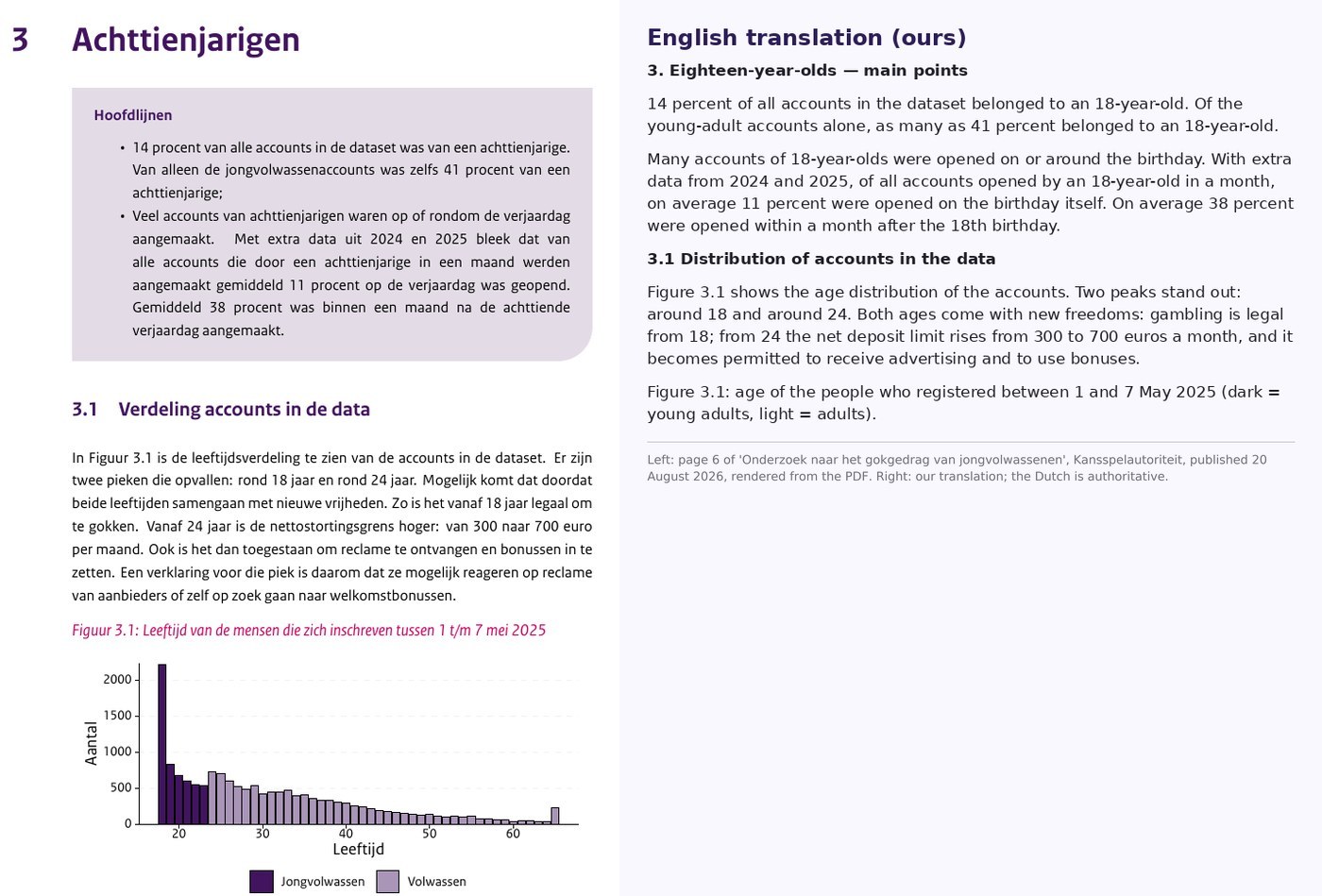
On 20 August the Kansspelautoriteit, the Dutch gambling authority, published three studies on young people and gambling. One of them is its own work. It took every account opened at a licensed online operator between 1 and 7 May 2025 that placed a bet that month — 15,761 accounts — and followed them to the end of July. It can do that because licensed Dutch operators feed player data into a control database the regulator runs. The other two studies are a survey of vocational students and a set of interviews with teenagers.[1]
What the account data shows
Break those 15,761 accounts down by age and 5,244 sit in the 18-to-23 band. Inside that band, 2,144 belong to 18-year-olds — 41 percent. Counted against every age group in the data, 18-year-olds are 14 percent of all the new accounts, more than any other single year of age.[2]
Bringing in extra data from 2024 and 2025, the regulator puts 11 percent of the accounts opened by 18-year-olds on the birthday itself, and another 38 percent inside the month that follows it. At every other age, the one-month figure sits around 10 percent.[2]
Eighteen-year-olds also play on more days. Among accounts active across all three months, the median 18-year-old gambled on 12 days a month, against 8 for the 19-to-23 group. What they stake is smaller: a median of 88 euros per gambling day in the first month, next to 193 euros for 19-to-24-year-olds and 209 for adults over 24.[2]
Earlier work had led the regulator to expect sports betting as the entry point, with casino games arriving later. This data does not show that. Seventy-two percent of young-adult accounts opened with casino games only, 11 percent with sports only and 17 percent with both; for 18-year-olds the split was 66, 9 and 26. Of the accounts that began casino-only, 97 percent were still casino-only the month after.[2]
What the students said
The second study leans on a lifestyle questionnaire that vocational schools (MBO) already run, with 29,724 answers across two school years. Thirty-two percent of the students had gambled in the past year — 28 percent of those under 18, and 39 percent of the adults. On the three screening questions the survey asks, 2 percent of all students scored as experiencing gambling harm. Of the minors who gamble, 51 percent had used at least one of the highest-risk products, which means casino games, sports betting or slot machines; for the adult students the figure was 65 percent.[3]
The third study is interviews: 24 young people aged 16 to 21, 22 of them boys, describing how they started. Scratch cards from parents came first, at 8 to 12. Betting on football or playing poker with friends followed at 12 to 14. Online sites arrived at 14 to 16, reached through an account belonging to an older friend, a brother or a father. It is small and qualitative and gives no percentages, by design.[4]
What it means
The Dutch market is licensed and watched closely: monthly deposit limits stay lower until a player turns 24, and adverts and bonuses may not be aimed at anyone younger.[2] Every number above comes from operators working inside those rules. So this is a picture of a legal market on the day a customer turns 18 — close to half signing up within weeks, going straight to casino games, and playing often for small amounts.
Two limits are worth carrying with the numbers. The account data covers licensed sites only, so anyone playing on an unlicensed site is invisible to it. And the student survey is self-reported, from the schools that chose to run it, which the regulator says makes it unrepresentative. Even so, a public view of new young players inside a regulated market is rare. Anyone in a country still deciding how to license online casino, Japan among them, has something to read here.
Sources
- Kansspelautoriteit — Nieuwe inzichten in gokgedrag minderjarigen en jongvolwassenen (20 August 2026). The announcement of the three studies and the headline figures.
- Kansspelautoriteit — Onderzoek naar het gokgedrag van jongvolwassenen (PDF, published with the announcement). The control-database analysis: 15,761 accounts, the age split, birthday timing, days and stakes, and the casino-first finding.
- Kansspelautoriteit — Gokgedrag en gokschade bij mbo-studenten (PDF). The vocational-student survey: 29,724 respondents, prevalence, harm and product risk.
- Youngworks for the Kansspelautoriteit — Kansspelreis onder 18 jaar in beeld (PDF, July 2026). The interview study: 24 young people aged 16 to 21.



