

Since 1 April 2025 Ukraine has had a new set of rules for gambling advertising, written into Article 22-1 of the Law on Advertising by Law No. 4116-IX. Almost everything is banned. A short list of places is allowed, and even there the ad must carry a warning, a licence number and no banned faces. The fine is 600 minimum wages, and it can land on the site or channel that ran the ad, not only on the casino. This guide sets out the rules as the law and the regulators publish them, checked on 17 August 2026. It is written for editors, bloggers and site owners, because they are the ones the fine reaches. It also covers the two questions they ask most: does the law reach a site outside Ukraine, and when does a guest article or a link become an ad.
If you publish anything in Ukraine, a news site, a Telegram channel, a TikTok account with a few thousand followers, the gambling-ad rules are your problem too. Three parties can be fined for a bad ad: whoever ordered it, whoever made it and whoever ran it.[1] The one who ran it is you. Nothing here explains how to dodge the rules. It lays out what they say, where they came from and what a breach costs.
How the ban came about
The story starts in the army. In April 2024 Ukraine's security council, the NSDC, decided that online gambling was doing harm, and a presidential decree gave that decision legal force. The government followed on 17 May 2024 with Resolution No. 566. Using its martial-law powers, it cut back the spread of gambling ads and gambling brands, online included, and singled out ads that used army symbols. It was a stopgap by design: it ran only until a proper law arrived, and in no case beyond martial law.[2] A fortnight later the media regulator, the National Council, told outlets that in its reading the resolution amounted to a full ban. The Law on Advertising said nothing of the kind yet, the Council admitted, but KRAIL, the gambling regulator of the day, could still fine anyone who ignored it.[3]
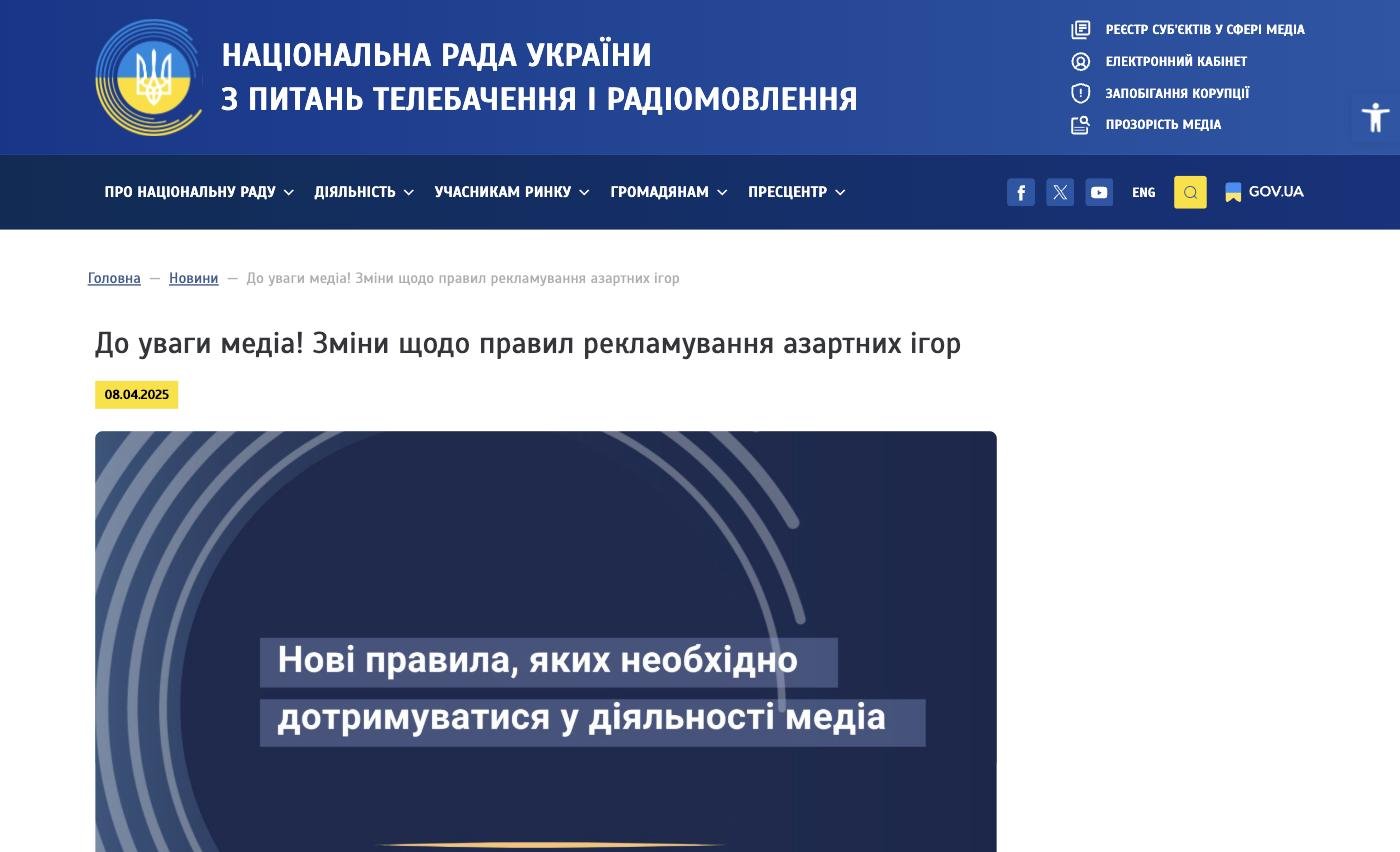
The dedicated law arrived in December 2024. Parliament passed bill No. 9256-д on 4 December, and it became Law No. 4116-IX. The head of the finance committee summed up the advertising part in one line: there would be no more gambling advertising on the streets.[4] The law also wound up KRAIL and handed its powers to a new agency, PlayCity, which the Cabinet created in March 2025.[5] Law 4116-IX was published on 4 January 2025 and came into force on 1 April 2025, and that is the date from which the current rules apply.[1][19] How the market got from a total ban to licences at all is told in our explainer on gambling in Ukraine.
What counts as a gambling ad
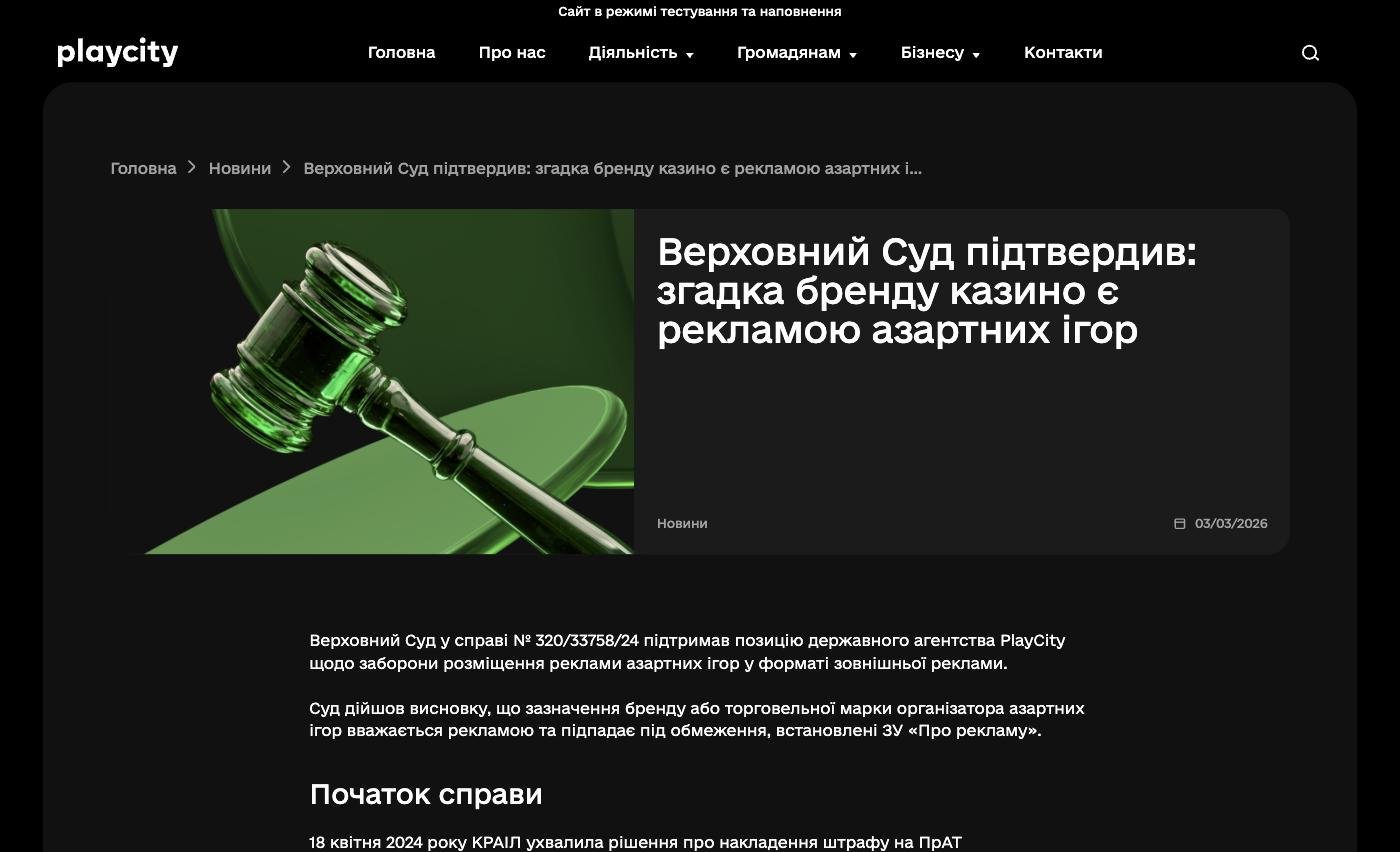
The net is wide. Article 22-1 catches ads for the games themselves, ads for the trademarks and other intellectual property the games are run under, and ads for any other name they are run under.[6] In plain terms: a brand name is enough. You do not need a "sign up" button. The Supreme Court settled that in case No. 320/33758/24. Back in April 2024 KRAIL fined a broadcaster, ПрАТ «Телерадіокомпанія Люкс», for outdoor advertising that carried a gambling operator's brand. The company fought it through the courts. In March 2026 PlayCity reported that the Supreme Court had upheld the fine, holding that information about an operator's brand is gambling advertising.[7]
The same article stretches the definition further. Any message about charity done by an operator, its affiliates or anyone else using the operator's brand counts as gambling advertising. So does naming an operator or its brand as a sponsor or partner in someone else's ad materials.[6] The one thing carved out is the app store: an operator listing its own gambling app in a mobile app store is not advertising.[6]
Does the law reach a website outside Ukraine?
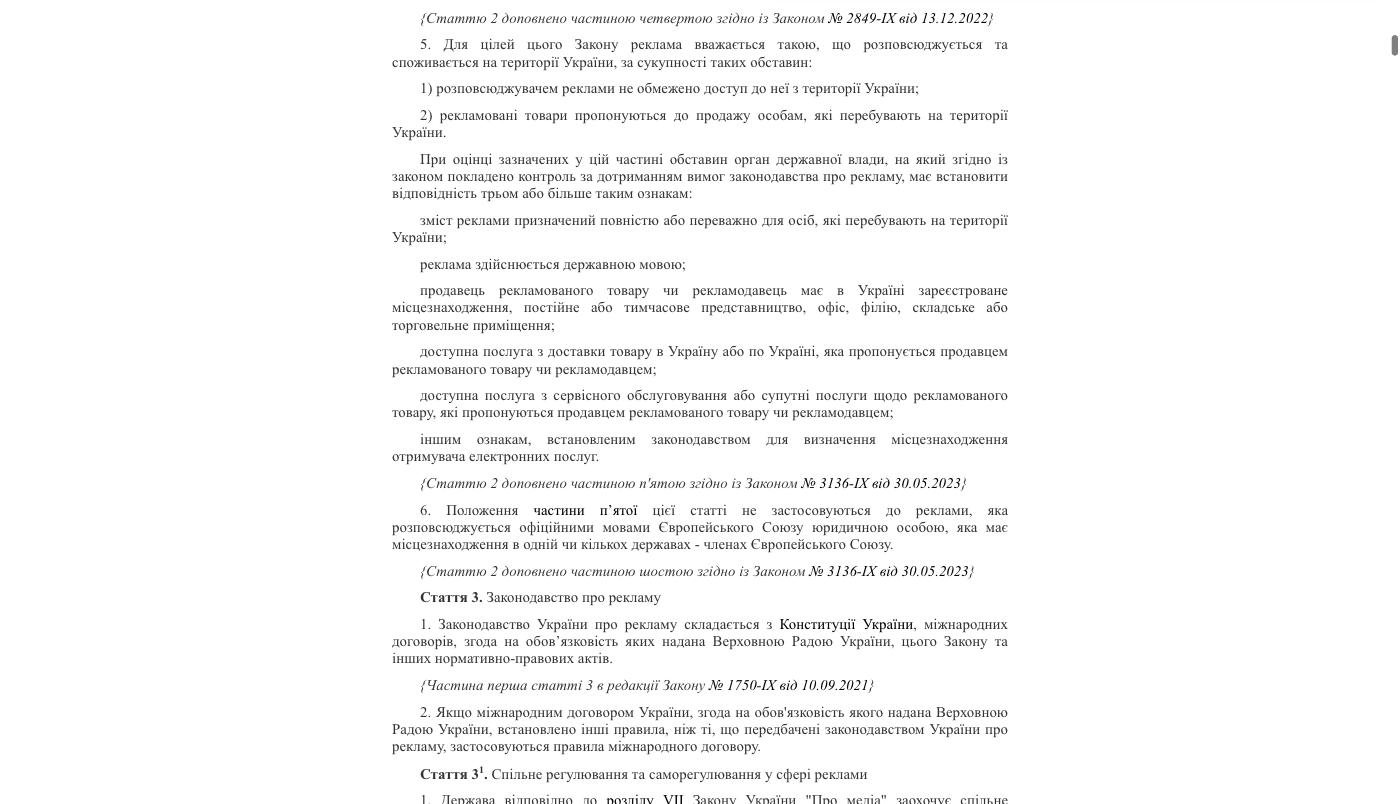
The Law on Advertising applies to ads made, run and seen inside Ukraine.[6] For the internet it spells out what "inside Ukraine" means, in Article 2, part 5. An online ad is treated as Ukrainian only if two things hold at once: nobody has blocked Ukrainian visitors from seeing it, and whatever it sells is on offer to people who are in Ukraine. Even then the regulator must tick at least three boxes out of six:[6]
- the ad is written wholly or mostly for a Ukrainian audience;
- it is in Ukrainian;
- the seller or advertiser has an address, office, branch, warehouse or shop in the country;
- the goods can be delivered to or around Ukraine;
- service or support for those goods is offered in Ukraine;
- any other marker the law uses to place a buyer of electronic services.
Part 6 then carves out ads in an official EU language published by a company based in an EU member state; the test does not apply to them at all.[6]
So a page in another language, built for another market and run by a company with no foothold in Ukraine is not caught simply because someone in Kyiv can open it. The gambling statute draws its own, separate line. It bans distributing, or opening access to, websites and apps inside Ukraine that plug into the servers of an unlicensed operator, and it orders the regulator to keep a public, up-to-date list of sites that run gambling, or lead to it, with no licence.[10] That list is the PlayCity domain-check tool walked through in our register guide. Neither clause replaces legal advice on a particular site; they are simply the two spots where the geography question is written into the law.
Where an ad may legally appear
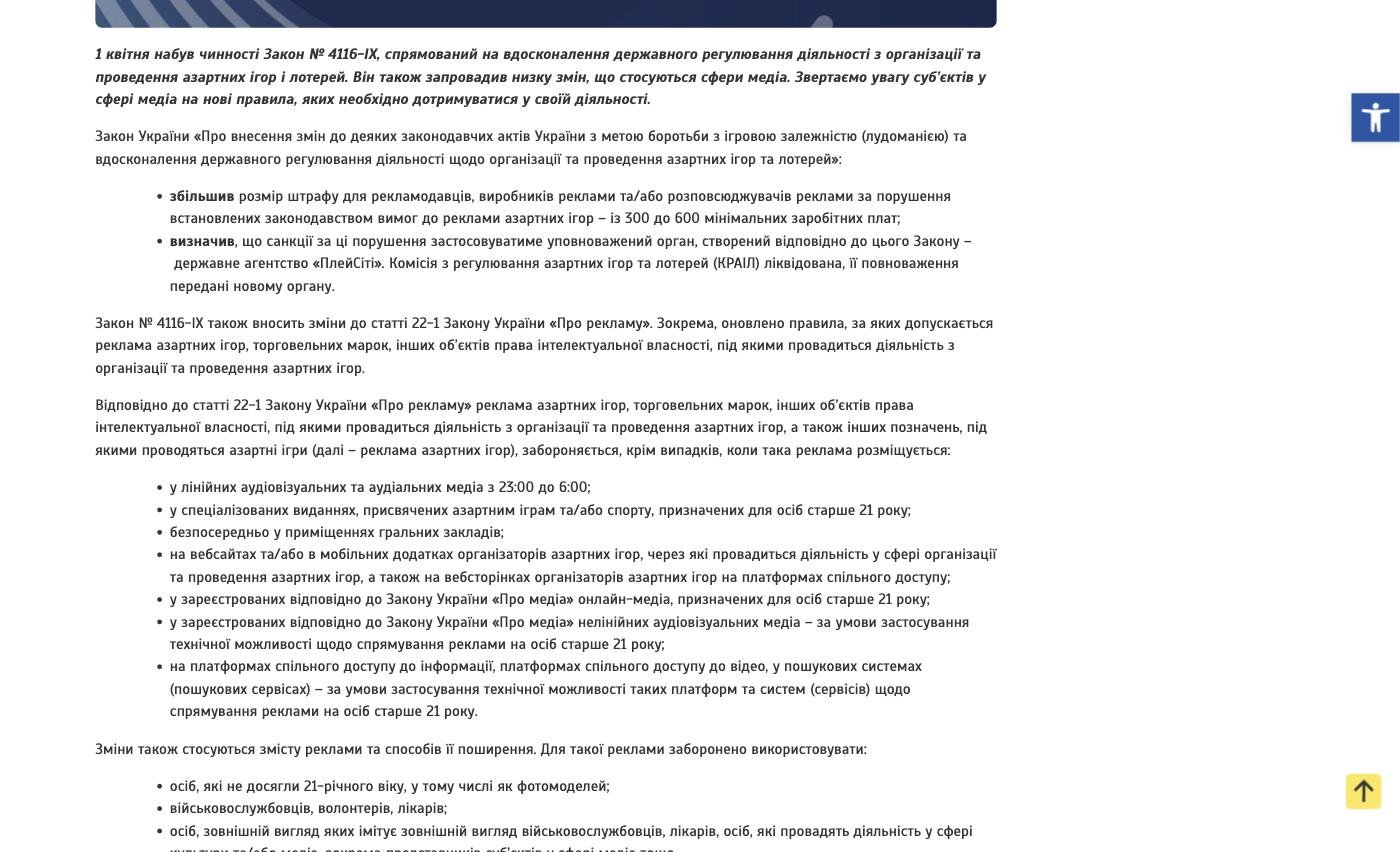
The rule is a ban with a closed list of exceptions. Article 22-1 forbids gambling advertising everywhere except:[1][6]
- TV and radio, but only between 23:00 and 06:00;
- specialist gambling or sports titles written for readers over 21;
- the inside of a casino, slot hall or betting shop;
- an operator's own website and app, the ones the games actually run on, and its own pages on sharing platforms;
- in online media registered under the Law on Media and aimed at people over 21;
- in registered non-linear audiovisual media (video on demand), provided the ad is technically targeted at people over 21;
- on information-sharing and video-sharing platforms and in search engines, again only where the platform can target the ad at people over 21.
Read that list from a publisher's chair. A general-interest news site is not on it. Neither is a personal Instagram or Telegram account, a billboard, a bus wrap or a printed weekly. The National Council spelled the print rule out in a notice to newspapers: gambling ads are banned in all print media except specialised gambling titles.[9] A registered online medium is on the list, but only one that is aimed at an over-21 audience, and there is a further catch we come to below.
What is banned outright, wherever the ad runs
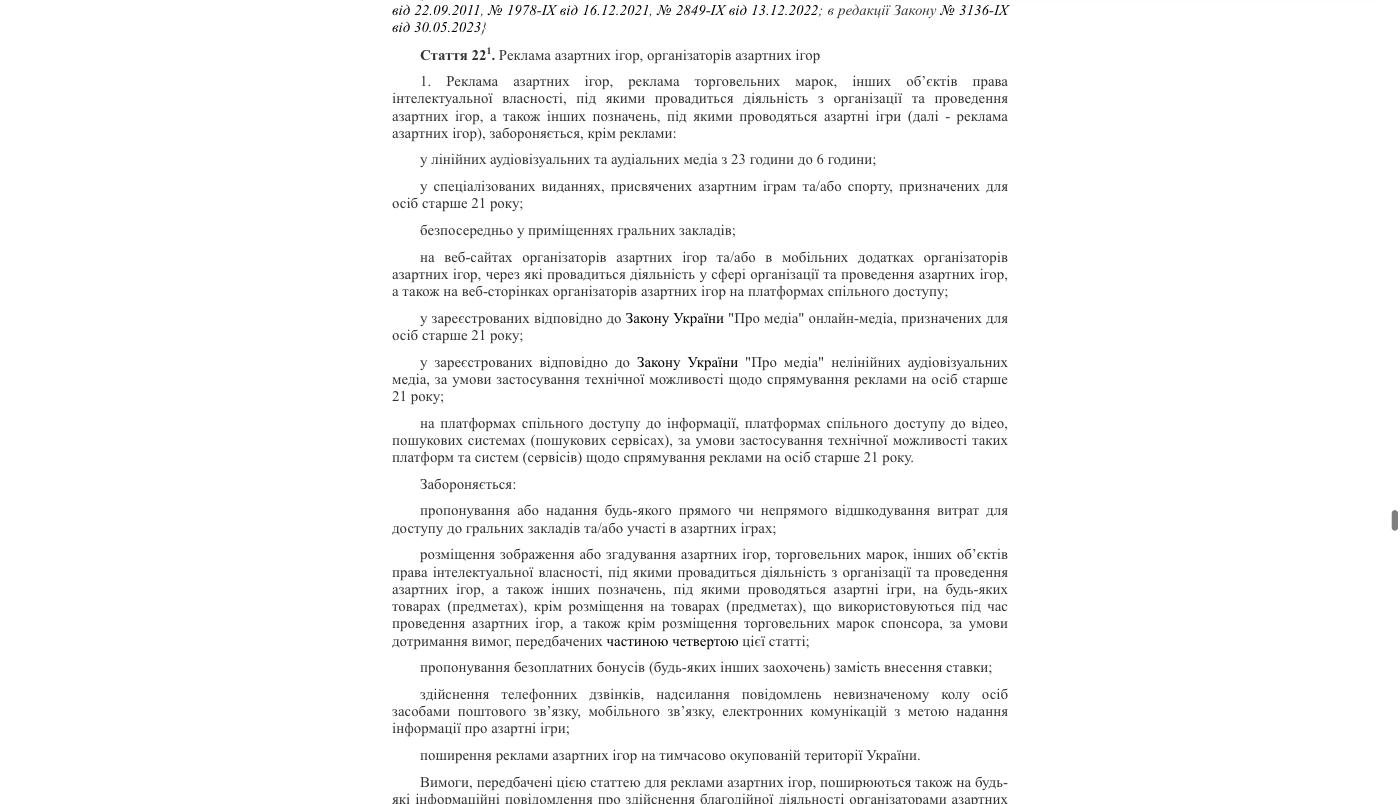
Even inside the allowed places, some things are always off limits. The article names five:[6]
- offering or paying any direct or indirect compensation for access to a venue or for taking part in a game;
- putting gambling brands on goods, other than gaming equipment and sponsor marks under the sponsorship rules;
- dangling a free bonus or any other sweetener in place of a stake;
- cold calls and bulk messages, by post, phone or online, to people at large about gambling;
- gambling ads of any kind in the temporarily occupied territories.
Product placement of gambling is banned in full.[1][6]
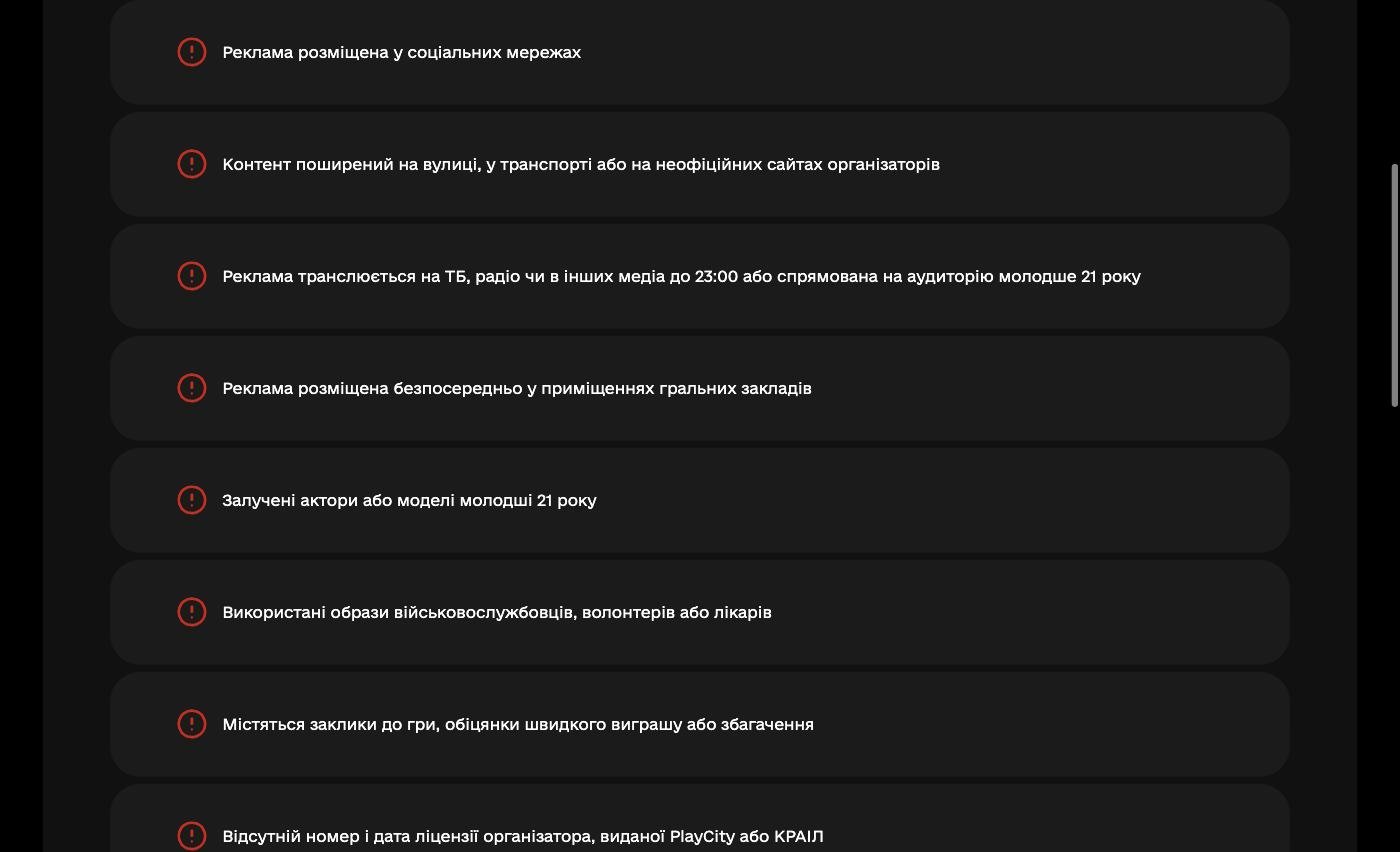
Then there is the content. An ad must not suggest that winning is easy, that gambling can pay the bills or that it can stand in for a job.[6] It has to be truthful, with nothing false, misleading or staged.[6] And it must not be pointed at groups the law calls vulnerable: children, people on low incomes, people with mental illness.[6] And only a company holding the relevant Ukrainian gambling licence may order an ad; promoting an unlicensed operator or its brand is banned in every form.[6][9] That licence is not cheap. For an online casino it costs 6,500 minimum wages over five years, about 56 million hryvnias or 1.26 million US dollars at 2026 rates. That is paid in equal yearly instalments of roughly 250,000 dollars, and each instalment is tripled until the state online-monitoring system is formally put into service.[20][11][12] How that licence shows up in the public register, and how to check the number an advertiser gives you, is the subject of our step-by-step guide to the PlayCity register. PlayCity's own page for the public says the same in everyday words: urging people to play, promising fast money, leaving out the licence number and date, leaving out the harm warning.[18]
Who may not appear in the ad
This is the part that changed most in 2025, and it is where publishers get caught. Under part 2 of Article 22-1 nobody under 21 may take part, not even as a model in a photo. Soldiers are out, and so are volunteers, doctors and other medical staff, along with anyone dressed up to look like a soldier or a doctor.[1][6]
It then bans a whole group the law calls "popular persons". That covers people working in culture or media, including staff of media outlets, professional creative workers, staff of cultural institutions, makers of information products and public figures. It also covers anyone who regularly spreads mass information under their own editorial control through their own accounts on sharing platforms for profit. Athletes are the only exception.[6] A blogger with a monetised account is a "popular person" under this wording. Such people may not take part in a gambling ad, may not promote or encourage gambling directly or indirectly, and their images and names may not be used. Neither may characters from films, TV series or cartoons.[6]
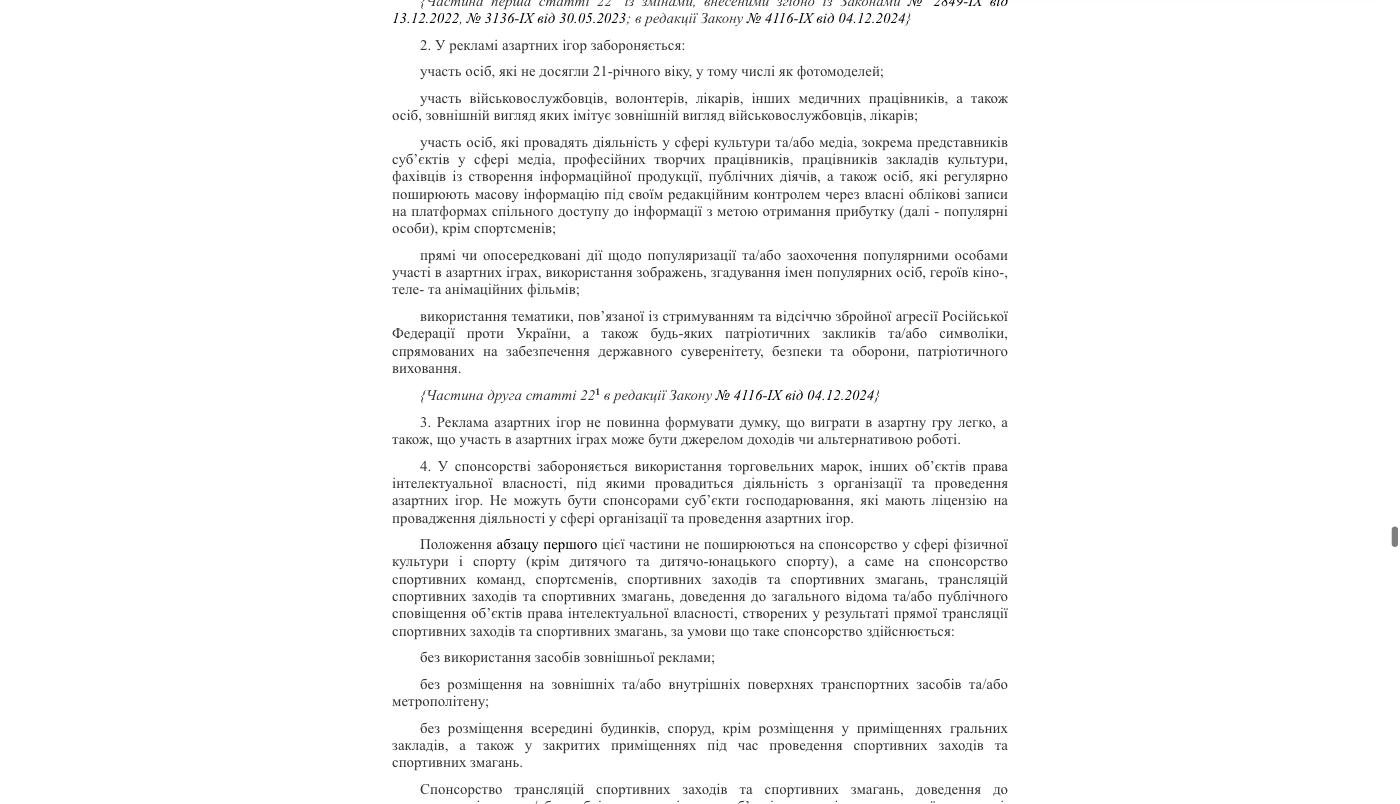
The last ban is about the war. An ad may not use themes linked to the deterrence and repulsion of the armed aggression of the Russian Federation against Ukraine. Nor may it use patriotic appeals or symbols meant to serve state sovereignty, security, defence or patriotic education.[6] The National Council's own summary of the new rules lists the same groups: under-21s, servicemen, volunteers, doctors, and look-alikes of soldiers, doctors, culture and media people.[1]
What every legal ad must carry
An ad that clears all of the above still has fixed parts. It must carry a text or audio warning with these exact words: «Участь в азартних іграх може викликати ігрову залежність. Дотримуйтеся правил (принципів) відповідальної гри». A text warning takes at least 15 percent of the whole ad's area, in black letters on a white background. An audio warning is played at least once per spot and at least once a minute, at the same volume and speed as the rest of the sound.[6][9] The ad must also state the licence: its number, its issue date and the name of the body that issued it.[6][9] Under the current law the issuing body is PlayCity; older ads may still name KRAIL, and PlayCity's guidance treats a missing number or date from either as a defect.[18] A publisher can check the number the advertiser supplies against the state register, and the guide linked above shows where that register is.
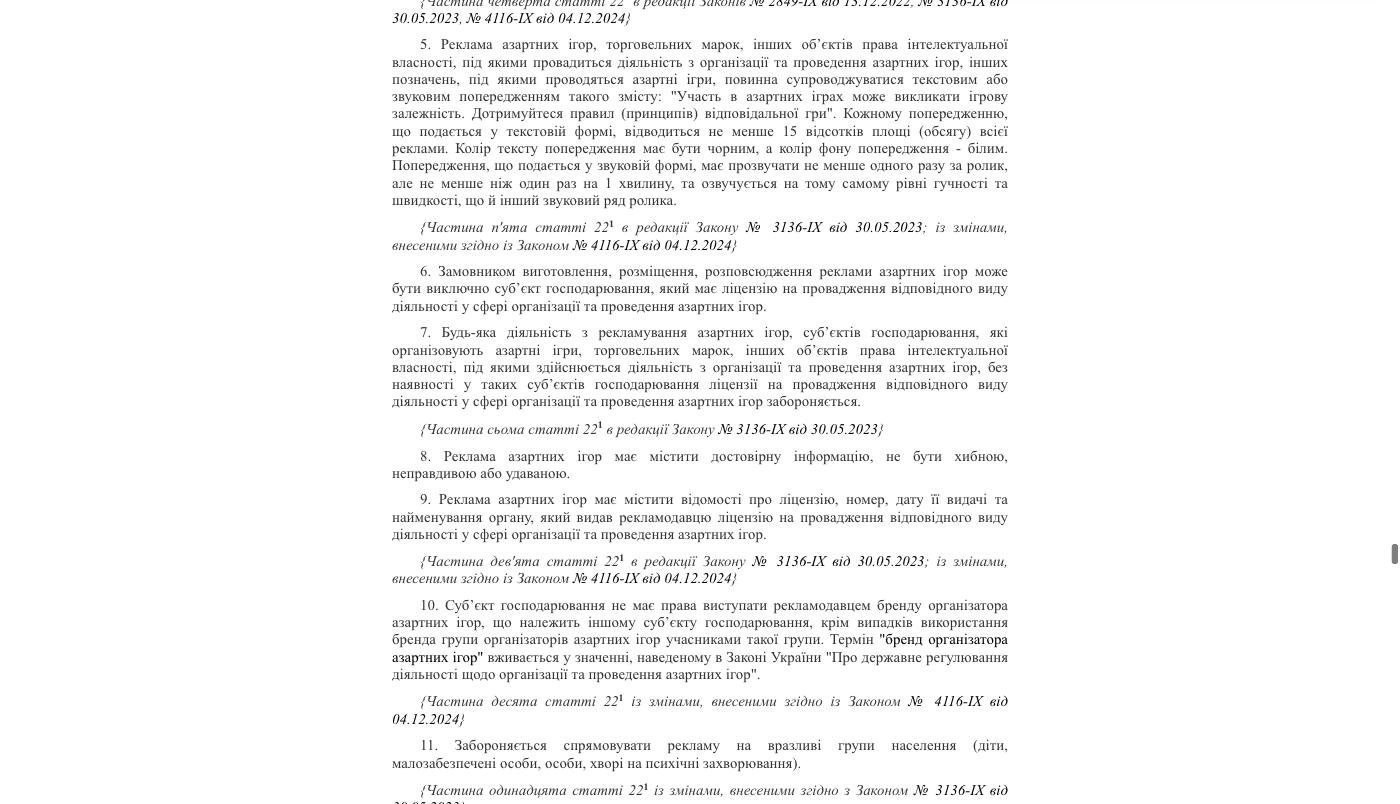
Sponsorship has its own rules. Gambling brands may not be used in sponsorship, and licensed operators may not act as sponsors, with one exception: sport, other than children's and youth sport. Even there the sponsorship must run without outdoor advertising and without placement on or inside vehicles or the metro. Placement inside buildings is out too, except in gambling venues and in closed arenas during events. Sponsoring a sports broadcast with a gambling brand is allowed only in media that hold the rights to that broadcast.[6]
The extra step for media: co-regulation codes
Part 12 of Article 22-1 gives the media co-regulation bodies a job. They set the requirements for distributing gambling ads in media by adopting codes, or rules.[6] On 22 April 2025 the National Council published its reading of that clause. In its view, media entities may not distribute gambling advertising until the co-regulation bodies for each kind of media, audiovisual, audio, online, print and video-sharing platforms, have approved such codes.[8] The Council described the codes as a legal instrument meant to refine Article 22-1 for the age profile of each medium and to protect vulnerable groups.[8]
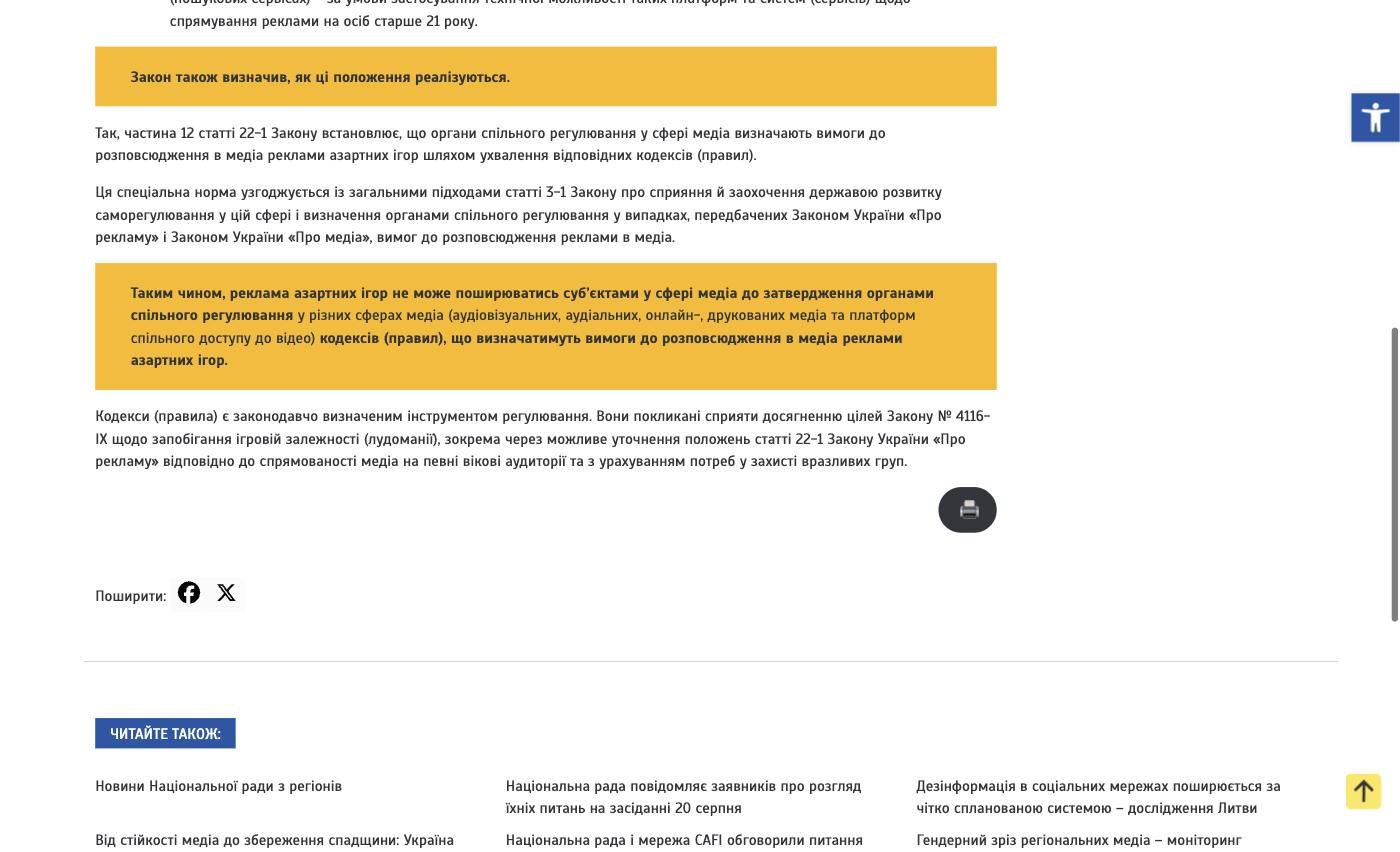
What this means in practice is that being a registered over-21 online medium is a necessary condition, not the whole test. An outlet on the allowed list still has to find out, before it runs anything, whether a code exists for its type of media and what that code says. The people to ask are its own co-regulation body and the National Council; the answer may have moved since this was written, and this page does not follow it.
Who pays, and how much
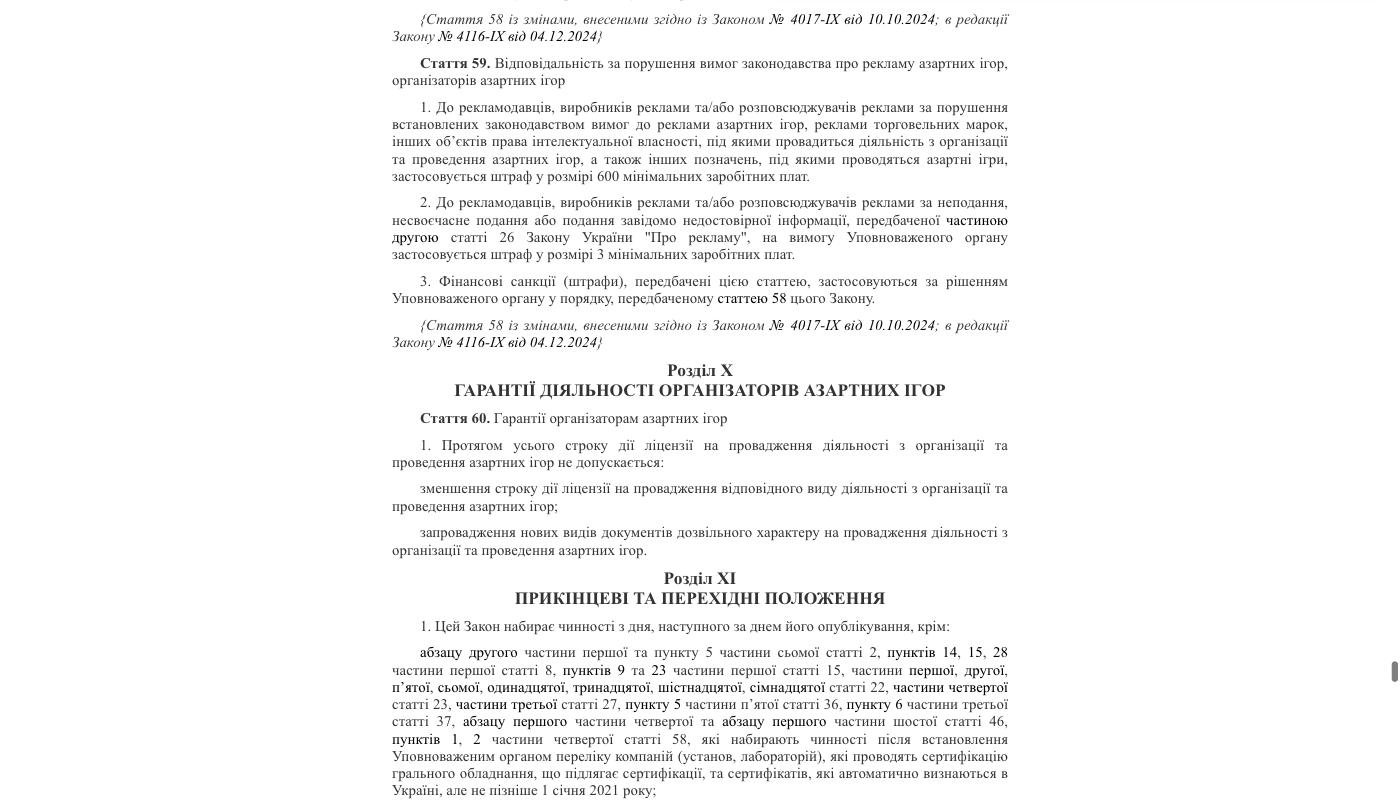
The penalty lives in Article 59 of the gambling statute, Law No. 768-IX, in the wording Law 4116-IX gave it. Whoever ordered, made or ran an ad that breaks the gambling-ad rules is fined 600 minimum wages. Ignoring the regulator's request for information under the Law on Advertising costs 3 minimum wages. Both are handed down by the authorised body, which is PlayCity.[10] When the law came in, the National Council put the change plainly. The fine went up from 300 to 600 minimum wages, and the body applying it is now PlayCity rather than KRAIL.[1] Read alongside it, the Law on Advertising points the same way. Its general fine article says financial sanctions for gambling-ad breaches are applied under the gambling law. It adds that media outlets answer to the National Council, under the Law on Media, when they break the rules on how ads are run.[6]
In money, 600 minimum wages meant 4.8 million hryvnias in 2025. From 1 January 2026 the minimum wage is 8,647 hryvnias, so the fine is 5,188,200 hryvnias, roughly 116,000 US dollars at the National Bank of Ukraine rate for 17 August 2026.[11][12] PlayCity's own complaint page quotes the same 5,188,200 figure for a 2026 fine.[15] The Ministry of Digital Transformation adds the timetable: a fined party has three months to pay voluntarily or to appeal, after which the case goes to the enforcement service.[13]
Each offender pays a fixed sum, and the distributor is an offender in his own right. Audience size does not change the amount.
How it has been enforced so far
PlayCity's first-year report gives the scale: about 80 million hryvnias in fines for breaches of advertising law. More than 700 social-media accounts were passed to the platforms for blocking over illegal gambling ads.[14] In December 2025 the ministry reported that in six months of checks the agency had fined 14 bloggers, websites and media outlets a total of 67.2 million hryvnias. The two most recent cases were Instagram bloggers with over half a million followers each, fined 4.8 million hryvnias apiece for promoting casinos.[13] The same notice listed what the agency treats as violations: content that shows the game interface, stakes or winnings; promotion of unlicensed brands; promises of bonuses or free play; gambling presented as easy income; and advertising dressed up as personal experience.[13]
The agency reports the platform side month by month. In February 2026 it found 87 TikTok accounts carrying illegal gambling ads and passed 27 Meta pages for blocking.[17] On 30 April 2026 it opened an online complaint form for illegal gambling ads at playcity.gov.ua. The form covers social media, websites, TV, radio, outdoor and public places, and it archives the material automatically because stories disappear.[15] Two weeks later it had received more than 250 complaints through the form.[16] The Radio Lux case shows the older, offline end of the same enforcement. The Supreme Court ruling in it is now the reference point that a brand mention alone is an ad.[7]
Guest posts, paid articles and links
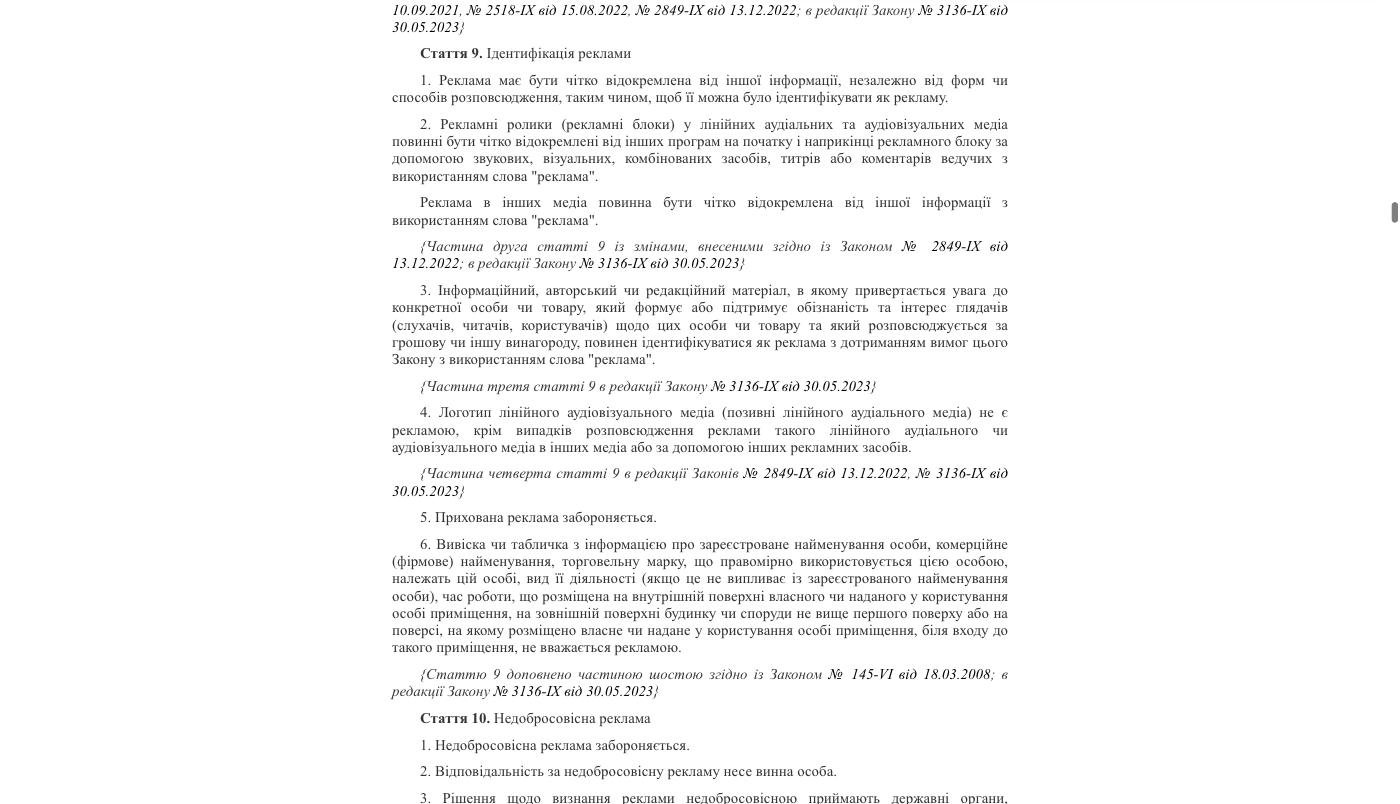
Editors ask this one most: does a guest article that touches gambling count as an ad, and what about the link inside it? The law answers on two levels. The first is the general rule in Article 9. Readers must be able to tell an ad from the rest of the page; outside broadcasting that means the word «реклама» on it. A piece of news, opinion or feature writing that has been paid for, and that pushes attention and interest towards one particular company or product, has to carry that same label. Disguised ads are banned full stop.[6] This level is about labelling, and it applies to every paid article on every subject.
The second level is Article 22-1 itself, and what defines it is its subject matter: the games, the operators, their trademarks and the other names they trade under.[6] A text can talk about the gambling market, the law, the regulator or the fines and contain none of those. The moment it names an operator or a brand, quotes a bonus or nudges the reader to play, it does contain them, and everything above kicks in: the allowed-places list, the warning, the licence line, the ban on "popular persons".[6] The ministry's list of what PlayCity punishes is the same test in practice. Game screens, stakes or winnings on show; unlicensed brands; bonuses or free play; gambling sold as easy money; ads dressed up as personal experience.[13] Calling a piece "editorial" settles nothing; what it draws the reader towards does.
Hyperlinks are not mentioned in the law at all. It regulates information about gambling and about operators' brands, whatever the channel. For an editor that boils the link question down to one plainer question: where does this send the reader? A link to a rules explainer, a regulator's page or a court ruling sends them to nothing Article 22-1 covers. A link whose anchor or landing page is an operator, a brand or a bonus does. The words of the anchor count in the same way. None of this is an invitation to be clever with phrasing; it is only where the statute happens to draw its line.
What this means if you publish things
None of this is legal advice, and the codes question above shows the picture can move. But the rules as published come down to a short set of questions a publisher can put to any gambling-related material before it goes out.[6][7]
- Is this outlet on the list of allowed places at all? If it is a registered online medium, is it aimed at over-21s, and has the co-regulation code for its kind of media been adopted?
- Does the advertiser hold a Ukrainian licence, and are its number, date and issuer printed in the ad?
- Is the warning there, filling 15 percent of the space in black on white, or spoken once a minute?
- Does anyone in it belong to a banned group: soldier, doctor, volunteer, blogger, anyone under 21?
- Does it dangle a bonus in place of a stake, an easy win or an income?
- Is a brand named anywhere, a "charity" or "partner" line included? Naming it is enough.
One wrong answer and the material is no grey area. It is a 600-minimum-wage decision waiting to be signed, and whoever ran the ad is one of the three names it can be signed against.[10] PlayCity's public list of tell-tale signs of an illegal ad is a handy mirror for the same check.[18] What a licence proves about the casino behind the ad is covered in our article on online casino licences.
Sources
- National Council of Ukraine on Television and Radio Broadcasting — "До уваги медіа! Зміни щодо правил рекламування азартних ігор" (8 April 2025). Entry into force of Law 4116-IX on 1 April 2025, the fine raised from 300 to 600 minimum wages, PlayCity as the body applying it, the list of allowed placements, the banned persons and the product-placement ban.
- Cabinet of Ministers of Ukraine — Resolution No. 566 of 17 May 2024 «Деякі питання протидії негативним наслідкам функціонування азартних ігор в мережі Інтернет». The martial-law restriction on gambling advertising, its basis in the NSDC decision of 20 April 2024 and Presidential Decree No. 234, and its duration until the dedicated law came into force.
- National Council of Ukraine on Television and Radio Broadcasting — "Національна рада звертає увагу суб'єктів у сфері медіа на дотримання заборони на рекламу азартних ігор" (30 May 2024). The Council's reading of Resolution 566 as a full ban pending the law, and KRAIL's power to fine.
- Verkhovna Rada of Ukraine — "Данило Гетманцев: Держава посилює контроль за гральним бізнесом…" (5 December 2024). Adoption of bill 9256-д in the second reading and the committee chair's summary of the advertising provisions.
- Ukrainian Wikipedia — ПлейСіті (accessed 17 August 2026). Creation of PlayCity by Cabinet resolution in March 2025 and the liquidation of KRAIL.
- Verkhovna Rada of Ukraine, legislation database — Law of Ukraine «Про рекламу» No. 270/96-ВР, Article 22-1 as amended by Law No. 4116-IX of 4 December 2024, Article 2 (scope and the online territorial test), Article 9 (identification of advertising) and Article 27. The definition, the list of allowed placements, the outright bans, the banned persons, the warning text and licence details, the sponsorship rules, part 12 on co-regulation codes, and the reference of gambling-ad fines to the gambling law.
- State Agency of Ukraine "PlayCity" — "Верховний Суд підтвердив: згадка бренду казино є рекламою азартних ігор" (3 March 2026). Case No. 320/33758/24, the KRAIL fine of 18 April 2024 on ПрАТ «Телерадіокомпанія Люкс», and the Supreme Court's holding.
- National Council of Ukraine on Television and Radio Broadcasting — "Нові правила рекламування азартних ігор: медіарегулятор продовжує надавати роз'яснення" (22 April 2025). Part 12 of Article 22-1 and the Council's position that media may not distribute gambling ads until co-regulation codes are approved; registration of online media under the Law on Media.
- National Council of Ukraine on Television and Radio Broadcasting — "До уваги друкованих медіа! Про дотримання норм Закону «Про медіа» і правил поширення реклами та спонсорства" (18 April 2024). Ban in print media other than specialised titles, the warning text and its 15-percent black-on-white rule, licence details in the ad, and licensed operators as the only permitted advertisers.
- Verkhovna Rada of Ukraine, legislation database — Law of Ukraine «Про державне регулювання діяльності щодо організації та проведення азартних ігор» No. 768-IX, Article 59 as amended by Law No. 4116-IX. Fine of 600 minimum wages on advertisers, producers and/or distributors; 3 minimum wages for failure to provide information; imposed by decision of the authorised body under Article 58. Also Article 24 (ban on giving access in Ukraine to sites connecting to unlicensed servers) and Article 25 (the published list of unlicensed sites).
- State Tax Service of Ukraine (Odesa region) — Основні соціальні стандарти з 01.01.2026: прожитковий мінімум та мінімальна заробітна плата (1 January 2026). Minimum monthly wage of 8,647 hryvnias from 1 January 2026.
- National Bank of Ukraine — Official exchange rates for 17 August 2026. 44.7061 hryvnias per US dollar, the rate used for the dollar figure.
- Ministry of Digital Transformation of Ukraine — "₴67,2 млн штрафів за незаконну рекламу казино — нагадуємо правила" (12 December 2025). Fourteen bloggers, websites and media fined 67.2 million hryvnias in six months, two bloggers fined 4.8 million each, the list of violations, and the three-month payment or appeal window.
- State Agency of Ukraine "PlayCity" — Результати першого року роботи (accessed 17 August 2026). About 80 million hryvnias in fines for advertising-law breaches and 700+ social-media accounts passed for blocking.
- State Agency of Ukraine "PlayCity" — "Запустили онлайн-інструмент для скарг на незаконну рекламу азартних ігор" (30 April 2026). The complaint form, its scope, automatic archiving, and the 5,188,200-hryvnia fine figure for 2026.
- State Agency of Ukraine "PlayCity" — "Понад 250 скарг на незаконну рекламу азартних ігор за два тижні" (14 May 2026). More than 250 complaints in the form's first two weeks.
- State Agency of Ukraine "PlayCity" — "PlayCity: результати роботи в лютому 2026 року" (5 March 2026). 87 TikTok accounts with illegal gambling ads and 27 Meta pages passed for blocking.
- State Agency of Ukraine "PlayCity" — Незаконна реклама азартних ігор (accessed 17 August 2026). The agency's public list of signs of an illegal gambling ad and the complaint form.
- Verkhovna Rada of Ukraine, legislation database — Law of Ukraine No. 4116-IX of 4 December 2024, document card. Adoption on 4 December 2024, publication in «Голос України» on 4 January 2025, entry into force of individual provisions on 5 January 2025 and of the law as a whole on 1 April 2025.
- Diia state-services portal — Ліцензія на провадження діяльності з організації та проведення азартних ігор казино у мережі Інтернет (step-by-step guide, accessed 17 August 2026). Quotes Article 53 of Law 768-IX: fee of 6,500 minimum wages, five-year term, paid yearly in equal parts, tripled until the state online-monitoring system is put into service.



