

Two bets, and what the regulator counts
Start with the word "spend", because it is not the obvious one. The Danish regulator's own worked example explains it better than any definition:
Two people bet. One stakes DKK 100 at odds of 3.0 and loses the lot. The other stakes DKK 80 at odds of 2.0 and collects DKK 160.[2]
DKK 180 went in. DKK 160 came back out. Spillemyndigheden counts the DKK 20 left over.[2]
The proper name for it is gross gaming revenue: deposits, plus any commission, minus winnings. It is, the regulator says, "the most accurate value for how much players have lost to the operators", and for the companies "a measure of 'sales' and not 'profit'".[2]
Spillemyndigheden also warns about the other number, the one people usually reach for. Turnover figures, it says, "can be misleading if the assumptions are not known".[2] Its own comparison shows why: Danish betting deposits in 2022 came to 20.1 billion kroner, against gross gaming revenue of 2.3 billion.[2]
So a headline reading "Danes gambled 17.2 percent more" would describe something the figures never measured. The growth is in the money the companies kept. The difference is not academic: Denmark's supreme court spent this month deciding who owns the money sitting in a player's account when a company collapses.
The six numbers
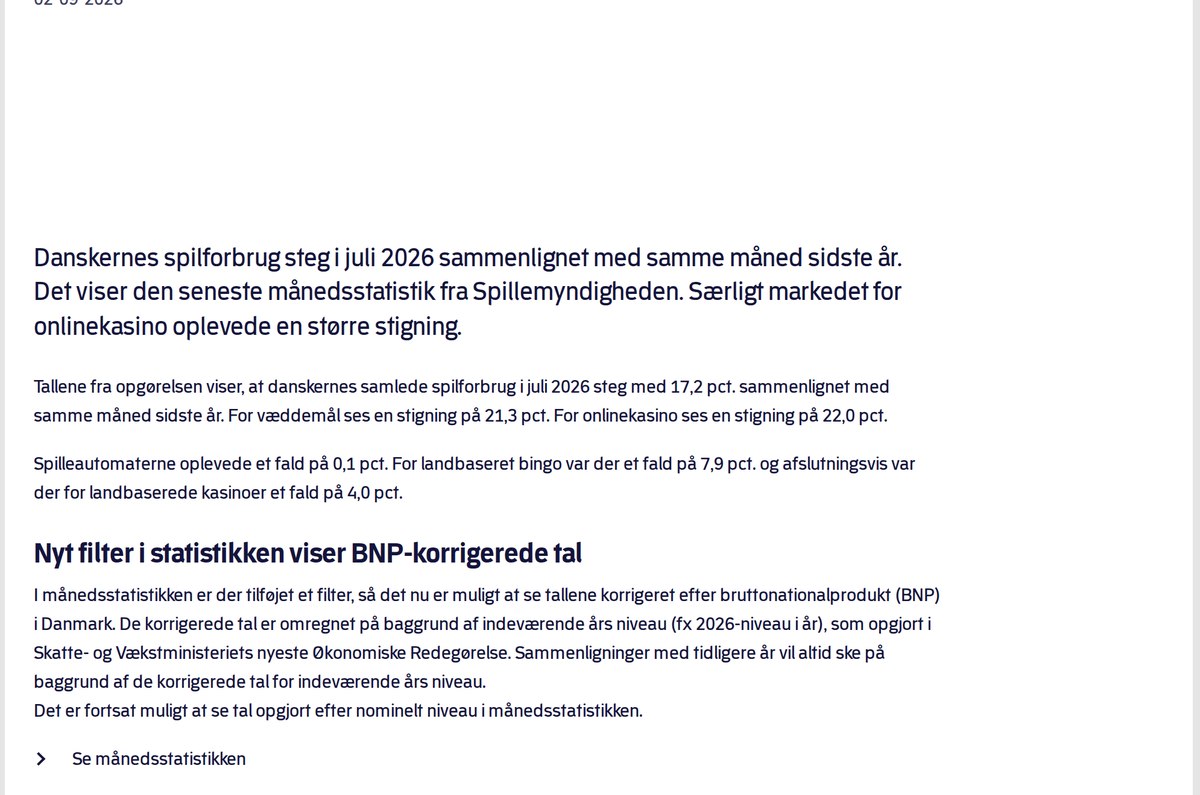
Spillemyndigheden published the July figures on 2 September. Total spend rose 17.2 percent against July 2025.[1]
Betting was up 21.3 percent and online casino up 22.0 percent. Slot machines were down 0.1 percent, land-based bingo down 7.9 percent and land-based casinos down 4.0 percent.[1] All six compare one month with the same month a year earlier.
The split falls along one line. The two things you reach from a phone each grew by more than a fifth. The three things with a door all shrank. Slot machines barely moved — 0.1 percent is flat, not a decline. Bingo halls fell furthest.[1]
July is a holiday month in Denmark, and one month against one month cannot separate a trend from a season. The release offers no longer run of figures, and neither will we.
The measuring stick moved
The same announcement carries a change that will outlast the month it was buried in. Spillemyndigheden has added a filter to its monthly statistics showing the figures adjusted for the size of the Danish economy. The adjustment uses this year's level of gross domestic product, taken from the tax and growth ministry's latest economic survey.[1]
Then comes the sentence worth keeping. From now on, comparisons with earlier years will always be made on the adjusted figures.[1] The unadjusted numbers stay available, so both views exist. But the default has moved, and a percentage that once meant one thing will now mean another.
Which basis the six percentages above sit on, the release does not say.[1]
No kroner anywhere
Not one absolute amount appears for July 2026 or July 2025. The release is percentages only.[1]
There are no player numbers either, no account counts and no self-exclusion figures. Nothing shows whether the growth came from more people playing or the same people losing more, and no operator is named.[1] The regulator does publish figures for its StopSpillet helpline and for ROFUS, its self-exclusion register, but in a separate collection that this month's release does not touch.[2]
A rising market says nothing about any one person's chances. Those are set by each game, and they do not move with a monthly statistic. The industry's income is the thing that has moved.
Sources
- Spillemyndigheden — Spilmarkedet i juli 2026: Onlinekasino og væddemål driver stigning i spilforbrug (2 September 2026, Danish; an English version is published alongside it). Total gambling spend up 17.2 percent on July 2025, betting up 21.3 percent, online casino up 22.0 percent, slot machines down 0.1 percent, land-based bingo down 7.9 percent and land-based casinos down 4.0 percent; the new filter showing figures adjusted for Danish gross domestic product, calculated on the current year's level as set out in the tax and growth ministry's latest economic survey; that comparisons with earlier years will always use the adjusted figures while nominal figures remain available; and the absence of any absolute amount, player number or operator name.
- Spillemyndigheden — Statistik (read 10 September 2026, Danish and English). The worked example of bettors A and B quoted above; the definition of gross gaming revenue as deposits plus any commission minus winnings; the statements that GGR is the most accurate value for how much players have lost to the operators and that for operators it is a measure of sales and not profit; the warning that turnover figures can be misleading if the assumptions are not known; the comparison of Danish betting deposits of 20.1 billion kroner in 2022 against gross gaming revenue of 2.3 billion; and that the statistics collection also carries figures for the StopSpillet helpline and the ROFUS register.



