

What the board decided
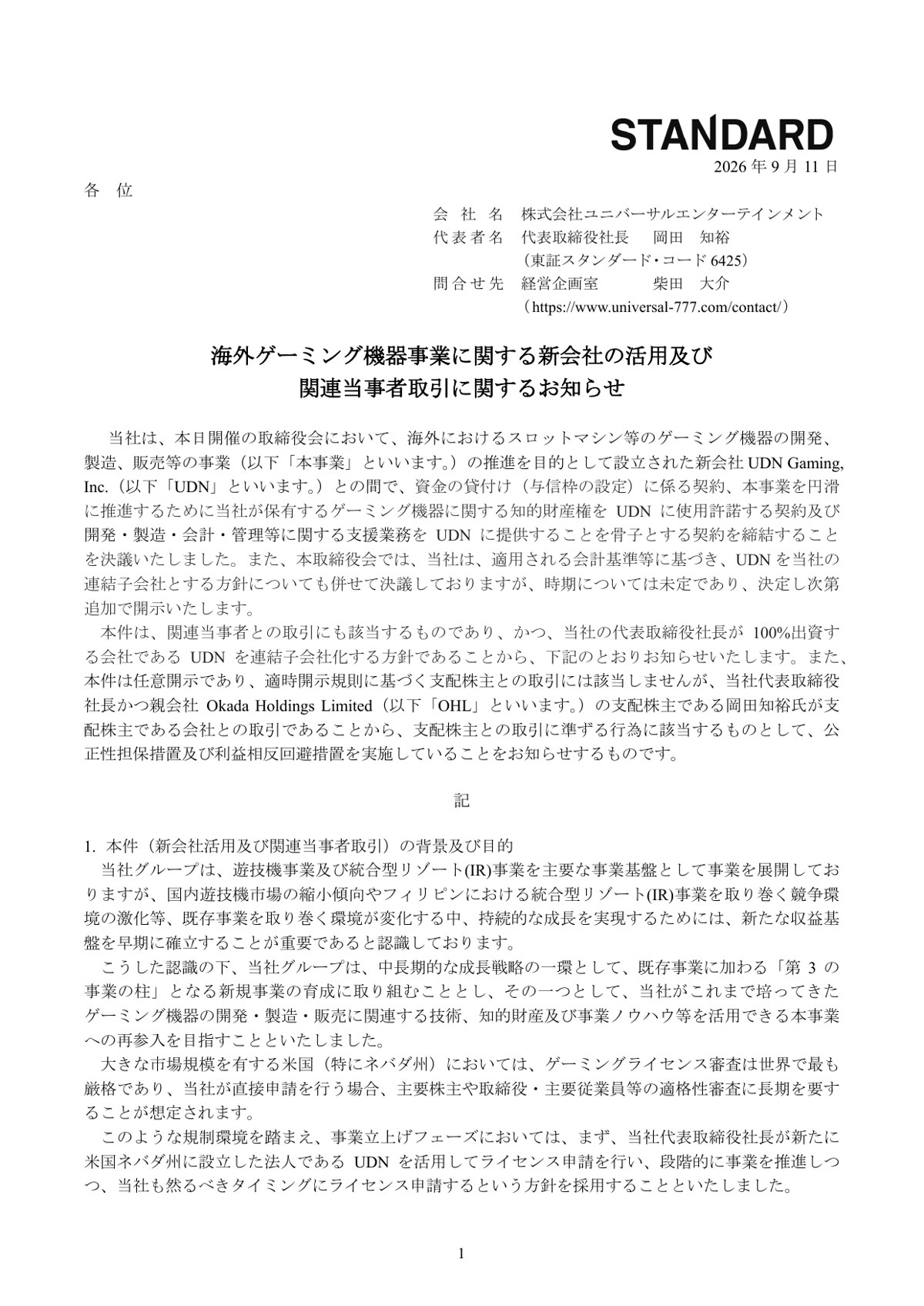
Three agreements were approved by Universal Entertainment Corporation’s board on 11 September. The first opens a loan facility for UDN Gaming, Inc. The second allows UDN to use Universal’s gaming-machine intellectual property. The third commits Universal to supplying UDN with development, manufacturing, accounting and administrative support.[1]
At the same meeting, the board adopted a policy to consolidate UDN into its accounts under the applicable accounting standards. The timeline for consolidation was left open, but the company committed to disclosing the date once it is settled.[1]
Universal Entertainment trades under Code 6425 on the Standard segment of the Tokyo Stock Exchange. Tomohiro Okada is its president and representative director. Okada Holdings Limited, where Mr Okada is the controlling shareholder, sits above it.[1]
The company that will hold the licence
Nevada incorporated UDN Gaming, Inc. on 13 March 2026, with a stated capital of one US dollar. Its registered business is developing, manufacturing and selling slot machines and other gaming equipment. Every voting right belongs to Tomohiro Okada, who is also the company’s director.[1]
As of the filing date, Universal’s group owned zero voting rights in UDN. The disclosure explains why it will nonetheless be consolidated: Mr Okada holds every vote, and the Universal group is funding the entity entirely and providing all of its intellectual property.[1]
Why the parent is not applying
The corporate filing lays out the strategic reasoning in two clear steps.
First, the group requires a new revenue stream. Its two existing pillars are amusement machines in Japan and an integrated resort in the Philippines. With the domestic machine market contracting and Philippine resort competition intensifying, re-entering the overseas gaming-equipment market was chosen as a third pillar because it leverages existing technology, intellectual property and expertise.[1]
Second, the licensing burden. The filing describes regulatory screening in the United States — and Nevada in particular — as the strictest in the world. If Universal applied in its own name, the mandatory suitability review reaching its major shareholders, its directors and its senior employees would severely delay market entry.[1]
Therefore, the initial licence application is being made by Mr Okada’s newly formed Nevada company. The business will be built up in stages, and Universal plans to apply in its own name at an “appropriate time” in the future.[1] While Nevada regulators routinely examine the individuals behind a corporate applicant, Universal’s strategy shifts this extensive corporate vetting to the back of the timeline.
The three contracts, and the money in them
The disclosure set 30 September 2026 as the signing date for all three agreements.[1]
- The loan: Aruze USA, Inc., a wholly owned Universal subsidiary, is the lender. The credit limit is US$25 million — roughly 4 billion yen at the 160.03 yen to the dollar the filing uses. Interest is set at 5.12% annually, pegged to US market rates. Funds are drawn in stages as needed, and the facility runs until 31 December 2035, when all principal and unpaid interest are due. The loan is secured by every share in UDN.[1]
- The licence: Universal grants UDN the intellectual property required to develop, make and sell gaming machines. UDN will pay a royalty of US$100 per shipped machine, a rate the filing says was set with general market prices in mind. The term is one year, automatically renewing annually unless terminated with a month’s notice.[1]
- The services: Universal will handle research and development, accounting, finance, parts procurement and manufacturing advice. UDN will pay Universal’s direct costs plus a 6% margin. This arrangement remains active as long as the licence agreement is in place.[1]
Read together, the three agreements keep the development, manufacturing expertise and funding on Universal’s side, while placing the actual licence application solely under Mr Okada’s name.
The string attached to the shares
The loan agreement includes a share-transfer clause that ultimately dictates ownership.
At a date of the lender’s choosing, Mr Okada is obliged to transfer all UDN shares to Universal, or to a nominated third party, at the exact price he paid when subscribing for them.[1]
He paid one dollar. Regardless of UDN’s future valuation, the transfer price remains fixed at that initial subscription price. The filing is explicit about the intent: once Universal gauges the progress of its own US licence application, it intends to take over UDN’s voting rights and convert it into a wholly owned subsidiary.[1]
How the board handled the conflict
Because this constitutes a related-party transaction, Universal treated it as equivalent to a transaction with a controlling shareholder, even though strict disclosure rules did not mandate it.[1]
Mr Okada recused himself from the discussion and the vote. The remaining eight directors, five of whom are external, approved the plan unanimously. Opinions from all five independent outside directors, including the audit-committee members, held that the purpose was legitimate, the terms reasonable and the procedure fair. Several law firms advised on the structure, and it was approved under article 423(4) of Japan’s Companies Act.[1]
The outside directors noted that this route was reasonable specifically because a direct application would cause unacceptable delays, and they agreed that the financial terms were aligned with market rates.[1]
What the filing does not say
The disclosure does not specify when UDN will officially apply for a Nevada licence, nor when Universal will step forward to apply in its own name. It omits product details, launch dates and specific revenue projections, only noting that the impact on the group’s 2026 results will be “minor”.[1]
It also leaves out how Nevada gaming authorities view this specific corporate structure. Nevada publishes its own agendas and dispositions, meaning this licence application will eventually become a matter of public regulatory record rather than just a corporate announcement.
Sources
- TDnet (Tokyo Stock Exchange timely disclosure) / Universal Entertainment Corporation (Japan) — Notice concerning the use of a new company for the overseas gaming-equipment business and a related-party transaction (11 September 2026, Japanese, PDF). Every fact and figure in this article, including the board resolution, UDN's details, the stated reason for not applying directly, the three contracts, the share-transfer clause, the governance steps and the earnings outlook. Translated by this desk from the Japanese original, which is archived with the article.



