

What the register says
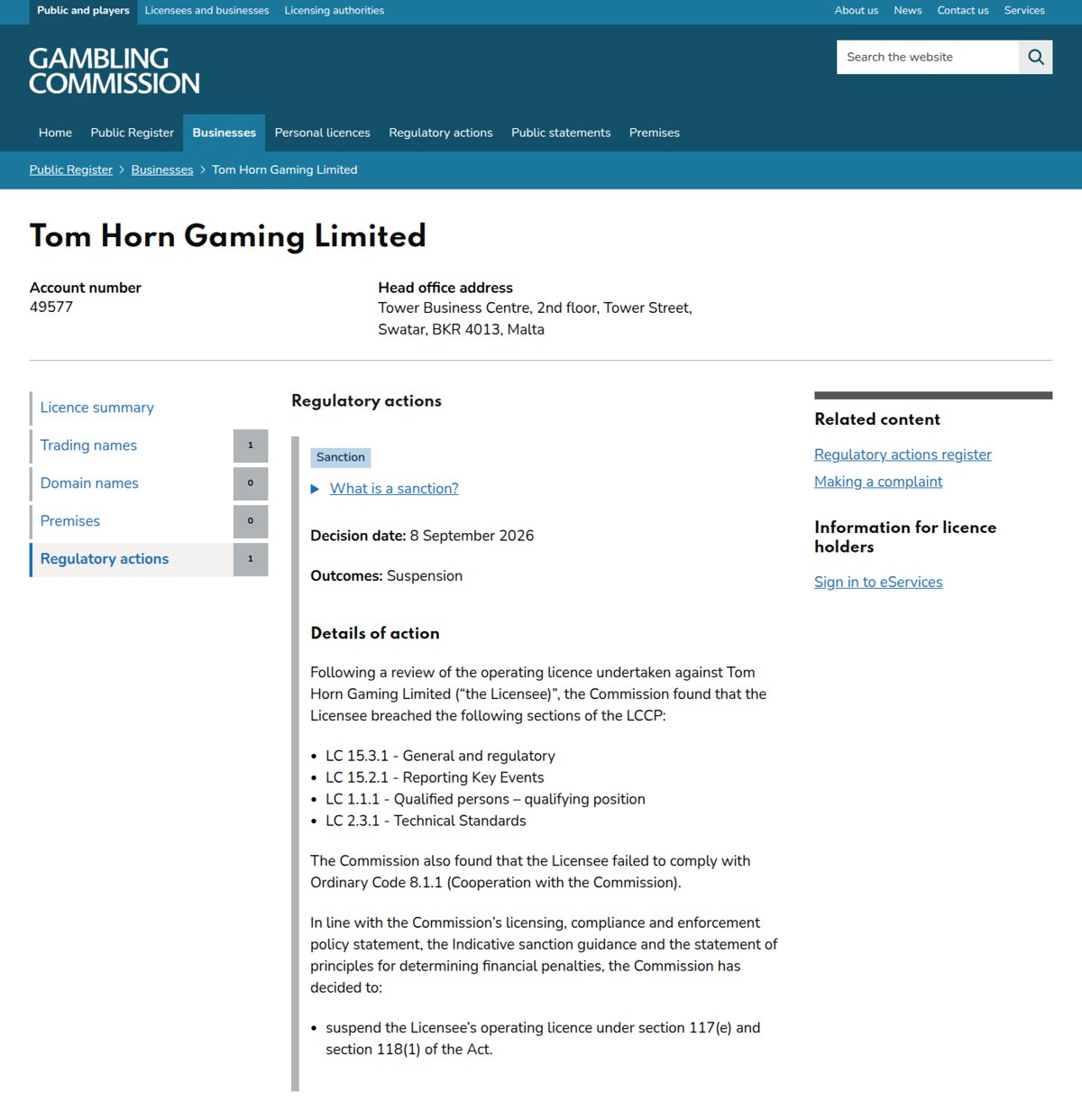
The Gambling Commission is the body that licenses gambling in Britain, and its register carries Tom Horn Gaming Limited at account number 49577. The address given for the head office is the Tower Business Centre in Swatar, Malta.[2]
Two distinct activities sit under the single licence number 049577-R-327138-005: ‘gambling software, remote’ and ‘game host for casino, remote’. Both have been active since 16 October 2017, but the status column for each now reads “Suspended”.[2]
The regulatory actions page lists a decision date of 8 September 2026 with one outcome: suspension. There is no mention of a fine or a full revocation.[1]
The five rules the Commission says were broken
Every British gambling licence is bound by a set of conditions and codes of practice (LCCP). The Commission found breaches of four conditions and one code.[1] Based on the Commission’s published wording, here is what each requires:[3]
- Technical standards (LC 2.3.1): The Commission publishes standards that a licensed product has to meet, and rules about when and how products get tested. A company that builds games lives under this one daily.
- Reporting key events (LC 15.2.1): Certain events are treated as capable of changing what the business is, or how it is put together. Once the licensee knows of one, the clock is five working days.
- Qualified persons (LC 1.1.1): Senior people are named on the licence itself. Somebody taking such a post, or leaving it, means the licence details have to be put right within 28 days.
- General and regulatory returns (LC 15.3.1): Information goes over when the Commission asks for it. On top of that comes a return each quarter, accurate, filed inside 28 days of the quarter closing.
- Cooperation (Ordinary Code 8.1.1): An ordinary code is guidance, not a condition. This one asks a licensee to deal with the regulator openly, and to raise anything that would materially affect the business or its ability to keep the rules.
Notably, four of the five breaches relate to communication and reporting failures. Only the technical standards finding directly concerns the company’s product.
What a suspension actually does
The powers cited are section 117(e) and section 118(1) of the Gambling Act 2005.[1] Once the Commission has reviewed a licence, section 117 gives it a menu: warn the holder, attach a new condition, drop or change an existing one, suspend, revoke, or impose a money penalty.[4]
Section 118 then sets the mechanics. A start time has to be named. So does either a length, or an event that will end it, and that event may be nothing more than the Commission sending a notice.[5]
The crucial sentence in the legislation is brief: an operating licence “shall have no effect in respect of anything done while it is suspended”.[5] The company technically still holds the licence, but it currently permits nothing.
Why carrying on would be a crime, not a breach
Section 41 turns the question into a criminal one. Adapting, installing, supplying or making gambling software, as a business and otherwise than under an operating licence, is an offence. The Act’s own definition of gambling software is software used in connection with remote gambling, and it leaves out anything built solely for a gaming machine.[6]
Before magistrates the penalty reaches 51 weeks inside, or a fine at level 5 on the standard scale, or both together. Read in Scotland, the prison maximum becomes six months.[6]
Therefore, supplying software to the British market while suspended is not simply another rule breach — it is an active criminal offence.
Nobody was told
The Commission maintains a news section and routinely uses it to announce suspensions. For example, it published articles when suspending Targetlocal Ltd on 21 September, and BresBet Ltd alongside Bet St George Ltd on 28 August.[7] However, all three are consumer-facing betting operators.
There is no article for Tom Horn Gaming. A player wanting to know about this suspension would have to look up the company in the public register, after first figuring out which B2B supplier built the specific game they were playing.[7]
This highlights a transparency gap: enforcement against backend suppliers is inherently harder for the public to see than enforcement against operators, because the supplier’s name is rarely known to the customer.
What the register does not say
The register provides no underlying reasons beyond the list of breached provisions. It details no suspension period and offers no account of the Commission’s investigation. It does not list which gambling sites hosted the company’s games, nor what happens to games currently live on British sites. Furthermore, a suspension does not automatically imply a finding of dishonesty, and the register records none here.
Sources
- Gambling Commission (Great Britain) — Public register, regulatory actions: Tom Horn Gaming Limited (decision dated 8 September 2026, English). The decision date, the outcome, the five provisions and the statutory powers used.
- Gambling Commission (Great Britain) — Public register, licence summary: Tom Horn Gaming Limited (checked 29 September 2026, English). The account number, the Maltese address, the two activities, the licence number and the dates.
- Gambling Commission (Great Britain) — Licence conditions and codes of practice (checked 29 September 2026, English). The wording of LC 2.3.1, LC 15.2.1, LC 1.1.1, LC 15.3.1 and Ordinary Code 8.1.1.
- legislation.gov.uk (United Kingdom) — Gambling Act 2005, section 117 (English). What the Commission may do following a review.
- legislation.gov.uk (United Kingdom) — Gambling Act 2005, section 118 (English). Suspension, what must be specified, and the effect of a suspended licence.
- legislation.gov.uk (United Kingdom) — Gambling Act 2005, section 41 (English). The gambling-software offence, the definition, and the maximum penalty.
- Gambling Commission (Great Britain) — News (checked 29 September 2026, English). The published suspension announcements for Targetlocal Ltd, BresBet Ltd and Bet St George Ltd.



