
What was published, and by whom
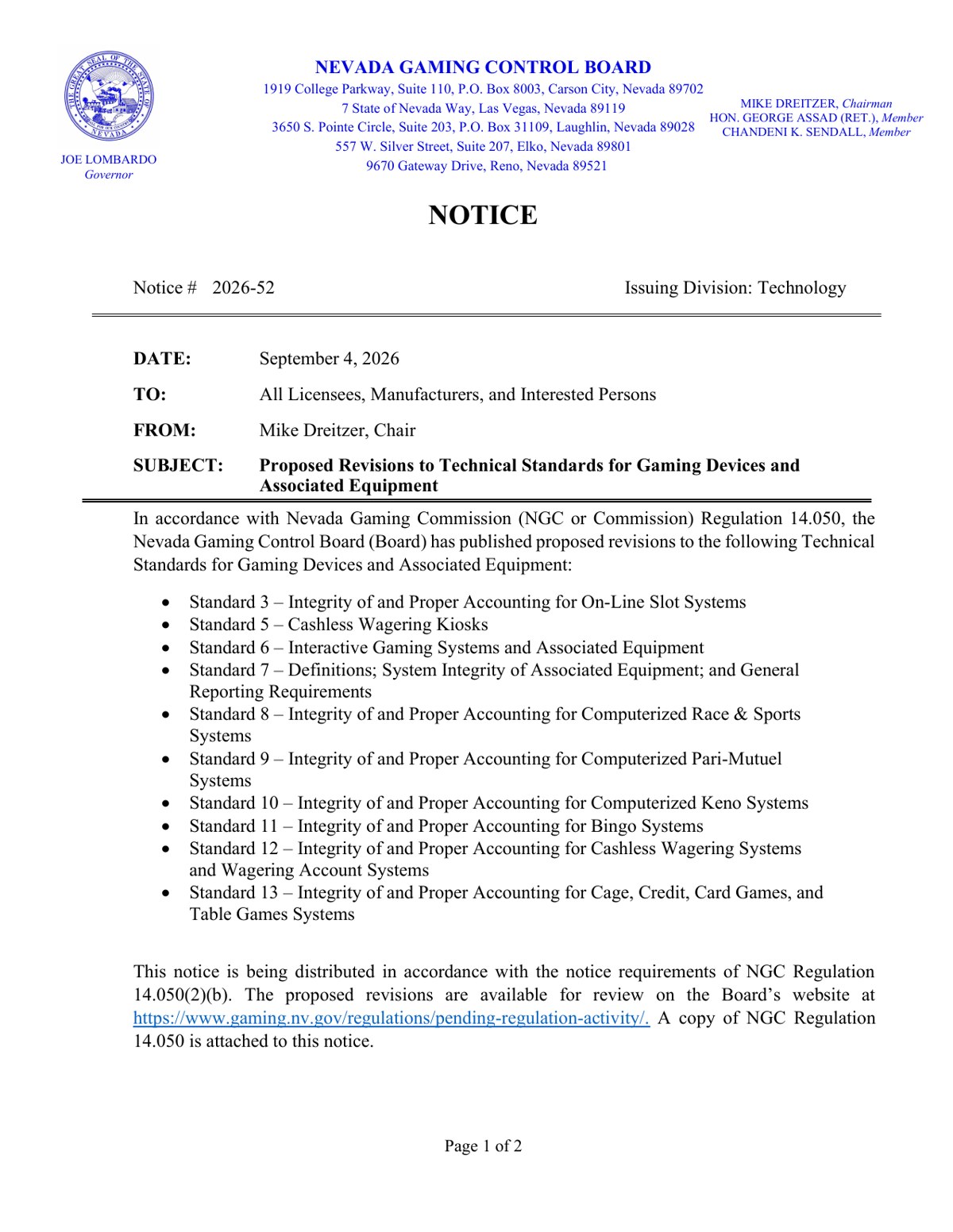
The Nevada Gaming Control Board issued Notice 2026-52 on 4 September. It came from the Board's Technology division, over the signature of its chair, Mike Dreitzer. The authority is Regulation 14.050, which requires the Board to publish proposed changes to its technical standards before it adopts them.[1]
Eleven standards are affected. Standard 3 covers the integrity of and accounting for on-line slot systems. Standard 5 covers cashless wagering kiosks. Standard 6 covers interactive gaming systems. Standards 7 to 13 cover definitions and general reporting. They also cover the accounting systems behind race and sports betting, pari-mutuel wagering, keno, bingo, cashless wagering and wagering accounts, and the cage, credit, card games and table games.[1]
The drafts themselves sit on the Board's pending-regulation page. They are marked up in the ordinary way: new wording in italics, deleted wording in brackets with a line through it.[2]
The dates
Written statements, arguments and comments go by email to Jeremy Eberwein, chief of the Board's Technology division and gaming laboratory, and must arrive no later than 5pm on Monday 5 October.[1]
The drafts and any comments received on time are then discussed at the Board's meeting on 7 October, where people may also speak.[1]
After that there is a second, narrower right. Any nonrestricted licensee or licensed manufacturer may file a written objection with the Gaming Commission, and the deadline for that is 19 October. The anticipated effective date of the revised standards is 23 October.[1]
The kiosk standard is being rewritten, not adjusted
Standard 5 is currently headed “Cashless Wagering Kiosks”. The draft renames it “Kiosks and Terminals” and its purpose statement says the aim is to make wholesale revisions to the requirements inside it.[2]
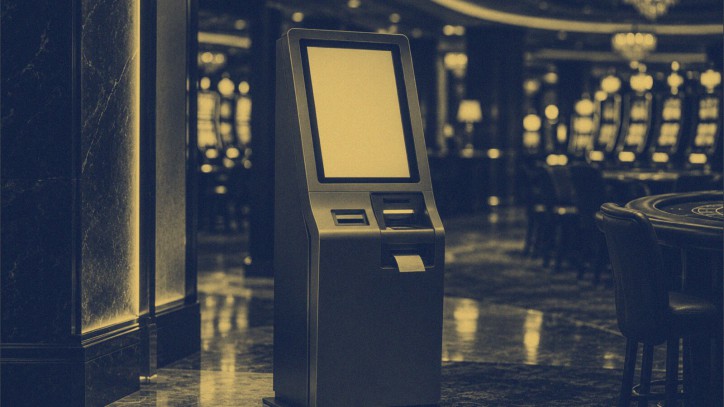
Some of what is in there reads like a description of things going wrong in a casino. A kiosk may be temporarily disrupted by a static shock of 20,000 to 27,000 volts. It then has to recover and finish the interrupted transaction, without losing or corrupting anything it had stored or displayed, and without a component failing. A manufacturer may satisfy that requirement instead by showing accreditation under section 9 of the Payment Card Industry Data Security Standard.[2]
On a power cut, the draft allows the transaction to fail, on one condition: the money has to be returned to the customer properly and accounted for.[2]
The machine also has to resist being forced open and keep evidence of any entry until that evidence is cleared or a new transaction starts. The boards carrying its programs need a protective cover, built so that a lock can be fitted.[2]
Then there is a list of faults that must stop the kiosk taking any new transaction until a member of staff clears it: failing to credit a deposit or make a payment, a bill validator failure, and a printer failure.[2] A player who has watched a kiosk swallow a note and print nothing has met that list from the other side.
One requirement gets looser. The old text demanded electronic digital storage meters of at least ten digits. The draft asks instead for a mechanism to record meters in dollars and cents, where the kiosk supports the function at all.[2]
What the online-gambling standard would require at sign-up
Standard 6 is being brought in line with version 9 of the Minimum Internal Control Standards, the Board's own control framework. Its draft sets out what an interactive gaming system has to collect before it opens an account.[3]
The list runs: the person's legal identity, with a nickname for use in play as an option. A date of birth showing the person is 21 or older. The address where they live. And, for a resident of the United States, the last four digits of the social security number.[3]
The system also has to establish two negatives before the account exists. The person must not have self-excluded with that operator, and must not appear on the list of excluded persons kept by the state under NRS 463.151 and Regulation 28.[3]
Note the age. Nevada wants the date of birth to show 21 or older, and the draft puts that in the list of things the system has to collect before the account can exist.[3]
A new definition worth reading twice
Standard 7 collects the definitions. The draft adds one for a “branch office”: a physical office that can take cash or its equivalent from a customer, either to put into an account or to pay off a credit instrument. The office is responsible for the funds it receives, and it has to record the transactions on an accountability form.[4]
The draft then says where such an office may be. It can sit inside another business, in a residence, or in any other physical space. It can be run by an employee of the licensee, by a marketing representative, or by an independent agent. One branch office may be used by several licensees.[4] The drafter's note says the definition is adapted from the cage and credit control standards.[4]
This is the regulated version of something that already happens. Somebody collects money for a casino away from the casino, and the draft writes down what that arrangement is called and what records it has to keep.
Why a consultation on technical standards is a business story
Technical standards decide what a manufacturer has to build before a regulator will approve it. A test house certifies against the version in force. So eleven standards changing together, with an effective date eighteen days after the comment deadline, is a piece of work for every company that sells kiosks, slot systems or online platforms into Nevada.
The people with a formal right to object are the nonrestricted licensees and the licensed manufacturers.[1] Anyone else may comment, and the notice invites them to.
What the notice does not say
It does not explain why the eleven were taken together, name anyone who asked for the changes, or say what the Board will do if a licensee objects in time. The effective date is described as anticipated, and the chair has to give separate written notice of the real one. Until that notice arrives, the standards in force are the old ones.[1]
Sources
- Nevada Gaming Control Board (United States) — Notice 2026-52, proposed revisions to technical standards for gaming devices and associated equipment (4 September 2026, English, PDF). The eleven standards, the deadlines, the objection right and the anticipated effective date.
- Nevada Gaming Control Board (United States) — Proposed amendments to Technical Standard 5, kiosks (draft dated 12 June 2026, English, PDF). The new heading, the wholesale-revision purpose statement, the static-discharge and power-loss requirements, the forced-entry and cover requirements, the error conditions and the meters.
- Nevada Gaming Control Board (United States) — Proposed Technical Standard 6, interactive gaming systems and associated equipment (draft dated 18 June 2026, English, PDF). The alignment with MICS version 9 and the account-opening requirements.
- Nevada Gaming Control Board (United States) — Proposed Technical Standard 7, definitions, system integrity and general reporting (draft dated 18 June 2026, English, PDF). The branch-office definition and the drafter's note.



