

The vote, in numbers
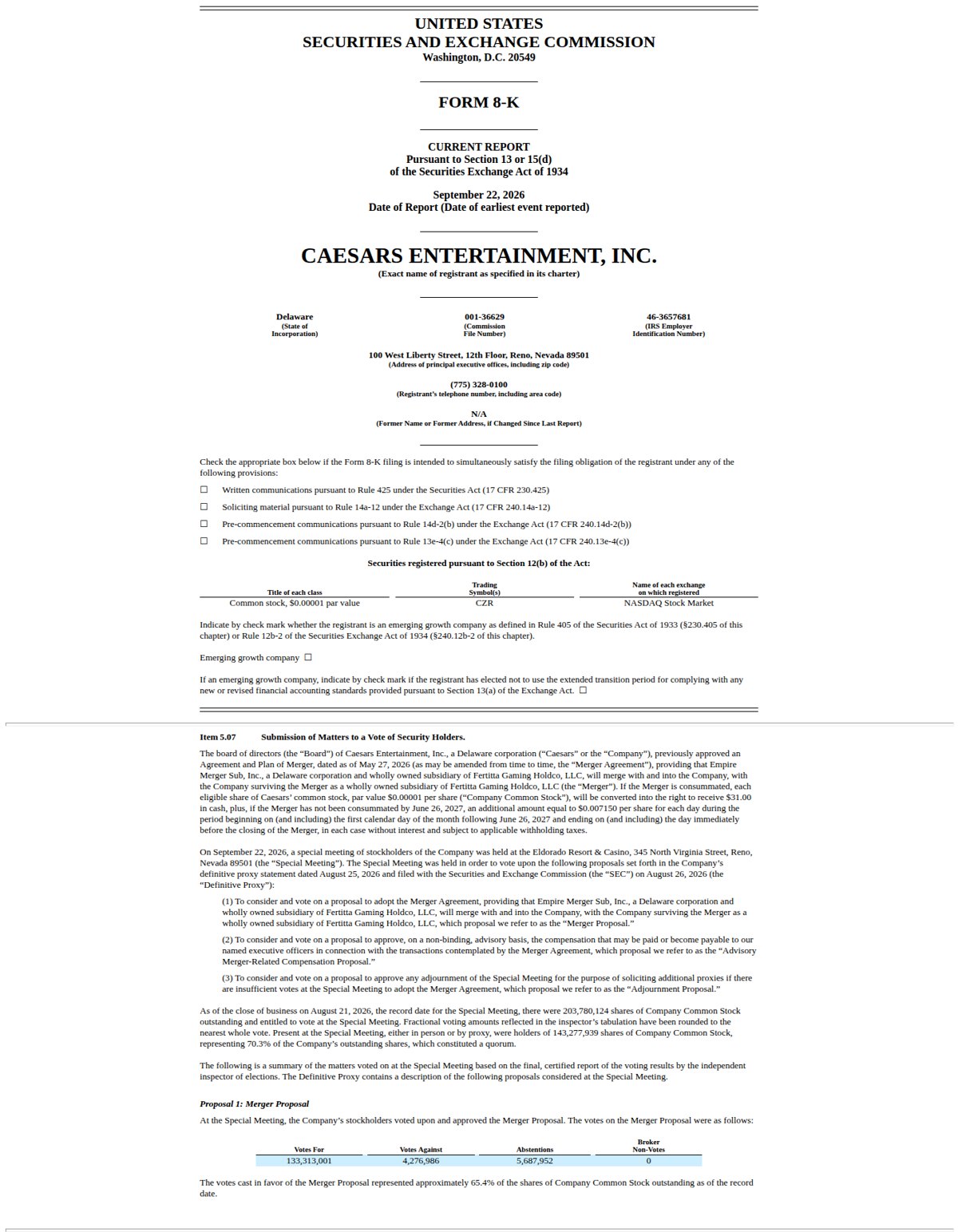
The meeting was held on 22 September at the Eldorado Resort & Casino in Reno, Nevada, the city where Caesars has its head office. On the record date of 21 August the company had 203,780,124 shares. Holders of 143,277,939 of them attended or sent a proxy. That came to 70.3% of the shares, enough for a quorum.[1]
Of those, 133,313,001 shares were voted in favour of adopting the merger agreement, 4,276,986 against, and 5,687,952 abstained. Brokers cast no unvoted shares. The filing puts the votes in favour at about 65.4% of every share the company had issued.[1]
A third proposal, on adjourning the meeting to go and collect more proxies, was “rendered moot and was not presented”. It was not needed.[1]
What the $17.6 billion counts
Each share converts into $31.00 of cash.[2] The figure put on the whole thing in May was “approximately $17.6 billion”, and the company's own sentence adds that this includes taking on “approximately $11.9 billion” of existing Caesars debt.[2] Subtract one from the other and the part that actually reaches shareholders is the smaller half.
Against the share price on 25 February — described in the announcement as the last day of trading before talk of a deal started — $31.00 was called a 49% premium. Measured against the volume-weighted average of the preceding 30 days, the announcement puts it at 46%.[2]
No part of the agreement waits on the buyer raising money. Fertitta brings equity of its own, takes over the Caesars borrowings, and has committed new debt from ten banks that the announcement leaves unnamed.[2] Holding roughly 5% of the shares, the Carano family agreed to roll part of what it owns into the buyer rather than take the cash.[2]
Then the competition regulator asked for more
A merger this size has to sit through a waiting period under the Hart-Scott-Rodino Act, the American law that gives competition authorities a look at a deal before it closes. Both sides filed their forms on 13 July. The buyer withdrew and refiled its own on 13 August after talks with the Federal Trade Commission. The waiting period was then set to run out at 11:59 in the evening, Eastern time, on 14 September.[5]
On that same day, both companies received a Second Request from the Commission — a demand for further information and documents. The effect, the filing says, is to extend the waiting period “until 30 days after each of the Company and Fertitta Entertainment has substantially complied with the Second Request issued to it”.[3]
Nobody has to comply by any particular date. The clock only restarts once both companies have handed over what was asked for, so the parties themselves decide how long this takes. Caesars says the two of them intend to keep working with the Commission.[3]
The approvals nobody outside the company can name
Buying a casino company also means satisfying the gambling regulator of every place it is licensed, and Caesars is licensed in a long list of American states.[2] The proxy statement calls these permissions the “Requisite Gaming Approvals” and defines them as the approvals “set forth on Section 1.1(b) of the Company Disclosure Schedule”.[5]
That schedule was not filed with the proxy. Search the document, all 898,000 characters of it, and the phrases Gaming Control Board, Gaming Commission and Division of Gaming Enforcement do not appear anywhere in it.[5]
The proxy does say that the parties agreed to submit their first applications and supporting papers within either 45 or 90 days of signing, depending on the approval.[5] A reader can work out for themselves which states are likely to be involved. A reader cannot check the list, because the list is not there.
What happens if this drags into next summer
The price has a clock attached. If the sale has not closed by 26 June 2027, each share earns an extra $0.007150 for every day from the first of the following month until the day before completion, without interest and before tax.[5] That works out at about $2.61 a share over a year, on top of the $31.00.
The agreement can be abandoned if the sale has not happened by 27 May 2027. That date extends automatically to 27 August 2027, and then to 27 November 2027, if the only conditions left outstanding are the regulatory ones.[5] So the parties have built in eighteen months of room for the regulators.
Asked in its own proxy when the merger will be completed, the company answers that it is “anticipated that the Merger will be completed in accordance with the closing procedures set forth in the Merger Agreement”, and gives no date.[5] Completion falls on the tenth business day after the last condition is met.[5]
Two smaller things in the same filings
On 16 September, six days before the vote, Jesse Lynn and Ted Papapostolou resigned from the board with immediate effect. Both had been appointed under an agreement with the Icahn group, which also gave up its right to name replacements.[3]
On 15 September a shareholder sent Caesars a demand letter asking to inspect company books and records under Delaware law. It argued that the proxy left out material information about the law firm Latham & Watkins, which advises Caesars and at the same time acts for Fertitta and its affiliates on unrelated matters. Caesars called the claims “without merit, immaterial” and added the disclosure anyway, to avoid a fight that might delay the sale.[4] No court case is mentioned in any of the filings.
What these filings do not tell you
They do not say which gambling regulators have to approve the sale, or whether any application has yet been lodged. They do not say what the Federal Trade Commission is worried about, because a Second Request is not published. They do not give a closing date, and the buyer, being privately held, publishes no accounts of its own.
For a customer, none of this changes anything today. The casinos keep trading, the loyalty scheme keeps working, and the state licences stay with the licensed companies until a regulator says otherwise. What changes, if the sale completes, is who owns the licences — and that is exactly the question the unpublished schedule covers.
Sources
- U.S. Securities and Exchange Commission / Caesars Entertainment, Inc. — Form 8-K, Item 5.07, results of the special meeting (filed 23 September 2026, English). The meeting, the share counts and the votes.
- U.S. Securities and Exchange Commission / Caesars Entertainment, Inc. — Exhibit 99.1 to the Form 8-K of 28 May 2026, the announcement of the agreement (English). The price, the premium, the $17.6 billion and the $11.9 billion of debt, the ten banks, the Carano rollover, and the 60 casinos.
- U.S. Securities and Exchange Commission / Caesars Entertainment, Inc. — Form 8-K of 17 September 2026, Items 5.02 and 8.01 (English). The Second Request and the two board resignations.
- U.S. Securities and Exchange Commission / Caesars Entertainment, Inc. — Form 8-K of 22 September 2026, Item 8.01 (English). The demand letter and the supplemental disclosure.
- U.S. Securities and Exchange Commission / Caesars Entertainment, Inc. — Definitive proxy statement (DEFM14A) (dated 25 August 2026, filed 26 August, English). The gaming-approval definition, the HSR dates, the ticking fee, the end dates and the closing mechanics.



