
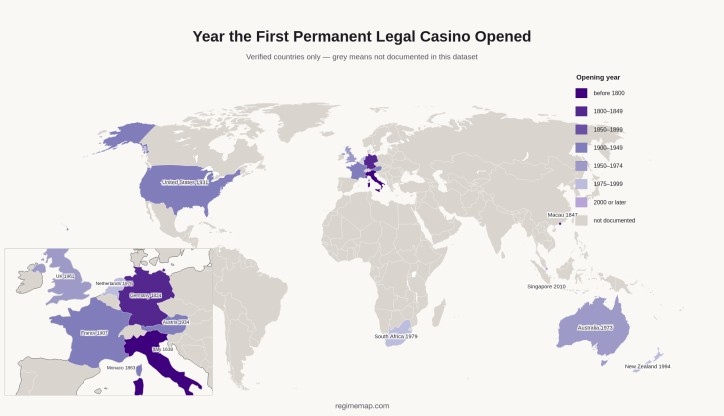
Here we list the year each country first let a real, legal casino open its doors. We only count a casino once it truly opened. A back-room game does not count, and neither does a law that was passed but never used. The list starts with Venice in 1638 and ends with Singapore in 2010. In most cases, a country allowed casinos because it needed the money. Every date here comes from an official record.
People have gambled almost everywhere, for as long as there have been people. It is much rarer for a government to hand a casino a licence and take a cut of the money made inside. This list is about that second step. It is the year each country first let a real, legal casino open and stay open.
This is where a lot of timelines go wrong, so it helps to be clear. If people gambled in a back room while the police looked the other way, that still was not a legal casino. If a country passed a law to allow casinos but none had opened yet, that does not count either. And a tent put up on a spa lawn for the summer was never a real casino. Once you go by those rules, only a handful of countries have a date you can trust. So the table below is short.
The timeline
| Country | Year | First venue or legal instrument |
|---|---|---|
| Italy | 1638 | Il Ridotto, Venice [1] |
| Germany | 1824 | Kurhaus, Baden-Baden [2] |
| Macau | 1847 | Gambling legalised and licensed [3] |
| Monaco | 1863 | Casino de Monte-Carlo [4] |
| France | 1907 | Law of 15 June 1907 [5] |
| United States | 1931 | Northern Club, Las Vegas [6] |
| Austria | 1934 | Semmering, then Baden bei Wien [7] |
| United Kingdom | 1961 | Casino Club, Port Talbot [8] |
| Australia | 1973 | Wrest Point, Hobart [9] |
| Netherlands | 1976 | Holland Casino Zandvoort [10] |
| South Africa | 1979 | Sun City, Bophuthatswana [11] |
| New Zealand | 1994 | Christchurch Casino [12] |
| Singapore | 2010 | Resorts World Sentosa [13] |
Venice invents the licensed casino
In 1638 the city of Venice tried something new. Other places just tried to shut down private card rooms. Venice opened its own instead. It was called the Ridotto, and it sat in a wing of a palace near the San Moisè church. The state ran it, and in theory anyone could walk in. In practice, the rules kept most ordinary people out. You had to wear a mask, dress a certain way, and bet large sums, so really it was a place for the rich. In 1774 the Venetian government shut it down, because too many noble families were gambling themselves into ruin. Legal casinos did not come back to Venice until the twentieth century. [1]
People often call the Ridotto the very first casino. The truer thing to say is that it was the first one a government owned and taxed. Every country that came later copied that idea. [1]
The spa century
The next wave came from the spa towns of Germany and Austria. There, gambling was not a big industry. It was more of a treat for rich people who came to spend the summer. Baden-Baden had let people play in its hotels since the early 1800s, and in 1824 it put all the tables under one roof, in a grand new hall called the Kurhaus. [2] Its big moment came by luck. When France closed its own gambling houses in the 1830s, French players just slipped across the border into Germany to keep playing.
Monaco did the same thing, only it needed the money far more. This tiny country had lost most of its land to France in 1861 and was almost broke. In 1863 its ruler, Prince Charles III, set up a company to run a casino and brought in François Blanc, who had already made a fortune from one in Germany. [4]
Monaco did not open Monte-Carlo for fun. It did it to survive.
It worked so well that in 1866 the area around the casino was renamed Monte-Carlo, after the prince. France went the other way. Its 1907 law only let casinos open in seaside towns and spa resorts, away from the big cities. That rule shaped gambling in France for the next eighty years, and it is why Paris still has no casino to this day. [5]
Why Macau sits awkwardly on this list
Portugal, which ran Macau back then, made gambling legal there in 1847 to bring in money, after nearby Hong Kong started pulling away its trade. [3] But the games it allowed were simple Chinese games and lotteries, not casinos like we picture today. The first proper casino deal did not come until 1937. Macau is also not its own country. It sits on this list because the 1847 date is well recorded, but we mark it with care, because it is not quite the same as the others.
Nevada writes the modern rulebook
Nevada opened the door wide in March 1931. The state was in deep trouble at the time. Silver prices had fallen and the Great Depression had hit hard, so it turned to gambling for money. Licences went out within days. The very first one went to a woman named Mayme Stocker, for the Northern Club on Fremont Street, and more clubs in downtown Las Vegas opened over the next few weeks. [6]
Nevada was different from the spa towns of Europe. In Europe, gambling was a side attraction. In Nevada, it was the main event. The state set up a clear system. It handed out permits, took a tax on what the casinos earned, and checked who was allowed to run them. Most places that allowed casinos later on copied that same setup, even ones that came along sixty years afterwards.
The late arrivals
Much of the English-speaking world held back until the second half of the twentieth century. Britain passed a gambling law in 1960 that took effect in January 1961. The place usually named as the country's first legal casino was not in London at all. It was above a shop in Port Talbot, a Welsh steel town where people had money to spend. [8]
Australia let the people vote. In 1968 the island of Tasmania backed the country's first casino by a narrow margin, and Wrest Point opened in Hobart in February 1973. [9] The Netherlands went a different way and let just one company run its casinos. It gave out a single licence in December 1975 and opened Holland Casino in the town of Zandvoort the next October, with only roulette and blackjack at first. [10] New Zealand waited until 1994, when the Christchurch Casino opened. [12]
South Africa is the hardest one to explain. A 1965 law allowed almost nothing beyond horse racing, so casinos opened instead in the so-called "homelands", which were small areas the government treated as separate countries. Sun City opened in one of them in December 1979 and became the country's most famous casino, even though on paper it counted as being abroad. [11] Casinos only became legal across South Africa itself in the mid-1990s, after apartheid ended.
Singapore comes last. For years it banned casinos completely. Then in 2005 the government agreed to allow two big resort casinos, and Resorts World Sentosa opened on the first day of the Chinese New Year, in February 2010. Marina Bay Sands followed that April. [13] Even so, Singapore makes its own citizens pay a fee to get in and keeps lists of people who are banned, as if it still wants to keep its own people out.
A note on what is missing
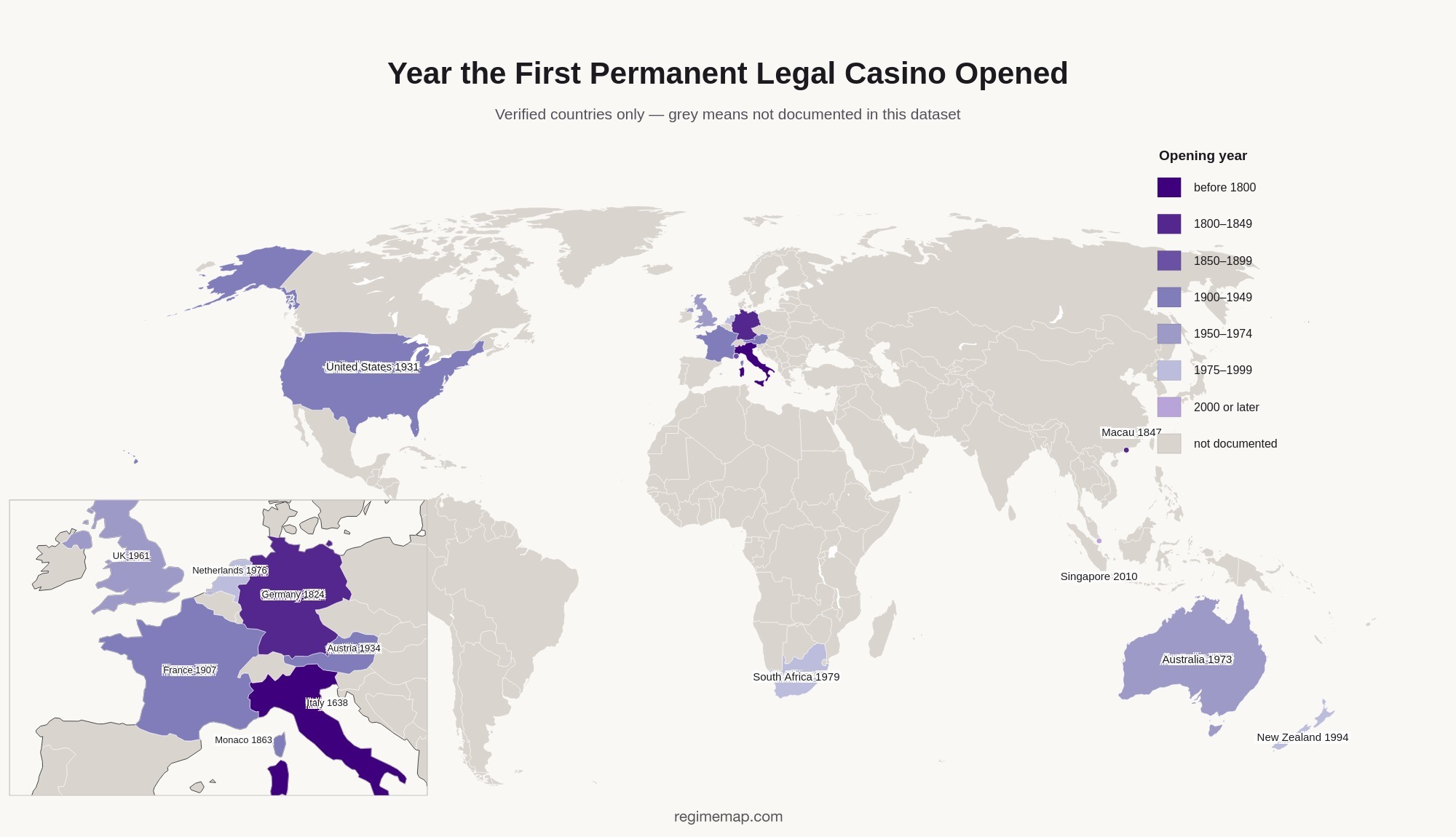
About three-quarters of the map above is grey, and we left it that way on purpose. For a lot of countries, the dates you find online mix up the year a law passed with the year a casino really opened, or they all trace back to the same old list that nobody ever sourced. If we cannot check a date, we leave the country blank instead of guessing at it. If you have one backed by a government, a regulator, or an operator's own records, send it to us and we will add it.
If you want the whole story for just one country, we wrote about how Ukraine went from banning gambling to allowing it again, with rules. You can read that story here. And if you want to know whether a casino's licence means anything where you live today, we explain where a casino licence counts and where it doesn't.
Sources
- Casinò di Venezia — official site and history of Il Ridotto. Backs the 1638 state-licensed gaming house in Venice.
- Casino Baden-Baden — the casino's official history. The Weinbrenner Kurhaus, completed 1824.
- Association of Certified Gaming Compliance Specialists — The history and development of casino gaming in Macau, citing the Macau Gaming Inspection and Coordination Bureau. Dates the 1847 legalisation; corroborated by Urban History (Cambridge University Press).
- Monte-Carlo Société des Bains de Mer — company history. The 1863 charter and the founding of the Casino de Monte-Carlo.
- Légifrance — Loi du 15 juin 1907 réglementant le jeu dans les cercles et les casinos des stations balnéaires, thermales et climatiques. The resort-only casino law.
- Nevada Resort Association — History of Gaming in Nevada. The March 1931 legalisation and the first Clark County licences; corroborated by The Mob Museum.
- Casinos Austria — Casino Baden history. Semmering (February 1934) and Baden bei Wien (April 1934).
- United Kingdom — Betting and Gaming Act 1960 (in force 1 January 1961). The statutory basis; Casino Club, Port Talbot is widely credited as Britain's first legal casino under it.
- Wrest Point — official history. Opened February 1973 after the 1968 Tasmanian referendum; corroborated by the Tasmanian Heritage Council listing.
- Holland Casino — corporate history. Licence granted 17 December 1975; Zandvoort opened 1 October 1976.
- National Gambling Board of South Africa — casino sector overview. Sun City opened in Bophuthatswana, December 1979; corroborated by a University of the Witwatersrand thesis.
- Te Ara — the Encyclopedia of New Zealand. Christchurch Casino, New Zealand's first, opened 1994.
- Singapore Ministry of Trade and Industry — Opening of the Integrated Resorts. Resorts World Sentosa's casino opened 14 February 2010.



